
Clinically reviewed by Dr. Ponlawat Pitsuwan, Physician, Doctor Bangkok. Last reviewed: August 2026
Yes, tonsil stones cause bad breath, and brushing your teeth will not fix it. The stones sit in the folds of your tonsils and release a sulfur smell that no mouthwash can reach. Treatment ranges from simple gargling to clinical removal, depending on how severe the problem is.
A lot of expats come in convinced they have a dental problem. They brush twice a day, use mouthwash, and the bad breath still will not go away. Half the time, the mouth is fine. The problem is at the back of the throat.
Tonsil stones, medically called tonsilloliths, are small hardened deposits that form in the folds of your tonsils. They are common, often invisible, and one of the most overlooked causes of persistent bad breath. If your breath is not improving despite good oral hygiene, keep reading.

What Are Tonsil Stones?
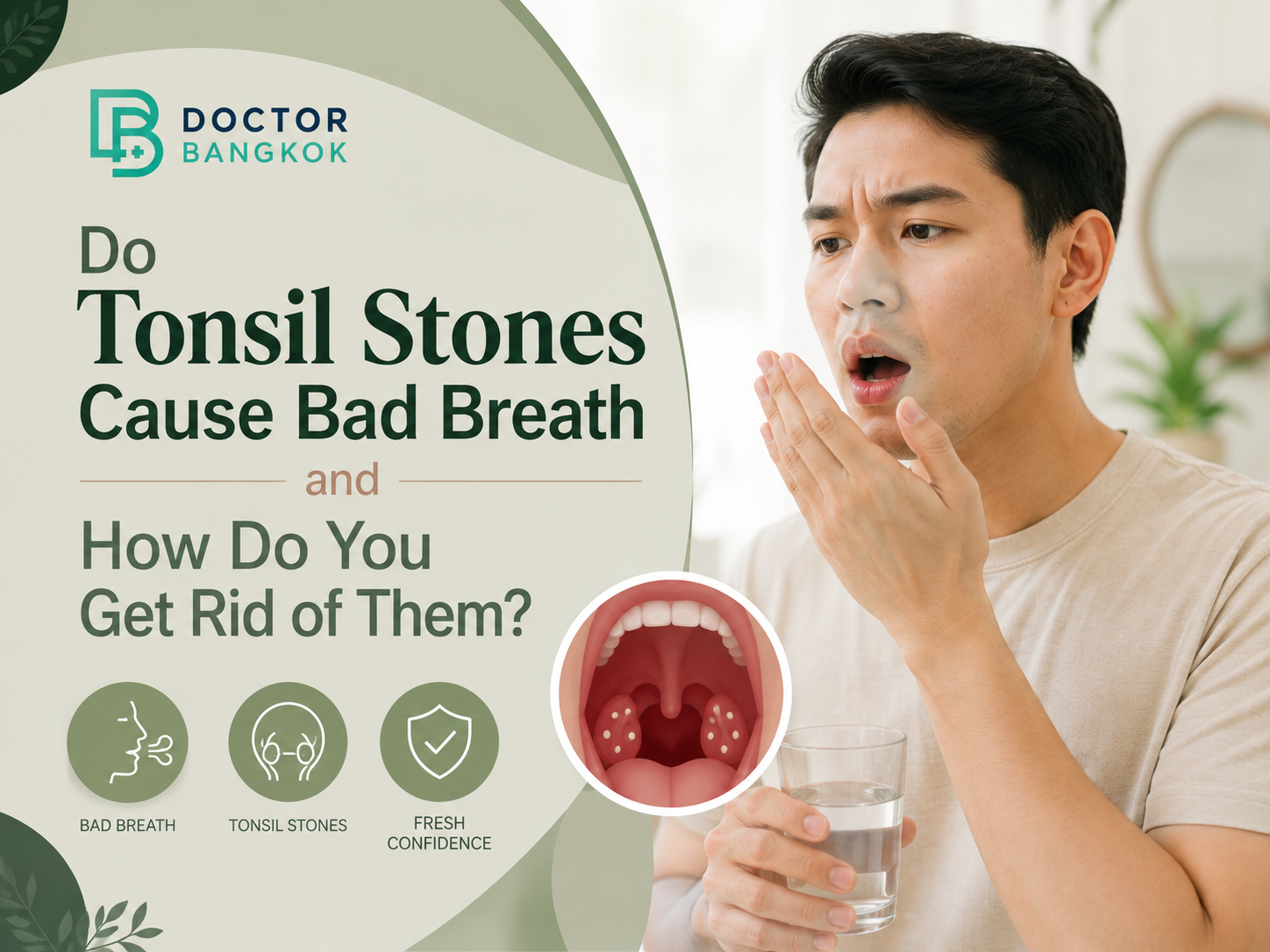
Your tonsils are not smooth. They have pockets and folds called tonsillar crypts. Food particles, dead cells, and saliva get trapped there. Over time, that debris hardens into small white or yellowish lumps. Those are tonsil stones.
Some people get them and never know. Others feel something stuck at the back of the throat or notice a foul taste that does not go away. You can sometimes spot them with a torch and a mirror. Most are small. Some grow large enough to cause real discomfort.
Why Do Tonsil Stones Cause Bad Breath?
The smell does not come from the stones themselves. It comes from bacteria living inside them.
The tonsillar crypts have very little oxygen. This creates ideal conditions for bacteria that thrive without air. These bacteria break down trapped debris and produce volatile sulfur compounds. Those compounds smell like rotten eggs. That is the smell you cannot brush away.
Standard oral hygiene does not reach deep into those crypts. Mouthwash masks the odor temporarily. It always comes back.

Tonsil Stones vs Other Causes of Bad Breath
Not all persistent bad breath comes from tonsil stones. Here is a simple way to think through it.
Tonsil stone bad breath tends to come with a persistent foul taste, not just a smell. It returns quickly after mouthwash. You might see white or yellowish spots at the back of your throat, or feel like something is stuck there.
Gum disease usually comes with bleeding gums or sensitivity. Acid reflux often brings a burning sensation in the chest or throat. Dry mouth, common in Bangkok’s heat and after alcohol, causes a stale flat smell. Post-nasal drip from allergies or sinus problems can also cause bad breath, especially in the morning. A throat examination sorts this out quickly.
Risk Factors — Who Gets Tonsil Stones More Often?
If you have had recurrent tonsillitis, your tonsils tend to develop deeper and more irregular crypts over time. That means more places for debris to collect.
Mouth breathing dries out the back of the throat and changes the bacterial environment there. Dehydration has the same effect. In Bangkok’s heat, and especially if you drink regularly, saliva production drops and the tonsils are less effectively flushed. Larger tonsils simply create more surface area for debris to get trapped.
Other Symptoms Beyond Bad Breath
Bad breath gets the most attention, but it is not always the first symptom patients mention. Many people describe a scratchy throat, a sensation of something stuck at the back of the throat, or a sore throat that keeps returning without an obvious cause.
One symptom that often alarms people is ear pain with no obvious ear problem. Tonsil stones can cause referred pain to the ear because the tonsil and the ear share a nerve pathway. The ear itself is fine, but the signal gets confused. This gets misdiagnosed more often than it should.
Post-nasal drip can also accompany tonsil stones. Mucus dripping down the back of the throat adds to the debris in the crypts and makes stones more likely to form or grow.
When Should You See a Doctor in Bangkok About Tonsil Stones?
Most small, symptom-free tonsil stones do not need a clinic visit. If a salt water gargle dislodges them and your symptoms resolve, you are probably fine.
Come in if the bad breath persists despite home care, if you have regular throat discomfort or ear pain, or if you can see lumps at the back of your throat that are not clearing. A peritonsillar abscess, a collection of pus near the tonsil, is a complication that needs urgent treatment. Signs include severe one-sided throat pain, difficulty swallowing, fever, and a muffled voice. That one does not wait.
For expats using the Bangkok healthcare system for the first time, start with a general medical consultation. Doctor Bangkok’s English-speaking doctors can assess your throat, tell you clearly what you are dealing with, and arrange an ENT referral if that is the right next step.
Treatment Options — From Home Care to Clinical Removal in Bangkok
What You Can Do at Home
A salt water gargle done consistently helps loosen small stones and reduces bacterial load. Warm water with half a teaspoon of salt, gargled for thirty seconds a few times a day, is a reasonable starting point. A water flosser on a low setting aimed at the tonsillar area can dislodge small stones without damaging the tissue.
Do not use a cotton swab or your fingers to dig at the tonsils. You can cause bleeding, trigger a gag reflex, or push stones deeper. The risk is not worth it.
Staying hydrated is the most underrated prevention step. In Bangkok’s climate you are losing fluid constantly, and low saliva flow lets debris accumulate faster. Drink water throughout the day, not just when you feel thirsty.
What a Doctor Can Do
A GP can examine your tonsils and, for small accessible stones, arrange gentle removal under proper conditions. This is straightforward but needs to be done correctly.
For recurring or larger stones, an ENT referral is the right step. Cryptolysis is a procedure where the tonsillar crypts are treated to reduce their depth and smooth the surface. Fewer crypts mean fewer places for stones to form. It is done under local anaesthetic and has a good evidence base for reducing recurrence. Tonsillectomy, the surgical removal of the tonsils, is reserved for cases where stones are severe, frequent, and significantly affecting quality of life. That decision is made with an ENT.
Doctor Bangkok can start that process for you. Whether it is a first assessment, a throat examination, or an ENT referral arranged in English, you do not need to work out where to go on your own.
Come in if your bad breath is not improving with regular dental care, or you can see or feel something at the back of your throat. Doctor Bangkok’s English-speaking doctors will examine your throat, give you a clear answer, and refer you to an ENT if needed. We are centrally located in Bangkok, BTS accessible, and open seven days a week. No referral needed to book.
FAQ
Dr. Ponlawat Pitsuwan
Physician, Doctor Bangkok
a private medical clinic in central Bangkok. He sees expats, residents, and medical tourists for general medical consultations, throat assessments, and a wide range of acute and ongoing health concerns. His focus is clear, evidence-based care delivered in plain English.

Dr. Ponlawat Pitsuwan is a physician at Doctor Bangkok, a private clinic in central Bangkok. He sees expats, residents, and medical tourists for general medicine, wellness consultations, and IV therapy. His focus is straightforward, evidence-based care delivered in plain language.