
100+ verified figures for tourists and expats, from the Department of Disease Control, WHO, Ministry of Public Health and peer-reviewed travel medicine research, plus our month-by-month risk calendar
Medically reviewed by Dr. Ponlawat Pitsuwan, Physician and Medical Director, Doctor Bangkok
Last updated: 27 October 2026. Next scheduled update: January 2027.
Thailand welcomed 32.9 million foreign visitors in 2025, and most travel without serious illness. The most common problem is an upset stomach: about 30% of backpackers studied in Bangkok had diarrhoea. The serious risks are road accidents (25.4 deaths per 100,000 people, 84% of them motorcyclists), dengue (21,620 cases by mid-August 2026, peaking June to August), rabies after animal bites (every 2025 death was in someone who skipped post-exposure vaccination), PM2.5 smog from January to March, and heat in April.
Dr. Ponlawat Pitsuwan
Physician and Medical Director, Doctor Bangkok
“The patients who worry us most are rarely the ones with dramatic stories. They are the traveller who was nipped by a temple monkey and decided it was too small to bother with, or the expat who has had a fever for three days during the rainy season and assumed it was flu. Both rabies and severe dengue are far easier to manage when we see people early, and the numbers in this report show how often that window is missed.”
Key takeaways
- About 3 in 10 backpackers studied in Bangkok got diarrhoea during their trip; most cases were mild, but 3.2% ended up in hospital.
- Thailand recorded 21,620 dengue cases and 31 deaths between January and mid-August 2026, including 1,785 cases in Bangkok. Risk peaks from June to August.
- Every person who died of rabies in Thailand in 2025 had skipped post-exposure vaccination, and fewer than half of bitten travellers in Bangkok got their first dose on the day of the bite.
- 12.3 million people in Thailand were diagnosed with air-pollution-related illness in 2024, with smog peaking from January to March.
- Thailand’s roads are among the world’s deadliest (25.4 deaths per 100,000 people), and 83.8% of road deaths are motorcyclists.
- April is the riskiest month on our calendar, combining peak heat, high pollution and the Songkran holiday road toll.
Thailand health risks at a glance
| Risk | Latest headline figure | When it peaks | How to reduce it |
|---|---|---|---|
| Diarrhoea / food poisoning | 30.7% of backpackers affected; 274,151 national diarrhoea cases Jan to mid-Mar 2026 | Year-round | Hand hygiene, care with ice and leftovers, carry oral rehydration salts |
| Dengue | 21,620 cases, 31 deaths (Jan to 19 Aug 2026) | June to August | Repellent day and evening; see a doctor for high fever |
| Rabies | 7 deaths in 2025, none vaccinated after exposure | Year-round | Avoid animals; same-day treatment after any bite or scratch |
| Air pollution (PM2.5) | 12.3 million related illnesses in 2024 | January to March | Check air quality daily; N95 mask outdoors |
| Road accidents | 25.4 deaths per 100,000; 83.8% motorcyclists | Songkran (April) | Avoid riding motorbikes; always wear a helmet |
| Heat illness | 61 deaths Jan to Apr 2024 | April | Hydrate, avoid midday sun, limit alcohol |
| HIV / syphilis | 9,083 new HIV infections (2023); syphilis up 69% since 2018 | Year-round | Condoms, testing, PrEP or PEP |
Thailand travel and tourism at a glance
These figures show how many people the risks in this article apply to.
1. Thailand welcomed 32.9 million foreign visitors in 2025. (Skift [1])
2. Foreign arrivals fell 7.23% in 2025, the first annual decline in a decade outside the pandemic years. (Skift [1])
3. Foreign visitors spent about THB 1.53 trillion (around USD 49 billion) in Thailand in 2025, down 4.7%. (Skift [1])
4. Kasikorn Research forecasts 34.1 million international arrivals in 2026, a rise of about 4%. (Kasikorn Research [2])
5. Chinese visitors now make up about 14% of arrivals, roughly half their pre-pandemic share. (Kasikorn Research [2])
6. Foreign medical-tourism patient numbers are forecast to grow just 0.4% in 2026, with related revenue up 3.7%. (Kasikorn Research [2])
7. Spread across 32.9 million visitors, Thailand receives about 90,000 foreign arrivals every day. (Doctor Bangkok analysis [3])
How often travellers get sick in Thailand
The best direct measure comes from a study of backpackers on Bangkok’s Khao San Road, where Doctor Bangkok also offers house calls.
8. 30.7% of foreign backpackers surveyed on Khao San Road had diarrhoea during their trip (124 of 404). (Journal of Travel Medicine [4])
9. The backpackers studied stayed a median of 30 days in the region. (Journal of Travel Medicine [4])
10. 88% of travellers’ diarrhoea cases were mild and cleared up without treatment. (Journal of Travel Medicine [4])
11. 8.8% of travellers with diarrhoea needed to see a doctor, and 3.2% were admitted to hospital. (Journal of Travel Medicine [4])
12. 93.9% of the backpackers ate food from street vendors and 92.5% drank beverages with ice. (Journal of Travel Medicine [4])
13. Longer stays and drinks with ice cubes were both linked to a higher risk of diarrhoea. (Journal of Travel Medicine [4])
14. Only 56% of the backpackers carried antidiarrhoeal medicine. (Journal of Travel Medicine [4])
15. Applied to 2025 arrivals, a 30% attack rate would mean roughly 10 million cases of travellers’ diarrhoea a year, although most visitors stay much shorter than the backpackers studied. (Doctor Bangkok analysis [3])
Food poisoning and diarrhoea
Thailand’s national surveillance system records hundreds of thousands of gastrointestinal cases each year, among locals and visitors alike.
16. Thailand recorded 274,151 cases of acute diarrhoea and 2 deaths between 1 January and 17 March 2026. (DDC via The Nation [5])
17. 39,233 food poisoning cases were reported in Thailand in the same period of 2026. (DDC via The Nation [5])
18. That works out at about 3,600 acute diarrhoea cases and more than 500 food poisoning cases reported every day in early 2026. (Doctor Bangkok analysis [3])
19. Leptospirosis cases surged after southern floods in late 2025: Songkhla recorded 341 cases in three weeks, the most of any province. (WHO SEARO [6])
20. Thailand reported 324 leptospirosis cases in a single week of December 2025, against 129 in the same week of 2024. (WHO SEARO [6])
Dengue fever
Dengue is the mosquito-borne infection travellers and expats in Thailand are most likely to catch. There is no routine vaccine for most short-term visitors, so avoiding bites matters.
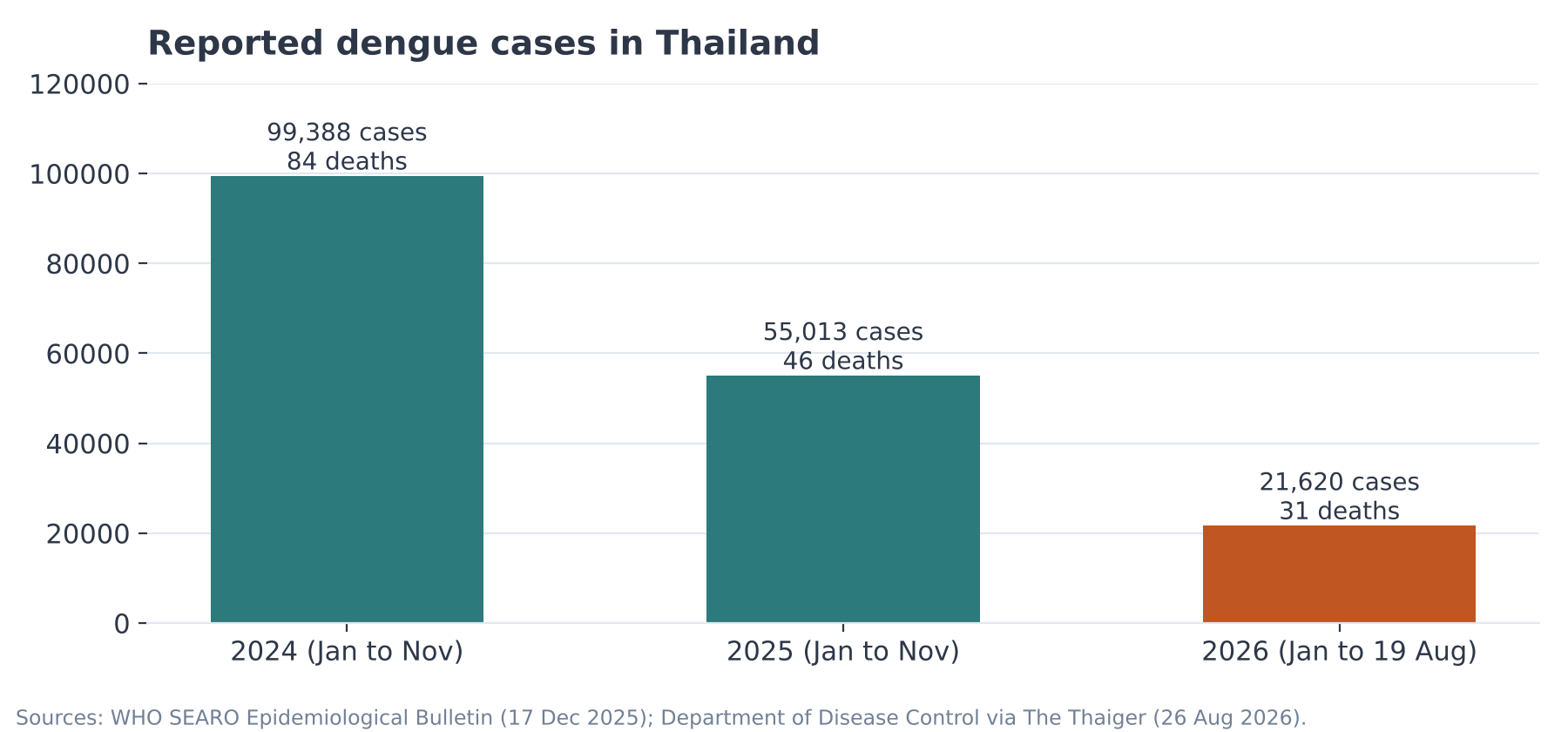
21. Thailand recorded 21,620 dengue cases and 31 deaths between 1 January and 19 August 2026. (DDC via The Thaiger [7])
22. Bangkok recorded 1,785 dengue cases and 4 deaths in the same period of 2026. (DDC via The Thaiger [7])
23. Bangkok accounted for about 8% of Thailand’s reported dengue cases in 2026 to date. (Doctor Bangkok analysis [3])
24. By the end of November 2025, Thailand had recorded 55,013 dengue cases and 46 deaths. (WHO SEARO [6])
25. In the same period of 2024, Thailand recorded 99,388 dengue cases and 84 deaths. (WHO SEARO [6])
26. Dengue cases in 2025 were about 45% lower than in 2024. (Doctor Bangkok analysis [3])
27. Thailand’s dengue case fatality rate was about 0.08% in both 2024 and 2025, roughly 1 death in every 1,200 reported cases. (Doctor Bangkok analysis [3])
28. Thailand reported 3,218 dengue cases in November 2025, down 16% from October. (WHO SEARO [6])
29. By early June 2025, Thailand had recorded 12,144 dengue cases and 16 deaths, an infection rate of 18.38 per 100,000 people. (BMA via The Nation [8])
30. Bangkok recorded 787 dengue cases and 1 death between 1 January and 31 May 2025, a rate of 14.43 per 100,000. (BMA via The Nation [8])
31. Children aged 5 to 14 are the age group most affected by dengue in Thailand, followed by people aged 15 to 24. (DDC via The Thaiger [9])
32. Phuket, Surat Thani, Songkhla, Phatthalung and Narathiwat had Thailand’s highest dengue incidence in early 2025. (DDC via The Thaiger [9])
33. Dengue risk in Thailand is highest from May to October, with cases typically climbing through June to August. (MBDS [10])
34. Thailand’s rainy season begins around mid-May, which is when dengue transmission picks up. (Thai Meteorological Dept [11])
Rabies and animal bites
Rabies is almost always fatal once symptoms start, and almost entirely preventable with prompt treatment after a bite or scratch. These figures show why prompt treatment matters.
35. Thailand recorded 7 human rabies deaths in 2025. (DDC via Khaosod [12])
36. None of the 7 people who died of rabies in Thailand in 2025 had received post-exposure vaccination. (DDC via Khaosod [12])
37. More than half of Thailand’s 2025 rabies deaths were caused by owned dogs rather than strays. (DDC via Khaosod [12])
38. Thailand’s first rabies death of 2026 was a man bitten by a puppy who died two days after symptoms began. (DDC via Khaosod [12])
39. Thailand reported 46 confirmed and probable human rabies cases between 2010 and 2015. (PLoS NTD [13])
40. More than 90% of people who died of rabies in Thailand between 2010 and 2015 had not received post-exposure treatment or stopped it too early. (PLoS NTD [13])
41. Eight provinces in eastern Thailand reported 6,204 suspected rabies exposures in a single year (2015), a rate of 106 per 100,000 people. (PLoS NTD [13])
42. Adjusted for under-reporting, the true exposure rate in eastern Thailand was an estimated 204 per 100,000. (PLoS NTD [13])
43. Dogs caused 77.8% of suspected rabies exposures in eastern Thailand. (PLoS NTD [13])
44. Only 15% of people in eastern Thailand who needed rabies immunoglobulin received it. (PLoS NTD [13])
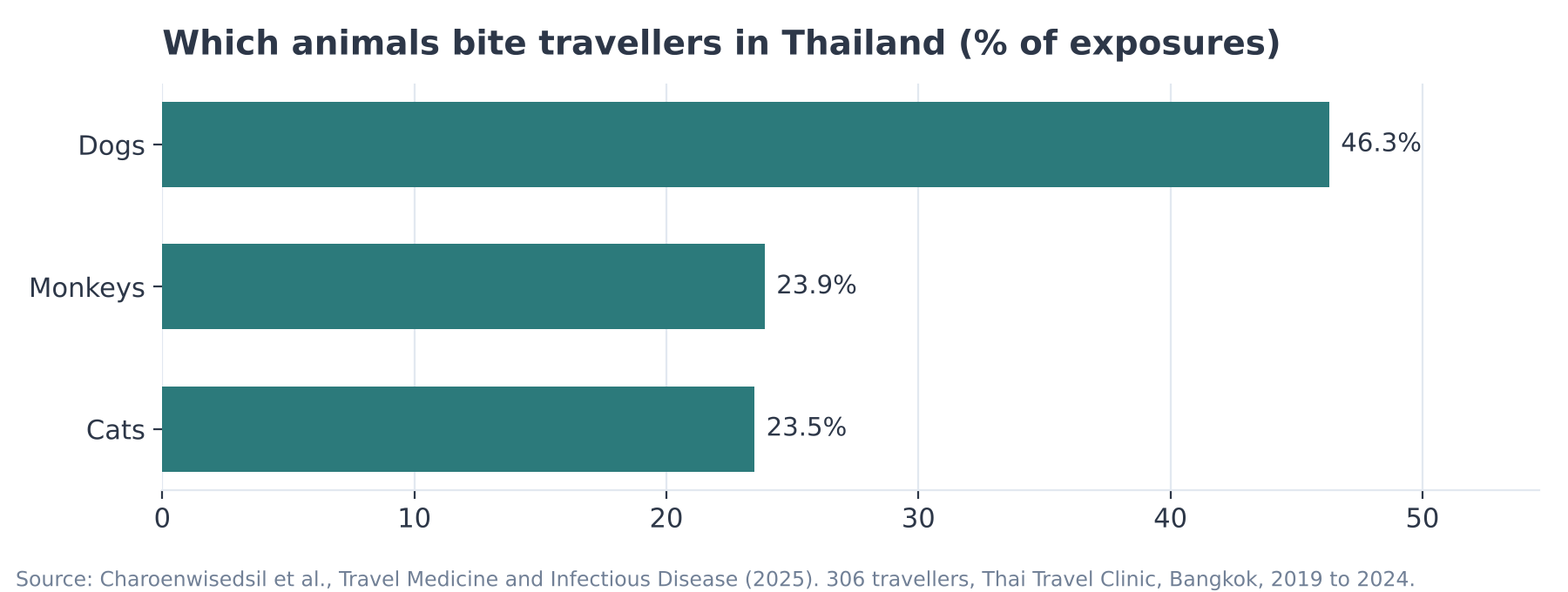
45. Dogs caused 46.3% of animal exposures among travellers treated at Bangkok’s Thai Travel Clinic, monkeys 23.9% and cats 23.5%. (Travel Med Infect Dis [14])
46. 40.1% of travellers’ animal exposures happened on the street and 20.5% on islands or beaches. (Travel Med Infect Dis [14])
47. The median time from arriving in Thailand to being bitten or scratched was 30 days. (Travel Med Infect Dis [14])
48. 14.7% of travellers who were bitten were bitten in their first week in Thailand. (Travel Med Infect Dis [14])
49. 59.8% of travellers’ wounds were WHO category III, the most serious type, which needs both vaccine and immunoglobulin. (Travel Med Infect Dis [14])
50. Only 47.5% of exposed travellers received their first rabies vaccine dose on the day of the bite. (Travel Med Infect Dis [14])
51. 57.9% of travellers who needed rabies immunoglobulin received it late. (Travel Med Infect Dis [14])
52. Only 9.5% of travellers who were bitten had completed rabies pre-exposure vaccination before their trip. (Travel Med Infect Dis [14])
53. Only 35.3% of bitten travellers had had a pre-travel health consultation. (Travel Med Infect Dis [14])
Warning:
Rabies is almost always fatal once symptoms appear. After any bite, scratch or lick on broken skin from a dog, cat, monkey or bat, wash the wound with soap and running water for 15 minutes and see a doctor the same day, even if you were vaccinated before your trip.
Air pollution (PM2.5)
Fine particle pollution peaks in the dry season, when Bangkok regularly ranks among the most polluted cities in the world.
54. 12.3 million people in Thailand were diagnosed with air-pollution-related illnesses in 2024. (NESDC/MOPH [15])
55. That was 10.1% more than in 2023. (NESDC/MOPH [15])
56. Bangkok ranked third among Thai regions for air-pollution illness cases in 2024, behind the north and northeast. (NESDC/MOPH [15])
57. About 980,000 air-pollution illness cases were recorded in Thailand in the first six weeks of 2025 alone (1 January to 14 February). (NESDC/MOPH [15])
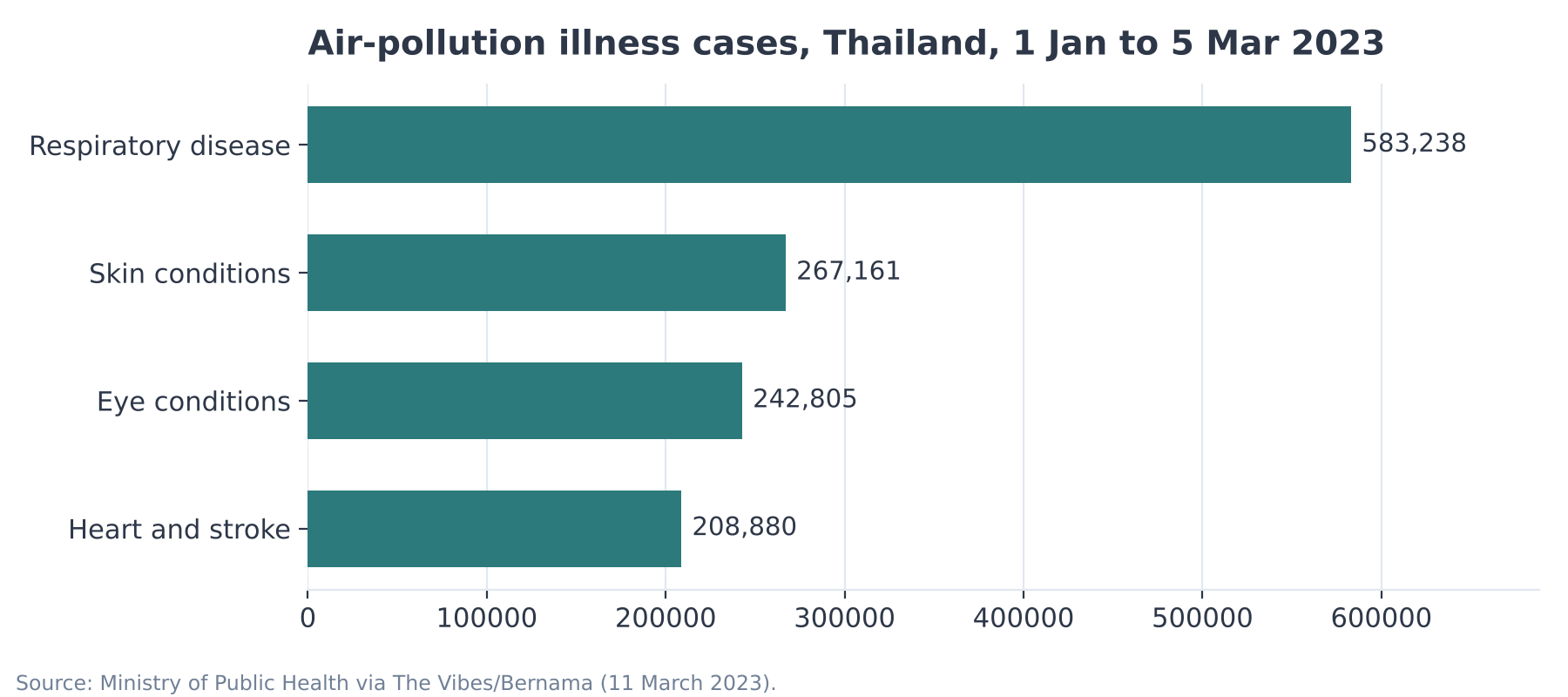
58. More than 1.3 million people in Thailand fell sick from air pollution between 1 January and 5 March 2023. (MOPH via Bernama [16])
59. Respiratory disease made up the largest group of those cases (583,238), followed by skin conditions (267,161), eye conditions (242,805) and heart disease and stroke (208,880). (MOPH via Bernama [16])
60. 196,311 people sought help for air-pollution ailments in a single week of March 2023. (MOPH via Bernama [16])
61. Thailand’s average PM2.5 level in 2025 was 17.8 micrograms per cubic metre, 3.6 times the WHO annual guideline. (IQAir [17])
62. Thailand ranked 48th of 143 countries for PM2.5 pollution in 2025. (IQAir [17])
63. PM2.5 in Thailand peaks from January through May and rises again in December. (IQAir [17])
64. Bangkok’s PM2.5 reached 108 micrograms per cubic metre on 24 January 2025, more than seven times the WHO 24-hour guideline of 15. (Bangkok Post/Guardian [18])
65. Bangkok closed 352 of its 437 city-run schools on 24 January 2025 because of smog, the most since 2020. (Bangkok Post/Guardian [18])
66. Thailand’s PM2.5 safety standard is 37.5 micrograms per cubic metre over 24 hours and 15 as an annual average. (Bangkok Post/Guardian [18])
67. Transport accounts for about 60% of Bangkok’s air pollution. (Bangkok Post/Guardian [18])
68. Bangkok spent about THB 140 million on a week of free public transport in January 2025 to cut traffic during the smog. (Bangkok Post/Guardian [18])
Road accidents
Thailand has some of the most dangerous roads in the world, and motorbikes, the way many visitors get around, account for most deaths.
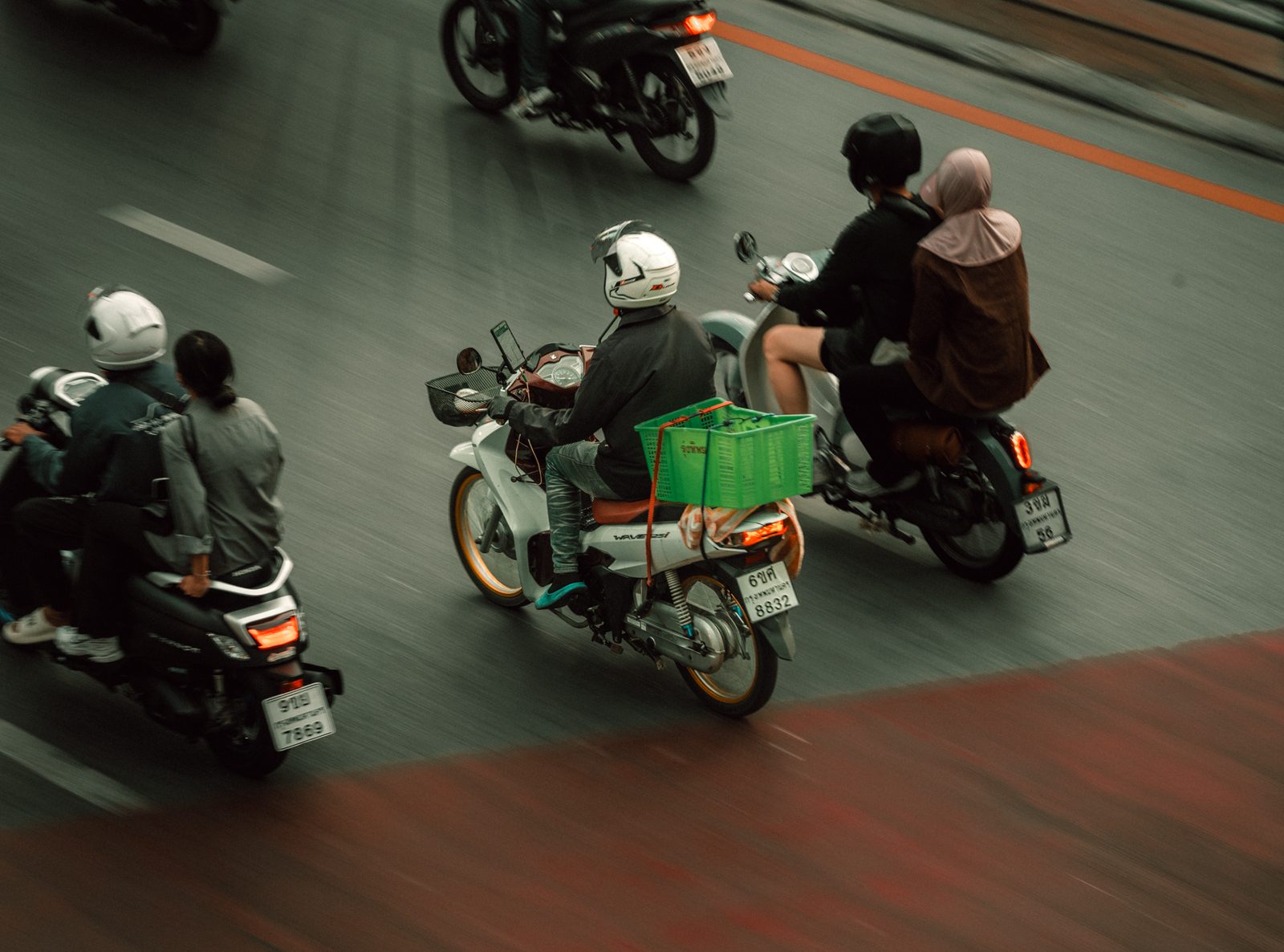
69. 18,218 people died on Thailand’s roads in 2021, about 50 deaths a day. (WHO [19])
70. Thailand’s road death rate was 25.4 per 100,000 people, one of the highest in Asia. (WHO [19])
71. Thailand ranked 9th out of 175 countries for road traffic deaths. (WHO [19])
72. Motorcyclists made up 83.8% of all road deaths in Thailand. (WHO [19])
73. People aged 15 to 29 are the age group most affected by road deaths in Thailand. (WHO [19])
74. Road crashes cost Thailand about THB 531 billion (around USD 15.5 billion) in 2022, equal to 3.06% of GDP. (WHO [19])
75. Thailand aims to cut road deaths to 12 per 100,000 by 2027 and halve motorcyclist deaths. (WHO [19])
76. In the first three days of Songkran 2025, Thailand recorded 756 road accidents, 100 deaths and 752 injuries. (Road Safety Centre [20])
77. Speeding caused 44.26% of Songkran accidents on 13 April 2025, and drink driving 29.05%. (Road Safety Centre [20])
78. More than 4 in every 5 road deaths in Thailand (83.8%) are motorcyclists, making motorbikes, the way many visitors get around, the main danger on Thai roads. (Doctor Bangkok analysis [3])
Sexual health: HIV and STIs
Thailand has one of Asia’s most successful HIV programmes, but syphilis has risen sharply. Testing, PrEP and PEP are widely available.
79. An estimated 576,397 people were living with HIV in Thailand at the end of 2023. (DDC HIV Factsheet [21])
80. Thailand recorded an estimated 9,083 new HIV infections in 2023. (DDC HIV Factsheet [21])
81. New HIV infections in Thailand have fallen 37% since 2013. (DDC HIV Factsheet [21])
82. An estimated 12,072 people died of AIDS-related causes in Thailand in 2023, a 57% fall since 2013. (DDC HIV Factsheet [21])
83. 4,236 of Thailand’s new HIV infections in 2023 (about 47%) were among young people aged 15 to 24. (DDC HIV Factsheet [21])
84. 91% of people living with HIV in Thailand know their status, and 91% of those diagnosed are on treatment. (DDC HIV Factsheet [21])
85. 98% of people on HIV treatment in Thailand have a suppressed viral load (below 1,000 copies/ml), a key step in stopping onward transmission. (DDC HIV Factsheet [21])
86. HIV prevalence is 1.7% among men who have sex with men, 2.2% among transgender women and 4.2% among male sex workers in Thailand. (DDC HIV Factsheet [21])
87. The number of people using oral PrEP in Thailand rose about 22-fold between 2016 and 2022. (DDC HIV Factsheet [21])
88. Thailand’s syphilis rate rose from 11 per 100,000 people in 2018 to 18.6 in 2022, an increase of about 69%. (MOPH via PRD [22])
89. Congenital syphilis in newborns nearly quadrupled, from 25.1 to 98.2 per 100,000 births, between 2018 and 2022. (MOPH via PRD [22])
90. Thailand aims to cut syphilis to 1 case per 100,000 people by 2030. (MOPH via PRD [22])
91. People with syphilis face 5 to 9 times the risk of HIV infection, according to the Department of Disease Control. (DDC via Bangkok Post [23])
Heat illness
Thailand’s hot season runs from late February to mid-May, and April is usually the hottest month.
92. 61 people died of heatstroke in Thailand in the first four months of 2024, nearly twice the 37 deaths recorded in 2023. (DDC via Bangkok Post [24])
93. 33 of 2024’s heatstroke deaths were in the northeast. (DDC via Bangkok Post [24])
94. 200 heat-related deaths were officially recorded in Thailand between 2018 and May 2024. (DDC via Bangkok Post [24])
95. 62.1% of people who died of heatstroke in early 2024 drank alcohol heavily, 49.2% had an underlying illness and 27.6% worked outdoors. (DDC via The Investor [25])
96. Thailand recorded 182 cases of heat-related illness in 2025, including 17 heatstroke cases and 21 deaths. (DDC [26])
97. 18 of the 21 people who died of heat in Thailand in 2025 were men, and their average age was 51. (DDC [26])
98. People aged 15 to 34 accounted for 42.8% of heat-illness cases in 2025. (DDC [26])
99. Peak temperatures in Thailand can reach 41°C in April. (DDC [26])
100. Heavy drinking was the most common risk factor among heatstroke deaths, ahead of chronic illness, which matters for visitors combining heat and alcohol. (Doctor Bangkok analysis [3])
Our month-by-month risk analysis
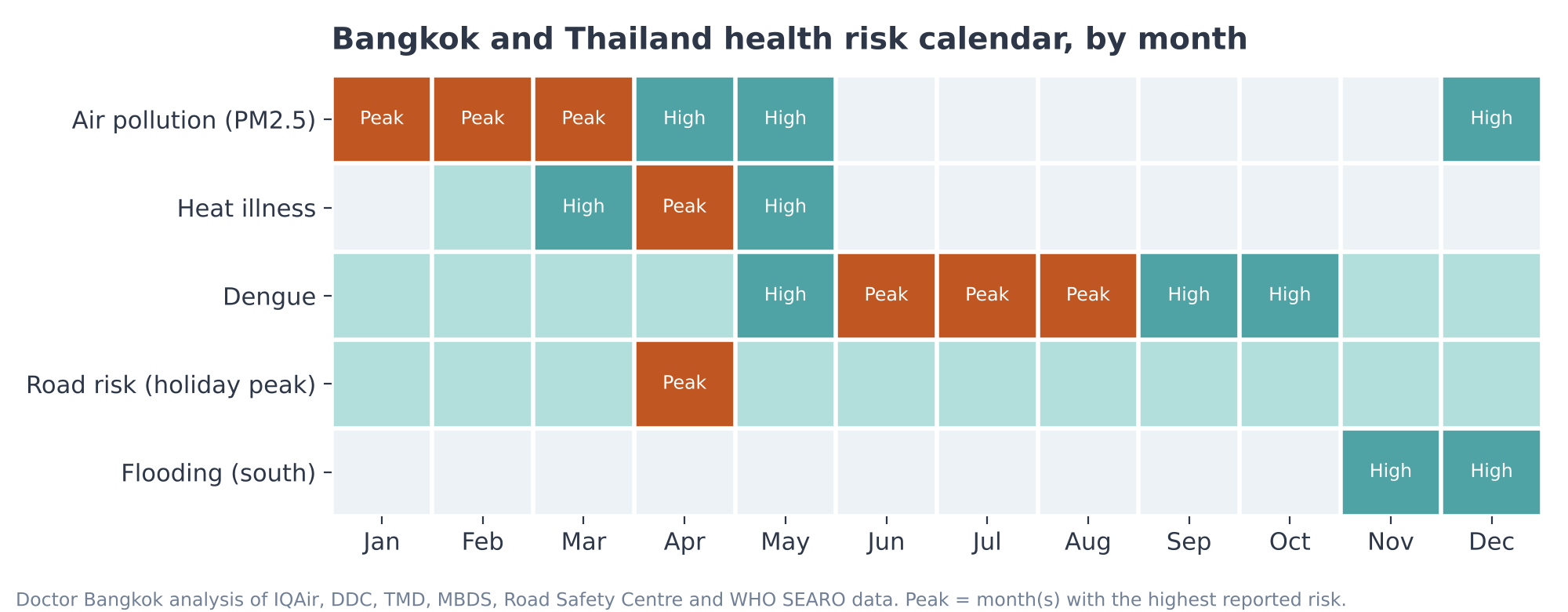
Official agencies publish each of these risks separately. We combined their seasonal patterns into one calendar (Figure 1) so travellers and expats can see which risks matter in the month they are in Thailand. Seasons come from IQAir (air pollution), the Department of Disease Control (heat), MBDS and the Thai Meteorological Department (dengue and the rainy season), the Road Safety Centre (Songkran) and WHO SEARO (late-2025 southern floods).
101. There is no ‘safe’ month in Thailand, only different risks: smog dominates January to March, heat peaks in April, dengue peaks from June to August, and southern flooding raises infection risk in November and December. (Doctor Bangkok analysis [3])
102. April is the single highest-risk month on our calendar, combining peak heat, high air pollution and the Songkran holiday road toll. (Doctor Bangkok analysis [3])
103. The risks travellers are most likely to underestimate are the preventable ones: every rabies death in Thailand in 2025 was in someone who did not get post-exposure vaccination, yet fewer than half of bitten travellers in Bangkok got their first dose on the day of the bite. (Doctor Bangkok analysis [3])
104. The most likely health problem for any visitor is not dengue or rabies but an upset stomach: about 3 in 10 backpackers studied in Bangkok got diarrhoea, while Thailand’s reported dengue rate in the first five months of 2025 was 18 per 100,000 people. (Doctor Bangkok analysis [3])
Clinical insight:
Dengue and many other infections look like flu for the first few days. In Thailand, a high fever during the rainy season, especially with headache, pain behind the eyes or body aches, is worth a blood test rather than a wait-and-see approach. Warning signs such as severe stomach pain, persistent vomiting or bleeding gums usually appear as the fever comes down, and need urgent care.
In an emergency in Thailand, call 1669 for an ambulance or 1155 for the Tourist Police (English-speaking). Doctor Bangkok’s walk-in clinic on Sukhumvit Soi 13 is open 24/7, and our doctors make house and hotel calls across central Bangkok.
Methodology
Every statistic comes from a Thai government agency, an international health body, a peer-reviewed journal, or a reputable news organisation reporting official figures, and each is linked below. Where we used a news report of official data, we name the agency behind the figures. Figures marked ‘Doctor Bangkok analysis’ are our own calculations from the cited data, such as daily averages and percentage changes. Some studies, such as the Khao San Road backpacker survey, are older but remain the best direct evidence available; we state the year for every figure. Surveillance counts reflect reported cases only, so true numbers are higher.
Cite this page
Doctor Bangkok (2026). Thailand Travel Health Statistics 2026: Dengue, Rabies, Food Poisoning, Air Pollution and Road Safety. Medically reviewed by Dr. Ponlawat Pitsuwan. Available at: https://doctorbangkok.co.th/travel-health-bangkok/thailand-travel-health-statistics/. Journalists, bloggers and researchers are welcome to use these figures and the risk calendar with a link to this page.
Summary
Thailand is a safe destination for the vast majority of its tens of millions of visitors, but its health risks are real, predictable and largely preventable. Stomach upsets are the most common problem. Road accidents are the biggest killer, overwhelmingly among motorcyclists. Dengue rises with the rains from May and peaks in mid-year, smog dominates the first months of the year, and April brings peak heat and the Songkran road toll.
The clearest message in the data is about timing. Rabies deaths happen almost exclusively in people who do not get treatment after a bite, and serious dengue is far easier to manage when it is diagnosed early. Knowing which risks peak in which month, and getting checked promptly when something goes wrong, removes most of the danger.
Dr. Ponlawat Pitsuwan
Physician and Medical Director, Doctor Bangkok
“Most of what we treat could have been a much smaller problem if the person had come in a day or two earlier. A bite cleaned and vaccinated the same afternoon, a fever tested on day two instead of day five, rehydration started before someone is too weak to stand. In Bangkok, a doctor is never far away, and using one early is the single best health decision a visitor can make.”
Frequently Asked Questions
Dr. Ponlawat Pitsuwan
Physician and Medical Director, Doctor Bangkok
Dr. Ponlawat Pitsuwan is the medical director of Doctor Bangkok, a private medical clinic on Soi Sukhumvit 13 that is open 24/7, with a doctor-on-call service that reaches hotels and condos across Bangkok within one hour. He sees travellers, expats and residents for fever and dengue testing, animal bites and rabies vaccination, food poisoning, travel vaccinations and general medical care.
Sources
- Skift. Why Thailand’s foreign tourist numbers slipped in 2025 and what it means for 2026 (6 January 2026). Available at: https://skift.com/2026/01/06/why-thailands-foreign-tourist-numbers-slipped-in-2025-and-what-it-means-for-2026/
- Kasikorn Research Center. Thai tourism outlook 2026, press release (21 November 2025). Available at: https://www.kasikornresearch.com/SiteCollectionDocuments/analysis/k-social-media/Pressrelease/2025-11-21/E_01_TH_Press_KR_Tourism_21%20Nov_Final.pdf
- Doctor Bangkok analysis of the official figures cited in this article (October 2026). Available at: https://doctorbangkok.co.th/travel-health-bangkok/thailand-travel-health-statistics/
- Piyaphanee W, et al. Travelers’ diarrhea among foreign backpackers in southeast Asia: a cross-sectional study on Khao San Road, Bangkok. Journal of Travel Medicine 18(2):109-114 (2011). Available at: https://murex.mahidol.ac.th/en/publications/incidence-and-impact-of-travelers-diarrhea-among-foreign-backpack/
- The Nation, reporting Department of Disease Control Digital Disease Surveillance data. Thailand sees rising risks of summer illness in extreme heat (5 April 2026). Available at: https://www.nationthailand.com/health-wellness/40064694
- WHO South-East Asia Regional Office. Biweekly Epidemiological Bulletin, 25th edition (17 December 2025). Available at: https://cdn.who.int/media/docs/default-source/searo/whe/wherepib/2025_25_searo_epi_bulletin.pdf
- The Thaiger, reporting Department of Disease Control and BMA Health Department figures. Thailand dengue cases hit 21,620, death toll reaches 31 in 2026 (26 August 2026). Available at: https://thethaiger.com/guides/best-of/health/thailand-dengue-cases-21620-death-toll-31-2026
- The Nation, reporting BMA Health Department figures. Bangkok urges action as dengue cases surge past 12,000 nationwide (7 June 2025). Available at: https://www.nationthailand.com/health-wellness/40050942
- The Thaiger, reporting Department of Disease Control figures. Dengue cases projected to drop this year (21 February 2025). Available at: https://thethaiger.com/news/national/thailand-dengue-cases-projected-to-drop-by-2025-five-recent-deaths
- Mekong Basin Disease Surveillance (MBDS). Elevated dengue fever activity reported nationwide in Thailand (August 2023). Available at: https://mbdsnet.org/regional-alert/elevated-dengue-fever-activity-reported-nationwide-in-thailand-through-july/
- The Nation, reporting the Thai Meteorological Department. Unstable weather as Thailand nears rainy season in mid-May (3 May 2025). Available at: https://www.nationthailand.com/news/general/40049544
- Khaosod English, reporting Department of Disease Control figures. First rabies death of 2026 confirmed in Rayong (13 February 2026). Available at: https://www.khaosodenglish.com/featured/2026/02/13/first-rabies-death-of-2026-confirmed-in-rayong-after-two-days-of-symptoms/
- An epidemiological study of suspected rabies exposures and adherence to rabies post-exposure prophylaxis in Eastern Thailand, 2015. PLoS Neglected Tropical Diseases (2020). Available at: https://doaj.org/article/9993feb841ac42a3b61b5c962d02f1d8
- Charoenwisedsil R, et al. Travel-related potential rabid animal post-exposure consultation at the Thai Travel Clinic, Hospital for Tropical Diseases, Bangkok. Travel Medicine and Infectious Disease 66:102870 (2025). Available at: https://doaj.org/article/5ae215e0db5c425c8addd7f4e2849575
- Asia News Network, reporting NESDC and Ministry of Public Health Health Data Centre figures. Air pollution illnesses in Thailand hit 12.3M in 2024 (27 February 2025). Available at: https://asianews.network/air-pollution-illnesses-in-thailand-hit-12-3m-in-2024/
- The Vibes / Bernama, reporting Ministry of Public Health figures. In Thailand, almost 200,000 seek help for air pollution-related ailments (11 March 2023). Available at: https://www.thevibes.com/articles/world/87600/in-thailand-almost-200000-seek-help-for-air-pollution-related-ailments
- IQAir. Air quality in Thailand, including 2025 World Air Quality Report data. Available at: https://www.iqair.com/thailand
- 2025 Bangkok smog, summary of reporting by The Guardian/AFP, Bangkok Post and Nation Thailand (Wikipedia). Available at: https://en.wikipedia.org/wiki/2025_Bangkok_smog
- World Health Organization Thailand. Road safety (data from the Global Status Report on Road Safety 2023). Available at: https://www.who.int/thailand/our-work/road-safety
- Asia News Network, reporting Road Safety Centre figures. Songkran road death toll rises to 100 after three days (15 April 2025). Available at: https://asianews.network/?p=198374
- Department of Disease Control, Ministry of Public Health. Thailand HIV Factsheet 2023 (estimates for 2023, published September 2024). Available at: https://hivhub.ddc.moph.go.th/officer/Download/RRTTR/HIV_Factsheet2023_EN_Final_021067.pdf
- Government Public Relations Department, citing the Ministry of Public Health. Govt ramps up fight against youth STD surge (2 January 2024). Available at: https://thailand.prd.go.th/en/content/category/detail/id/52/iid/246461
- Bangkok Post, reporting Department of Disease Control figures. Sexually transmitted diseases surge among young. Available at: https://bangkokpost.com/thailand/general/2775464/sexually-transmitted-diseases-surge-among-young
- Bangkok Post, reporting Department of Disease Control figures. 61 deaths caused by heat stroke in 2024, says ministry (May 2024). Available at: https://www.pressreader.com/thailand/bangkok-post/20240511/281500756343839
- The Investor, reporting Thai PBS and Department of Disease Control figures. Thailand: 61 die of heat stroke in four months (2024). Available at: https://theinvestor.vn/thailand-61-die-of-heat-stroke-in-four-months-d10023.html
- Asia News Network, reporting Department of Disease Control figures. Thailand warns of heat stroke risk as country enters hot season (16 March 2026). Available at: https://asianews.network/thailand-warns-of-heat-stroke-risk-as-country-enters-hot-season/
The information in this article is for educational purposes only and does not constitute medical advice. It should not be used to self-diagnose or replace a consultation with a qualified physician. If you have concerns about your health, contact a licensed medical professional. In an emergency in Thailand, call 1669.

Dr. Ponlawat Pitsuwan is a physician at Doctor Bangkok, a private clinic in central Bangkok. He sees expats, residents, and medical tourists for general medicine, wellness consultations, and IV therapy. His focus is straightforward, evidence-based care delivered in plain language.