
Clinically reviewed by Dr. Ponlawat Pitsuwan, Physician, Doctor Bangkok. Last reviewed: August 2026
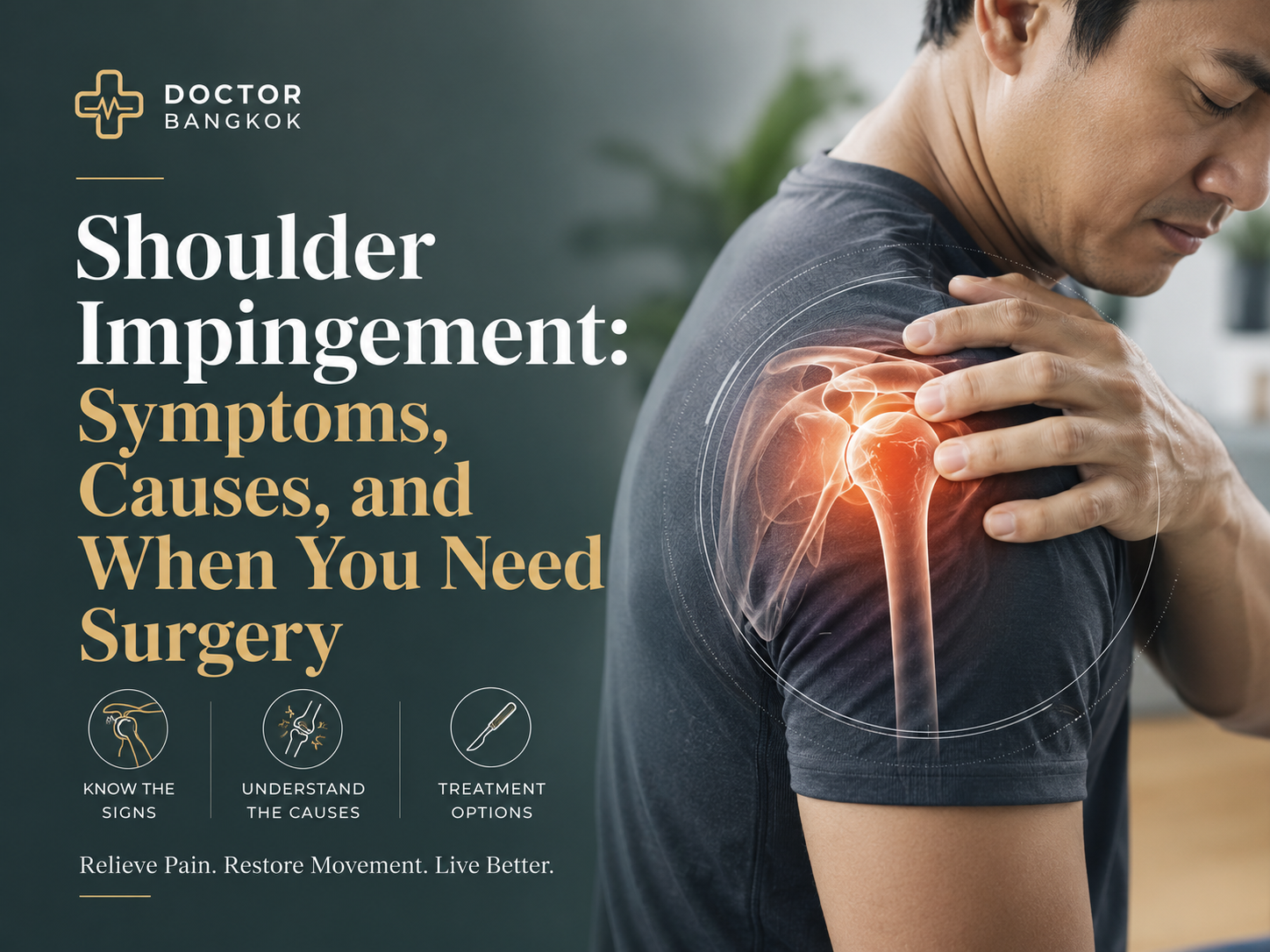
Shoulder impingement happens when the tendons at the top of your shoulder get pinched as you lift your arm. The main shoulder impingement symptoms are pain when reaching overhead, aching at night, and weakness when lifting. Most people improve without surgery. Getting an accurate diagnosis early makes a real difference to how quickly you recover.
You lifted something overhead at the gym, served in a badminton game, or reached for the overhead compartment before a flight, and now your shoulder hurts every time you repeat the movement. This is one of the most common shoulder complaints I see in Bangkok, particularly with expats who are active, sitting at a desk for long hours, and not sure whether to push through it or come in.
The short answer: shoulder impingement symptoms usually do not settle on their own if you ignore them. The earlier you get it assessed, the better your chances of avoiding more serious damage. Here is what you need to know.

What Shoulder Impingement Actually Feels Like
The most common complaint is pain when lifting the arm to the side or overhead. It often catches at a specific point in the movement, somewhere between chest height and fully raised, then eases once the arm is all the way up. That catching sensation is what we call a painful arc, and it is one of the clearest signs of impingement.
Night pain is also very common. Lying on the affected shoulder becomes difficult, sometimes impossible. Some patients tell me they wake at 3am and cannot find a comfortable position. It is not dramatic pain, just persistent and exhausting.
You may also notice weakness. Reaching behind your back to fasten a seatbelt or grab something from the back seat becomes awkward. That combination of pain, limited range, and weakness is what brings most patients in.
What Causes Shoulder Impingement, Including Bangkok-Specific Triggers
When you raise your arm, the space between the top of your shoulder joint and the tendons below it narrows. If that space is already reduced, the tendons and the small fluid-filled sac above them, the bursa, get pinched. Repeated pinching causes inflammation and pain.
Posture is a major cause. Eight hours a day at a desk rounds your shoulders forward. That shifts the shoulder blade out of position and reduces the space available for the tendons. I see this constantly in Bangkok, with remote workers, finance professionals, and anyone spending long days at a co-working space with the air conditioning keeping them locked in one position.
Sport is the other main trigger. Badminton, swimming, padel, tennis, and overhead pressing in the gym all place repeated stress on the same tendons. Sudden increases in training volume, a common story among expats who ramp up their gym routine after arriving here, are a frequent cause.

Two Types of Shoulder Impingement and Why It Matters
There are two main types, and they affect which treatment works best.
Subacromial impingement is the more common type. The tendons and bursa get compressed underneath the bony arch at the top of the shoulder, called the acromion. This is the classic overhead pain pattern, and posture, bone shape, and bursal swelling are usually responsible.
Internal impingement is less common and tends to affect overhead athletes, including swimmers and racket sport players. The tendons get pinched inside the joint itself, usually at the back, and the pain tends to sit at the back of the shoulder during a serve or throw rather than the front. Treatment focuses more on rotator cuff strengthening and technique correction.
If you play badminton or tennis here and your pain is at the back of the shoulder during your serve, tell your doctor exactly that. It changes the assessment.
Conditions That Look Like Shoulder Impingement Symptoms But Are Not
Self-diagnosis gets people into trouble here, because several conditions present almost identically.
Frozen shoulder causes pain and stiffness in all directions of movement, not just overhead. With impingement, your arm can typically be moved through a full range by someone else, even if it hurts. With frozen shoulder, it simply cannot get there.
Calcific tendinitis involves calcium deposits forming inside the tendon. It can cause sudden severe pain that comes on at rest or at night, not just with movement, and it shows up clearly on an X-ray.
Cervical radiculopathy is a pinched nerve in the neck that sends pain into the shoulder and upper arm. Neck movement reproduces the arm pain, and you may have tingling or numbness into the hand. This needs a neck assessment, not a shoulder injection.
A partial or full rotator cuff tear can present almost identically to impingement. With a complete tear, many patients cannot raise the arm at all. With impingement, strength is reduced but movement is still there, just painful. An ultrasound or MRI is the only reliable way to tell them apart.
How Shoulder Impingement Is Diagnosed in Bangkok
You do not need a referral to see a doctor at a private clinic in Bangkok. You walk in, describe your symptoms, and we work through it from there.
A clinical examination comes first. Two tests are particularly useful. The Neer test involves the doctor raising your arm in a specific way to reproduce the impingement pain. The Hawkins-Kennedy test rotates the shoulder inward at ninety degrees of flexion. If either reproduces your pain, that points toward impingement. Neither test is more painful than what your shoulder is already doing.
Imaging is usually the next step. An ultrasound can show tendon thickening, bursitis, and partial tears, and we can arrange that referral the same day. An MRI gives more detail and is recommended if a full rotator cuff tear is suspected or if conservative treatment has not worked. At Doctor Bangkok, we arrange imaging referrals the same day without you needing to navigate a large hospital system.
Treatment Options, and When Surgery Actually Becomes Relevant
Strong evidence supports non-surgical treatment for the majority of shoulder impingement cases. Most patients improve with rest from aggravating activities, anti-inflammatory medication such as NSAIDs, and targeted physiotherapy to restore shoulder blade mechanics and rotator cuff strength.
A corticosteroid injection into the subacromial space can reduce inflammation enough to allow physiotherapy to begin properly. It is not a cure, but it is a useful bridge when pain is too severe to allow meaningful exercise.
Surgery becomes a conversation when conservative treatment has genuinely failed after several months, or when imaging confirms significant structural damage. The most common procedure smooths down the underside of the acromion to create more space for the tendon. It is done through small incisions with a camera, and recovery typically takes three to six months back to full sport.
Most patients do not need surgery. But waiting too long before starting any treatment increases the risk of the tendon breaking down further, which is when surgery does become more likely.
Realistic Recovery Timelines for Shoulder Impingement
Mild cases caught early often respond within four to eight weeks of consistent physiotherapy and activity modification. Do not expect overnight results.
Moderate cases with established bursitis or partial tendon involvement typically take three to six months. The first month settles the inflammation. The next phase rebuilds strength and movement. The final phase is return to sport or full overhead activity, and that is where many people rush and re-injure.
If you are planning travel, a fitness event, or a sports competition and your shoulder is already troubling you, come in now rather than hoping it holds. I see too many people who push through an event and then present with a complete tear six weeks later.
Red Flags: When Shoulder Pain Is More Than Impingement
Most shoulder pain is musculoskeletal. But not all of it.
Shoulder pain that comes on suddenly at rest without any injury, especially alongside shortness of breath or chest tightness, needs urgent assessment. Cardiac referred pain can present in the left shoulder.
Right shoulder pain under the shoulder blade, particularly after fatty meals, can occasionally reflect gallbladder referred pain. If there has been no injury and the pain sits under the right scapula, mention it to your doctor.
Any shoulder pain after a significant fall or direct impact needs imaging to rule out a fracture, particularly of the clavicle or upper arm bone. Do not try to rest your way through a fracture.
If your shoulder has been hurting for more than two to three weeks, or if overhead movement, night pain, or arm weakness are affecting your daily life, this is worth assessing properly. At Doctor Bangkok, our English-speaking physicians can examine your shoulder, perform provocation tests, and arrange same-day imaging referrals if needed. No hospital queue, no GP referral required. We see expats, residents, and visitors for exactly this kind of assessment. Book a walk-in or scheduled appointment at Doctor Bangkok in central Bangkok, BTS accessible.
Frequently Asked Questions About Shoulder Impingement Symptoms
Dr. Ponlawat Pitsuwan
Physician, Doctor Bangkok
a private medical clinic in central Bangkok. He sees expats, residents, and medical tourists for musculoskeletal pain, shoulder and joint assessments, sports injuries, and general medical care. His focus is straightforward, evidence-based care delivered in plain language.

Dr. Ponlawat Pitsuwan is a physician at Doctor Bangkok, a private clinic in central Bangkok. He sees expats, residents, and medical tourists for general medicine, wellness consultations, and IV therapy. His focus is straightforward, evidence-based care delivered in plain language.