

Clinically reviewed by Dr. Ponlawat Pitsuwan, Physician, Doctor Bangkok. Last reviewed: July 2026
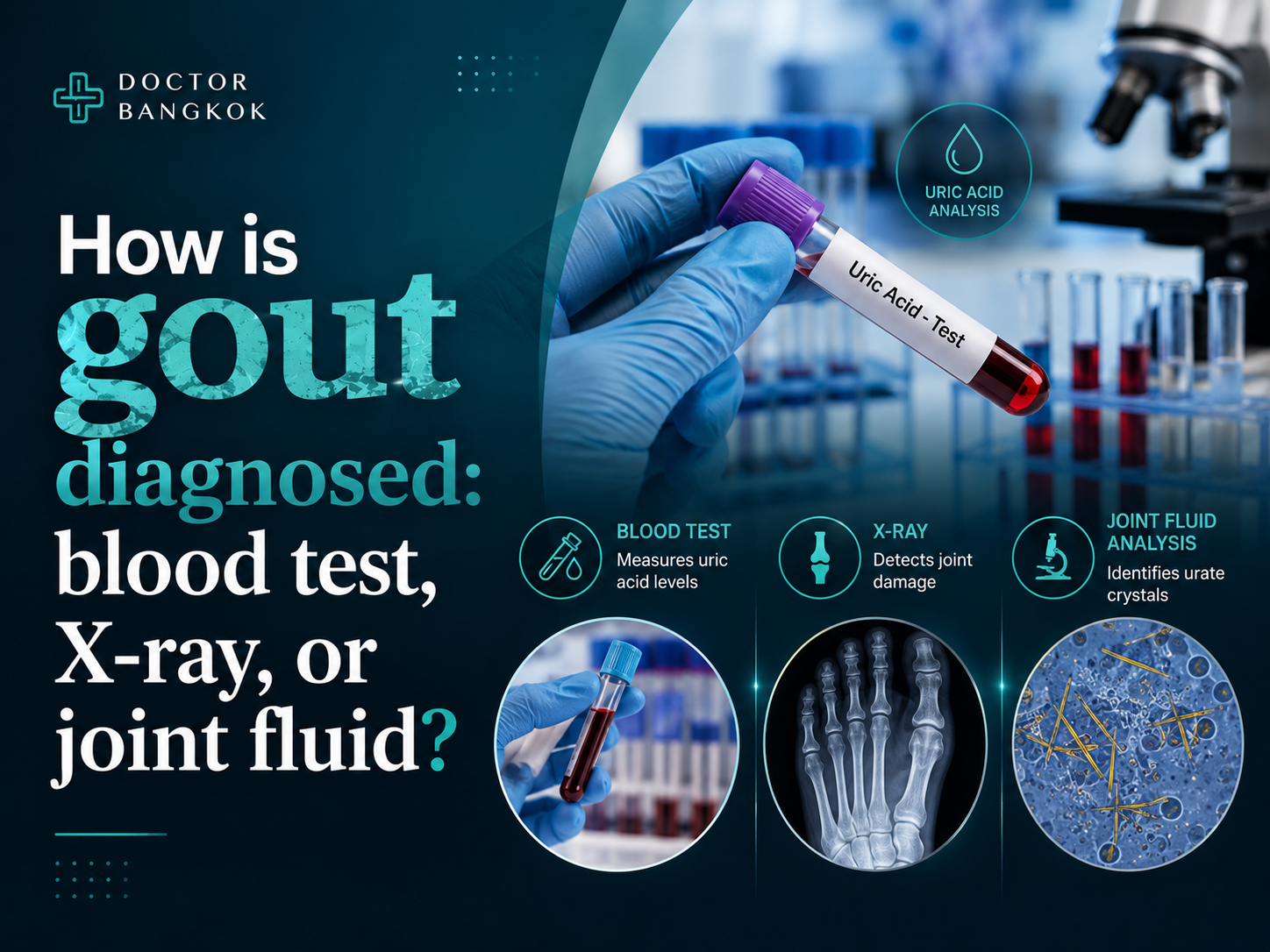
Gout is diagnosed through a combination of your symptoms, a blood test for uric acid, and sometimes a sample of fluid taken from the swollen joint. The joint fluid test is the most reliable, because it can confirm gout crystals directly. A blood test alone is not enough to rule gout in or out. If you have a hot, swollen joint that came on suddenly, come in and get assessed properly.
You went to bed fine and woke up at 3am with a big toe so painful you could not put a sheet over it. Or maybe it is your ankle, your knee, your wrist. It came out of nowhere. It is red, swollen, and the kind of sore where even a light touch is unbearable. You are searching "is this gout?" at an odd hour in Bangkok, and you want a straight answer.
Here is the honest one: there is no single test that instantly confirms gout. A good diagnosis uses your symptoms, your history, a blood test, and sometimes a look at the fluid inside the joint. Most cases can be assessed quickly at a private clinic in Bangkok, and you can usually start getting answers the same day you come in.

What the doctor does first: your symptoms and history
Before any test, I am listening to you. How fast did it come on? Which joint? How bad is the pain? Have you had this before?
Gout has a fairly recognisable pattern. It tends to hit one joint at a time and builds fast, often overnight. The skin over the joint turns red and feels warm. The big toe is the classic spot. But gout can hit any joint and does not always follow the textbook.
I also ask about diet, alcohol, and any recent illness or surgery. All of these can trigger a flare. For expats living in Bangkok, I ask about seafood habits and beer intake, because both are relevant and I will come back to that.
The blood test: what your uric acid level tells me and what it does not
The first test most people expect is a blood test for uric acid. High uric acid raises your risk of gout. But the number alone does not confirm the diagnosis.
Here is the part most people miss. During an active flare, your uric acid can actually drop to a normal level. So if your toe is in agony and the result comes back normal, that does not mean it is not gout. It means the timing of the test was off.
The reverse is also true. Many people with high uric acid never develop gout at all. A high number on a blood test does not automatically mean you have gout and need treatment. I also check kidney function alongside uric acid, because gout and kidney disease are closely connected and knowing where your kidneys stand shapes the treatment plan.

Joint fluid analysis: the most reliable test for gout
If I want to be certain, the most reliable test is taking a small sample of fluid from the swollen joint. This is called joint aspiration. The joint gets numbed, a thin needle draws out a small amount of fluid, and that fluid gets examined under a microscope for urate crystals. If those crystals are present, the diagnosis is confirmed.
This test also rules out something important: septic arthritis, which is a joint infection. A joint infection and a gout flare can look almost identical from the outside. Both come on fast, both cause redness, heat, swelling, and severe pain. But septic arthritis is a medical emergency, and joint aspiration is often the only way to tell the two apart with certainty.
Not every patient needs this. If your symptoms are classic, your history fits, and your blood tests support the picture, a clinical diagnosis is reasonable. But if there is any doubt, especially on a first flare or an unusual presentation, I want that fluid sample.
Imaging: when X-rays and scans help
Standard X-rays are not useful for diagnosing early gout. What X-rays show is bone damage, and by the time that is visible, gout has usually been going on for years untreated. I sometimes use X-rays to see how much damage has already occurred in a patient with long-standing gout, but not to make the first diagnosis.
Ultrasound is more useful at an earlier stage. It can detect urate crystal deposits on joint cartilage before any bone damage appears. Some patients show a characteristic double contour sign on ultrasound, which points clearly toward gout.
Dual energy CT, also called DECT, is the most advanced imaging option and can visualise urate deposits very accurately. It is not available everywhere in Bangkok and is rarely needed for a straightforward case, but it is an option for complex presentations.
Diagnosing gout without a lab test: clinical scoring
What happens when joint aspiration is not possible? In those cases, doctors use a clinical scoring system. The criteria include which joint is affected, how fast the pain built up, redness over the joint, and uric acid levels. A high score makes gout the likely diagnosis even without lab confirmation. This gives a structured way to reach a working diagnosis when the gold standard test is not available.
Gout looks like other things: the mimics you need to know about
I have already mentioned septic arthritis, the most dangerous mimic. But gout also gets confused with pseudogout, where a different type of crystal causes joint inflammation. Pseudogout tends to hit the knee more than the big toe. Joint fluid analysis distinguishes the two.
Reactive arthritis, cellulitis, and even a fracture can look like gout at first glance. This is why I am cautious when a patient says "I already know it is gout, can you just give me something for it?" without a prior confirmed diagnosis. I want to be sure we are treating the right thing.
Living in Bangkok with gout: diet triggers that matter here
Generic advice tells you to avoid red meat and alcohol. That is accurate but incomplete when you are living in Bangkok.
Thai cuisine has several high-purine foods that come up often in my consultations with expats. Shellfish and seafood are everywhere and eaten in large quantities. Fish roe, organ meats used in soups and salads, and fermented fish products all add to uric acid load. Beer, very common at expat social gatherings, raises uric acid and reduces how well your kidneys clear it.
This does not mean you cannot eat Thai food. It means knowing your triggers. For many patients, medication is the more important long-term lever, especially if flares keep coming back. The gout treatment options available in Bangkok include both short-term flare management and long-term urate-lowering therapy.
What happens if gout goes undiagnosed
Left alone, gout does not stay the same. Flares come more often and hit more joints. Urate crystals start depositing in soft tissue, forming lumps called tophi. You can see them under the skin near joints, ears, and tendons. At this stage, joint damage can become permanent.
Gout is also connected to kidney stones, kidney disease, high blood pressure, and cardiovascular disease. These are real risks that give me reason to take an elevated uric acid level seriously, even between flares. Getting an accurate diagnosis early protects more than just your joints.
What to expect at Doctor Bangkok
If you come in with a swollen, painful joint, we do not make you wait weeks for a referral chain. At Doctor Bangkok, we take your history, examine the joint, and arrange blood tests including uric acid and kidney function on the same day.
We see many expats who have been managing what they assume is gout without ever having it properly confirmed. Some of them are right. Some are not. Getting the right diagnosis the first time is faster than treating the wrong condition for months.
If you have already been diagnosed and want to discuss gout treatment in Bangkok, including urate-lowering therapy and long-term management, we handle that in the same appointment.
Sudden joint pain in Bangkok? Do not wait it out. Doctor Bangkok offers same-day gout assessment, uric acid blood testing, and kidney function review at our central Bangkok clinic. English-speaking physicians, BTS accessible, no referral needed. Book at doctorbangkok.co.th or walk in.
FAQ
Can a blood test alone confirm I have gout?
No, not reliably. A uric acid blood test is a useful starting point, but it can be normal during an active flare and elevated in people who never develop gout. The most reliable confirmation comes from finding urate crystals in a sample of joint fluid. At Doctor Bangkok, we combine blood testing with a full clinical assessment so you get an accurate picture, not just a number.
How do doctors tell gout apart from a joint infection?
From the outside, they can look identical: sudden onset, red, hot, swollen joint with severe pain. The key test is joint aspiration, where a small sample of fluid is taken from the joint and examined under a microscope. A joint infection is a medical emergency, so if your flare does not fit a classic pattern, come in promptly rather than waiting.
Can I get tested and treated for gout at a private clinic in Bangkok on the same day?
Yes. At Doctor Bangkok, we can assess you, arrange same-day blood tests for uric acid and kidney function, examine the joint, and start acute management in one visit. If you want to discuss longer-term urate-lowering treatment, we cover that in the same appointment. No referral needed.
Does Thai food make gout worse?
It can. Shellfish, fish roe, organ meats, and fermented fish products are high in purines, and beer raises uric acid while slowing how quickly your kidneys clear it. That does not mean you must avoid all Thai food, but knowing your personal triggers helps. For most patients with recurrent gout, medication does more than diet changes alone.
What happens if I ignore a gout flare?
Flares become more frequent and start affecting more joints. Over time, urate crystals build up in soft tissue, forming visible lumps called tophi, and joint damage can become permanent. Gout also raises your risk of kidney stones, kidney disease, high blood pressure, and heart disease, which is why early diagnosis and proper management matter beyond just the pain.
My uric acid level is high but I have no joint pain. Do I have gout?
Not necessarily. Many people have high uric acid and never develop gout. We do not treat a blood number in isolation. If your uric acid is high, it is worth monitoring alongside kidney function and other risk factors, but a high result alone does not mean you need gout treatment.
Is joint aspiration painful?
Most patients find it uncomfortable rather than painful. The area is numbed first, and the procedure itself is brief. The anxiety beforehand is usually worse than the procedure. If there is any real question about your diagnosis, the information from that fluid sample is well worth it.
Dr. Ponlawat Pitsuwan
Physician, Doctor Bangkok
a private medical clinic in central Bangkok. He sees expats, residents, and medical tourists for joint pain assessment, gout diagnosis, general medicine, and health checks. His focus is straightforward, evidence-based care delivered in plain language.
Dr. Ponlawat Pitsuwan is a physician at Doctor Bangkok, a private clinic in central Bangkok. He sees expats, residents, and medical tourists for general medicine, wellness consultations, and IV therapy. His focus is straightforward, evidence-based care delivered in plain language.