Clinically reviewed by Dr. Ponlawat Pitsuwan, Physician, Doctor Bangkok.
Last reviewed: June 2026
Pollen allergy in Bangkok does not follow the seasonal pattern most expats expect. Grass pollens including nutsedge, para grass, and Bermuda grass circulate year-round in Bangkok’s tropical climate, meaning symptoms can persist for months without a clear trigger. A runny nose that lasts longer than two weeks, comes with itchy eyes, and has no fever is almost certainly allergic. An allergy test at a Bangkok clinic with a tropical allergen panel will identify your specific triggers and guide treatment.
If you have been blowing your nose every morning since you moved to Bangkok, you are not alone. I hear this from expats constantly. They arrive from Europe or North America expecting allergies to be a spring problem. Then they spend twelve months sneezing and assume it must be a series of colds. It is usually neither. Bangkok has its own set of airborne allergens, and they do not take a season off.
The good news is that most allergy symptoms are manageable once you know what is causing them. The frustrating part is that many people spend months on antihistamines that do not fully work, or avoiding triggers that are not actually their problem. Getting tested properly changes that. Here is what you need to know about allergy symptoms in Bangkok, how to tell them apart from a cold, and when it is time to stop guessing and come in.

Pollen allergy in Bangkok: why it behaves differently from back home
Most of my patients from Europe or North America expect pollen to be a spring problem. Birch trees, ragweed, high counts in April and May, then it settles down. Bangkok does not work like that.
Research conducted in Bangkok confirms that the dominant pollen allergens here are grasses and weeds, not trees. Nutsedge, para grass, and Bermuda grass are the main culprits. Because Bangkok’s tropical climate supports year-round grass growth, these pollens stay in the air across all seasons. Symptoms that started in February may still be going in September.
Your allergy test results from back home may not tell the full story either. Standard Western panels are built around temperate-climate allergens. If your panel never tested for nutsedge or para grass, you may have a sensitivity that was never picked up.
Bangkok’s air quality adds another layer. Fine airborne particles from traffic irritate the lining of the nose and airways, lowering the threshold at which pollen triggers a reaction. Even a moderate pollen count on a high-pollution day can produce symptoms that feel disproportionately severe. It is a double hit that is uniquely Bangkok.
Dust allergy: symptoms, triggers, and treatment options
Dust mite allergy is the most common indoor allergy I see here, and Bangkok’s warm, humid climate is almost perfect for dust mites. If your nose runs every morning when you wake up but clears once you have been out of the apartment for an hour, dust mites in your bedding or mattress are a strong suspect.
Symptoms include sneezing, a blocked or runny nose, itchy or watery eyes, and sometimes a dry cough. They are often worst first thing in the morning or after time in bed. Some patients also react to cockroach allergen, which is relevant in Bangkok, and mould spores that build up during the rainy season.
Avoidance measures help but rarely solve the problem entirely. Washing bedding weekly in hot water, using allergen-proof mattress covers, and running a HEPA air purifier in the bedroom all reduce the allergen load. They are worth doing, but they are not a substitute for treatment.
For moderate to severe symptoms, I recommend a nasal corticosteroid spray used daily. It reduces inflammation over time with consistent use and has strong evidence behind it as a first-line treatment. Antihistamines help with sneezing and itch but do less for congestion. For patients who want a longer-term solution, allergen immunotherapy, which gradually desensitises your immune system to the trigger, is something we discuss after formal allergy testing.

Nasal allergy: what causes a persistently blocked or runny nose?
Allergic rhinitis simply means inflammation of the nasal lining caused by an allergen. When it happens year-round, we call it perennial allergic rhinitis, and it is extremely common in Bangkok.
The nose reacts to an allergen by swelling, producing mucus, and triggering sneezing. Postnasal drip, where mucus runs down the back of the throat rather than out the front, is a common complaint. Patients describe it as a constant need to clear the throat or a mild cough that will not go away. It often gets misread as a chest infection.
Nasal corticosteroid sprays are the cornerstone of treatment. They need to be used daily and consistently, not just when symptoms are bad. Most patients notice real improvement within one to two weeks. Antihistamines help with breakthrough sneezing and itch. Decongestant sprays give fast relief but should not be used for more than a few days at a time.
If nasal symptoms are affecting your sleep or your ability to function, do not just push through. Untreated allergic rhinitis can contribute to sinus infections, middle ear problems, and can make asthma harder to control. Getting on top of it early makes a real difference.
Allergies vs cold: how to tell the difference
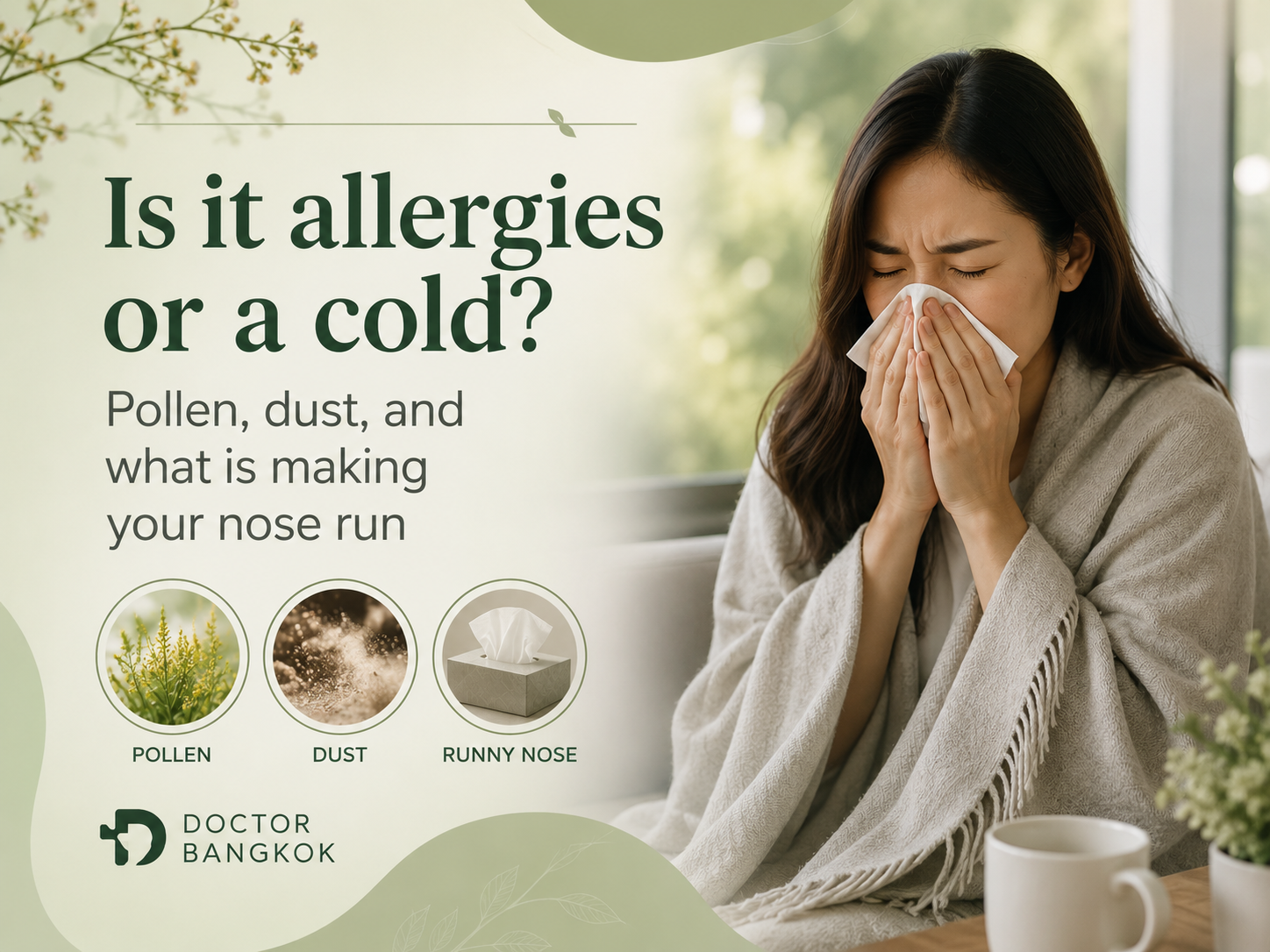
This is the question I get asked most often. Here is how I think about it.
Itching is the clearest sign that something is allergic. A cold does not make your eyes itch or your nose itch inside. If you are rubbing your eyes constantly and your nose itches before you even sneeze, that points strongly to an allergic response. Fever, on the other hand, points toward infection. Allergies never cause a fever. If your temperature is above 37.5 degrees Celsius alongside nasal symptoms, you are dealing with an infection.
Timing also matters. A cold starts, worsens over a few days, and resolves within one to two weeks. Allergy symptoms can appear quickly after allergen exposure and last for weeks or months without resolving. Allergy nasal discharge is usually clear and watery. A cold can start that way but often turns yellow or green as the infection progresses.
| Feature | Allergies | Cold |
|---|---|---|
| Itchy eyes or nose | Common | Rare |
| Fever | Never | Often |
| Duration | Weeks to months | 7-14 days |
| Mucus colour | Clear, watery | Yellow or green over time |
| Onset | Immediate after exposure | Gradual over 1-2 days |
| Body aches | No | Common |
In Bangkok, poor air quality can irritate the airway in ways that look a lot like both. If you are not sure what you are dealing with after two weeks of symptoms, stop guessing and get assessed.
When to see a doctor about allergy symptoms in Bangkok
Most mild allergy symptoms can be managed with over-the-counter antihistamines to start. But there are clear points where you need to come in.
If your symptoms have lasted more than two to three weeks and are not improving, that is a signal to get tested. If symptoms are affecting your sleep, your work, or your ability to exercise, you need a proper treatment plan rather than another round of pharmacy guesses. If you are using a decongestant spray more than a few days a week, that is a problem in itself, as it can make congestion worse over time.
The bigger concern is the link between untreated allergic rhinitis and asthma. Persistent nasal allergy that goes unmanaged can eventually affect the lower airways. If you already have asthma and your control has deteriorated since arriving in Bangkok, an unidentified allergen may be driving it.
At Doctor Bangkok, we run either a skin prick test or a specific IgE blood test using a panel that includes Bangkok-relevant tropical allergens. Results guide a treatment plan tailored to what is actually triggering your symptoms here. You can find out more about our allergy testing and treatment and book online.
Struggling with a runny nose, sneezing, or itchy eyes that will not settle? Doctor Bangkok offers allergy testing and treatment for expats, residents, and visitors in central Bangkok. Our English-speaking physicians use allergy panels that include Bangkok-specific tropical pollen species. We are BTS accessible and offer same-week appointments. Visit doctorbangkok.co.th/allergy-treatment to book or find out more.
Frequently asked questions
Is there a pollen season in Bangkok, or can I get pollen allergy symptoms all year?
Bangkok does not have a defined pollen season the way temperate countries do. Grass pollen including nutsedge, para grass, and Bermuda grass is present year-round, with some months worse than others. If you are waiting for pollen season to end before seeking treatment, you may be waiting a long time.
Why do I have allergies in Bangkok when I never had them at home?
New-onset allergies after relocating are more common than people realise. Bangkok exposes you to a completely different set of allergens, including tropical grass pollens, dust mites in high humidity, cockroach allergen, and rainy season mould, that your immune system may never have encountered before. The immune system can develop new sensitivities at any age, and testing with a Bangkok-appropriate panel is the only way to find out what is driving your symptoms.
Can pollen allergy make my asthma worse?
Yes, and this is something I watch closely in patients. Allergic rhinitis and asthma share the same underlying immune pathway, and grass pollen in particular can trigger inflammation in the lower airways, not just the nose. If your asthma has been harder to control since moving to Bangkok, an unidentified pollen or dust mite sensitivity may be part of the reason.
How do I know if my Bangkok symptoms are a cold, allergies, or air pollution irritation?
Fever and body aches point to infection. Itchy eyes and an itchy nose point to allergy. Symptoms that came on gradually and cleared within two weeks are more likely a cold. Symptoms that have persisted for a month or more with no fever are almost certainly allergic or pollution-related. If you are genuinely not sure after two to three weeks, a brief clinical assessment clears things up quickly.
What does pollen allergy testing involve at a private clinic in Bangkok?
We typically start with either a skin prick test, which takes about 20 minutes in clinic, or a specific IgE blood test. The blood test is a good option if you are taking antihistamines you cannot stop. Critically, the panel we use includes tropical allergens like nutsedge and para grass, which standard Western panels often miss. Results guide a personalised treatment plan for your specific triggers in Bangkok.
Do I need to stop antihistamines before an allergy test?
For a skin prick test, yes. Antihistamines suppress the skin reaction and can give a false negative result, so we generally ask patients to stop oral antihistamines at least five to seven days before. A specific IgE blood test does not require stopping antihistamines. When you book at Doctor Bangkok, we will confirm exactly what preparation is needed based on which test is right for you.
Dr. Ponlawat Pitsuwan
Physician, Doctor Bangkok
a private medical clinic in central Bangkok. He sees expats, residents, and medical tourists for allergy assessment, respiratory symptoms, general health consultations, and travel medicine. His focus is straightforward, evidence-based care delivered in plain language.

Dr. Ponlawat Pitsuwan is a physician at Doctor Bangkok, a private clinic in central Bangkok. He sees expats, residents, and medical tourists for general medicine, wellness consultations, and IV therapy. His focus is straightforward, evidence-based care delivered in plain language.