Clinically reviewed by Dr. Ponlawat Pitsuwan, Physician, Doctor Bangkok. Last reviewed: September 2026
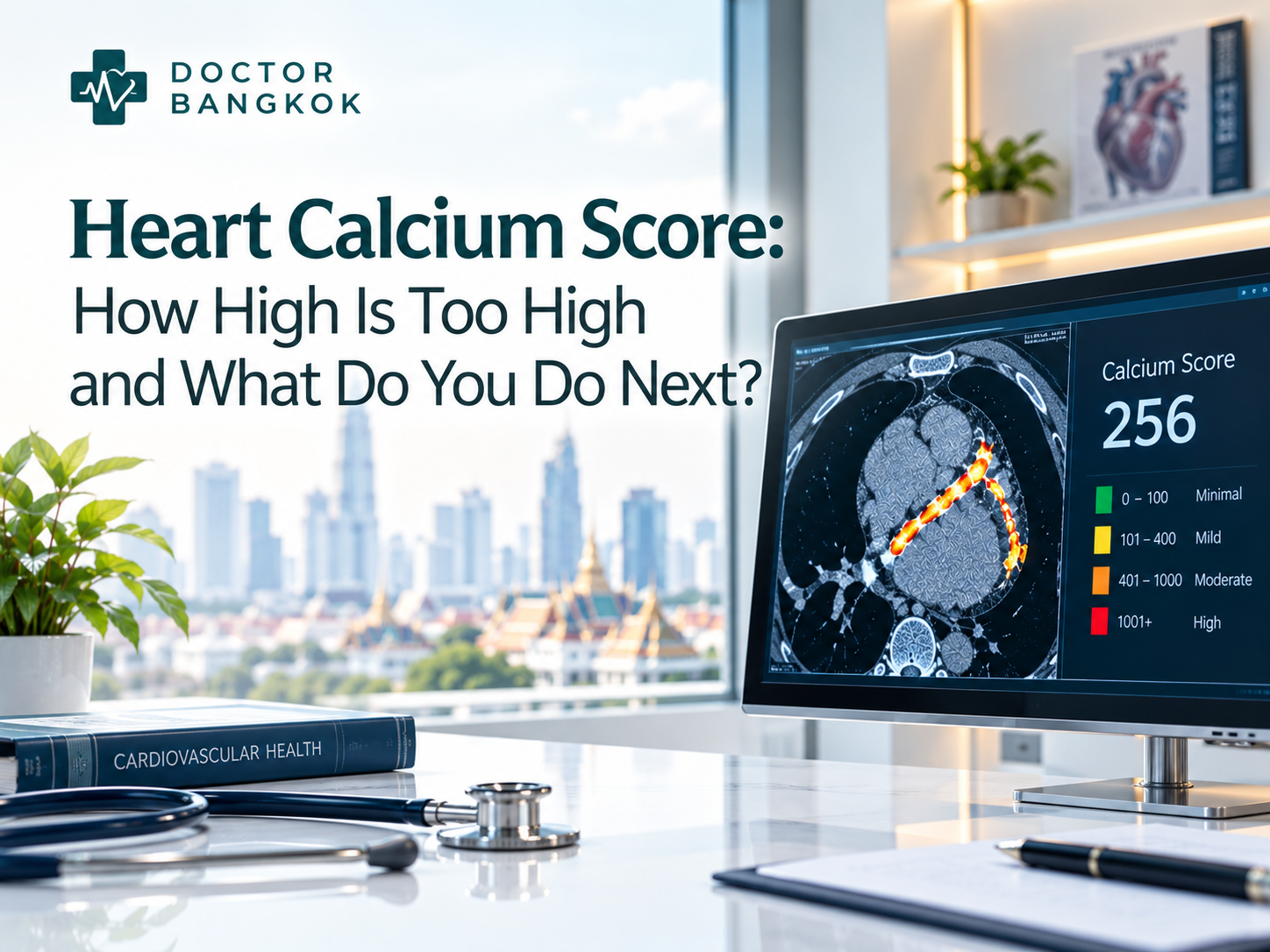
A heart calcium score measures calcified plaque in your coronary arteries using a low-dose CT scan. A score of 0 means very low near-term risk. A score above 100 typically triggers active treatment, including statin therapy. The result does not diagnose a heart attack, but it tells your doctor how much silent arterial damage is already there, before symptoms appear.
A lot of expats come in having received a letter from their GP abroad suggesting they "consider statins." They feel fine. They are not sure they need medication. And they do not know where to start in a system they do not fully know. A coronary artery calcium scan, the CAC scan, is often exactly the test that resolves that uncertainty.
This is a non-invasive CT scan that looks for calcified plaque inside your coronary arteries. It gives a number called the Agatston score. That number, combined with your age, sex, and other risk factors, tells us how much arterial disease is already present and whether you need treatment now or can safely wait. If you are in that grey zone where your doctor back home was not sure what to recommend, this is the test that usually makes the decision clear.

What the Numbers Actually Mean
The score runs from 0 upward with no ceiling. A score of 0 means no detectable calcified plaque. That is good news. It means your near-term risk of a heart attack is very low, even if you have other risk factors like elevated cholesterol or a family history.
A score between 1 and 99 indicates mild plaque. Scores between 100 and 399 indicate moderate burden. Above 400 puts you in the high-risk category. These are not arbitrary cut-offs. Each band correlates with measurably different rates of future cardiac events.
Here is what most clinic websites do not tell you: the raw number is only half the picture. A score of 75 in a 45-year-old man may actually be very high for his age. The same score in a 68-year-old might be below average for his peer group. Your result is also interpreted as a percentile against others of the same age and sex. That percentile often matters more than the absolute number.
| Agatston Score | Plaque Level | General Clinical Implication |
|---|---|---|
| 0 | None detected | Very low near-term cardiovascular risk |
| 1 to 99 | Mild | Mildly elevated risk; lifestyle measures key |
| 100 to 399 | Moderate | Statin therapy typically recommended |
| 400 or above | High to very high | Active management; cardiology referral warranted |
Heart Calcium Score vs. Cholesterol Test: What Is the Difference?
This is something I explain almost every week. A cholesterol test, or lipid profile, measures what is circulating in your blood right now. A calcium score tells us about actual arterial damage. There is a meaningful difference between the two.
You can have high cholesterol for years and still have a calcium score of 0. That means your arteries have held up so far, and your near-term cardiac risk is lower than your cholesterol alone suggests. Conversely, someone with borderline cholesterol and a score of 250 has confirmed arterial damage that demands action, regardless of what the lipid panel shows.
The two tests answer different questions. Cholesterol asks: what is your risk potential? The calcium score asks: has that risk already translated into arterial disease? For patients in the grey zone, the calcium score is usually the deciding factor.

Who Should Get a Heart Calcium Score Test?
The test is most useful for people at intermediate cardiovascular risk. Those are patients who are not clearly low risk and not clearly high risk. This typically means adults over 40 with one or more risk factors: high cholesterol, high blood pressure, a smoking history, a family history of heart disease, or diabetes.
I recommend it most often for expats who have been managing risk factors for years but have never had a clear conversation about whether they actually need statins. If your 10-year cardiovascular risk score puts you in the middle ground, this scan often gives us the answer your cholesterol test cannot.
It is generally not useful for people already known to have coronary artery disease. If you already have a diagnosis, the scan does not add much. It is a prevention tool, most valuable before disease is confirmed.
What Happens During the Scan?
It is quick. You lie in a CT scanner for around 15 to 20 minutes total. No injections, no contrast dye, no special preparation needed. The scan itself takes only a few minutes once you are positioned.
Results come back as a report with your Agatston score and usually some imaging of where the calcification sits. You need a doctor to review that report in the context of your full history. A number alone, without clinical context, does not tell you what to do next.
What Your Score Means for Statin Decisions
This is the part most clinic websites skip entirely, and it is arguably the most useful thing to understand.
A score of 0 in an intermediate-risk patient is strong grounds to defer statins, even if the lipid panel looks borderline. Current cholesterol guidelines specifically support this approach. A score of 100 or above typically confirms that statin therapy is warranted, even if cholesterol numbers alone were not compelling. The calcium score turns an uncertain conversation into a clear one. You come in with a number, and we make a plan around it.
If You Are Already on Statins, Read This First
Long-term statin use can actually raise your calcium score numerically. This surprises a lot of patients who expect the number to fall if they have been taking medication faithfully.
Statins stabilise soft plaque, which then calcifies over time. So the Agatston score rises, but the plaque is actually less dangerous than it was in its earlier, unstable form. A rising score on statins does not mean treatment is failing. It often means the opposite.
If you are already on statins and considering a calcium scan in Bangkok, mention this before the scan. The result needs to be read with your medication history in mind. Without that context, a rising score can look alarming when it may not be.
Getting a Heart Calcium Score in Bangkok as an Expat or Visitor
In Thailand’s private sector, you generally do not need a GP referral to book a CT scan. Most hospitals will accept self-referrals. That said, arriving at a hospital without context, without someone who speaks your language and knows your history, often means the result lands in your hands as a number with no explanation.
The better approach for expats is a GP consultation first. At Doctor Bangkok, we see patients who want to think through whether the CAC scan is the right next step before committing to it. We look at your full picture: lipid profile, blood pressure history, family history, and age. If the scan makes sense, we help coordinate the imaging and then review the results with you in English.
The clinic is BTS accessible and centrally located, easy to reach from Silom, Sathorn, or Sukhumvit. CAC scan pricing at major Bangkok hospitals typically runs between 5,000 and 10,000 THB, not including the consultation. The consultation, the part where someone explains what the number means and what you do with it, is where the real value sits.
Why CAC Scoring Is Especially Relevant in Thailand
Southeast Asian patients are sometimes undertreated for cardiovascular disease because standard Western risk calculators were built on Western population data. A CAC scan cuts through that uncertainty. It shows what is actually in your arteries, regardless of which risk table you use.
Research published in Thai patient populations supports the use of CAC scoring for cardiovascular risk prediction and suggests it improves accuracy beyond traditional risk scores alone. If you are living here long-term or are a Thai national being treated in the private system, this matters practically, not just theoretically.
How Often Should You Repeat the Scan?
A score of 0 does not mean you are done. For intermediate-risk patients, a repeat scan every five to seven years is generally reasonable. If your score is above 100 and you have started treatment, your cardiologist will guide the interval based on how your risk factors respond.
The radiation dose is low, roughly comparable to a mammogram. It is not something most people need every year. But used at the right intervals, it is one of the most informative tools available for primary cardiovascular prevention.
If you are an expat or visitor in Bangkok with elevated cholesterol, a family history of heart disease, or a recommendation from your doctor abroad to look into cardiac screening, Doctor Bangkok can help you decide whether a heart calcium score test is the right next step. We offer cardiovascular risk consultations in English, help coordinate imaging referrals, and review your results so you leave with a clear plan, not just a number. Book a consultation at doctorbangkok.co.th.
Frequently Asked Questions
Dr. Ponlawat Pitsuwan
Physician, Doctor Bangkok
a private medical clinic in central Bangkok. He sees expats, residents, and medical tourists for cardiovascular risk assessment, health screenings, and general medical consultations. His focus is straightforward, evidence-based care delivered in plain language.

Dr. Ponlawat Pitsuwan is a physician at Doctor Bangkok, a private clinic in central Bangkok. He sees expats, residents, and medical tourists for general medicine, wellness consultations, and IV therapy. His focus is straightforward, evidence-based care delivered in plain language.