

Clinically reviewed by Dr. Ponlawat Pitsuwan, Physician, Doctor Bangkok. Last reviewed: September 2026
Vitreous degeneration is the gradual breakdown of the gel inside your eye. It is the most common reason people see floaters. Most cases are harmless and need monitoring only. But a sudden shower of new floaters, flashing lights, or a shadow across your vision needs same-day assessment. It can signal a retinal tear.
Most floaters are harmless. That is the honest answer. But the ones that appear suddenly, in large numbers, are a different story. Knowing which category you are in is what this article is for.

What Is Vitreous Degeneration?
Your eye is filled with a clear gel called the vitreous. When you are young, it is smooth and uniform. As you age, or sometimes earlier if you are highly short-sighted, this gel starts to break down. The fibers inside it clump together and the gel partly liquefies.
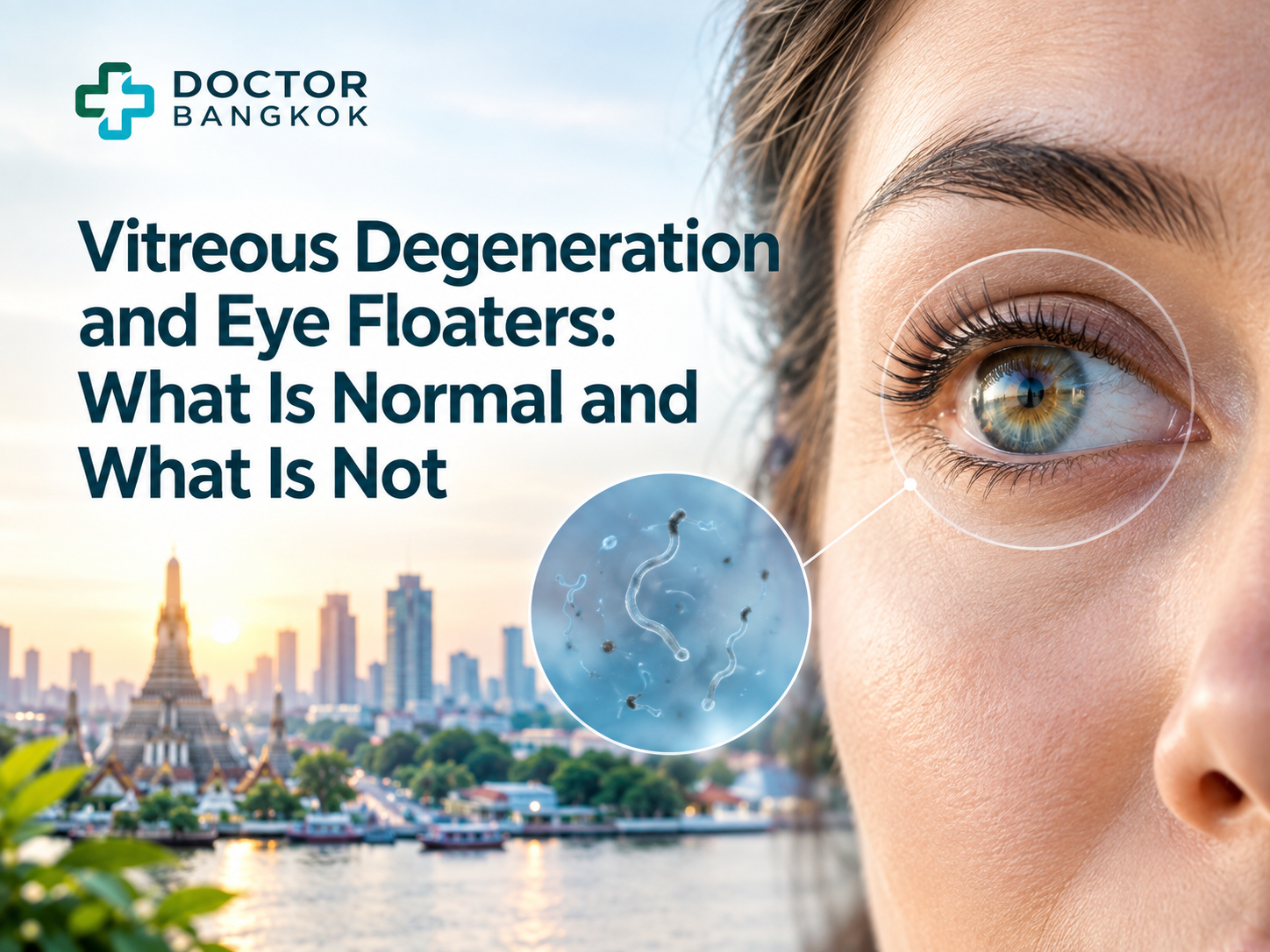
Those clumped fibers cast tiny shadows on your retina, the light-sensitive layer at the back of your eye. That is what you see as floaters: specks, threads, rings, or cobwebs drifting across your vision. They move when your eyes move and drift when you stop.
Eventually the gel can pull away from the retina entirely. This is called a posterior vitreous detachment, or PVD. PVD is the end stage of vitreous degeneration and happens to most people at some point. It is usually harmless, but it carries a real risk of tearing the retina on the way out.
Symptoms of Vitreous Degeneration
The most common symptom is floaters. These can look like dots, strands, squiggly lines, or a large ring drifting across your field of view. That ring shape, called a Weiss ring, is a sign the vitreous gel has fully detached from the optic nerve head. It is one of the clearer signs of PVD.
You might also notice flashes of light at the edge of your vision. These happen when the vitreous pulls on the retina. Most settle within a few weeks once the gel has fully separated.
Floaters that have been there for months and look the same every day are almost always benign. The ones that appear suddenly, in large numbers, are the ones that need attention today.

Red Flag Symptoms: When Vitreous Degeneration Needs Same-Day Assessment
Some symptoms need same-day care. Do not wait for a routine appointment if any of these apply.
A sudden large increase in floaters, appearing all at once like a shower or a cloud of pepper, is a red flag. Flashing lights that persist or worsen over hours rather than settling are a red flag. A dark shadow, curtain, or veil blocking part of your vision, even briefly, is a red flag.
These can mean a retinal tear or retinal detachment. A tear caught early can be treated in clinic with laser. A detachment is a surgical emergency, and the gap between the two can come down to hours.
If this is happening to you right now, go to an ophthalmology unit today.
Risk Factors Worth Knowing
Age is the biggest driver. Most people over 60 have some degree of vitreous degeneration. But I see it regularly in patients in their thirties and forties, and Bangkok’s expat population is a good example of why.
High myopia, being significantly short-sighted, is a major independent risk factor. A highly myopic eye is physically longer than average. That extra length stretches and thins the vitreous structure, making degeneration happen earlier and sometimes more severely. If you are already a high myope and spending long hours on screens, your risk profile is worth discussing with a doctor.
Other risk factors include previous eye surgery, head or eye injury, diabetes, and uveitis, which is inflammation inside the eye. If any of these apply to you, your risk of earlier complications is higher than average.
How Vitreous Degeneration Is Diagnosed
The core test is a dilated eye exam. Eye drops widen the pupil so the doctor has a full view of the retina and vitreous. The drops take around 20 to 30 minutes to work. Your vision will stay blurred and light-sensitive for several hours afterward.
Do not plan to drive. Take a BTS or taxi. Bring sunglasses. Do not schedule this during a lunch break expecting to go back to the office.
For cases where floaters block the view of the retina, further imaging may be needed. An ocular ultrasound can image the vitreous and retina even when direct view is difficult. These are specialist tools and they make a real difference in complex cases.
At Doctor Bangkok, we can assess your symptoms, identify red flags, and arrange an urgent or routine referral to an ophthalmologist depending on what we find. That first triage step matters, especially when you are not sure how serious this is.
Treatment Options for Vitreous Degeneration
For most people, vitreous degeneration requires no treatment. Floaters tend to settle, and the brain partially filters them out over months. A follow-up dilated exam at four to six weeks after a new PVD is the standard approach for uncomplicated cases.
When floaters are severe enough to affect reading or daily work, there is a middle-ground option worth knowing about: YAG laser vitreolysis. This is an outpatient laser procedure that breaks up significant floater strands into smaller, less visible fragments. Not every patient is a candidate, and not every floater type responds well, but it is worth asking your ophthalmologist about.
Vitrectomy, surgical removal of the vitreous gel, is reserved for the most severe cases or where complications like vitreous bleeding have occurred. It carries real surgical risks and is not a first-line option for typical floaters.
If a retinal tear is found, laser or freezing treatment can seal it before it becomes a detachment. Early detection is what makes that possible.
Getting an Eye Check in Bangkok
If something feels wrong with your eye and you are not sure where to go, a general clinic is a sensible first stop. Doctor Bangkok can assess your history, identify warning signs, and direct you to the right place. Same-day specialist referral if needed, planned referral if not. You do not need to find an ophthalmologist on your own if you are not sure where to start.
Major private hospitals in Bangkok offer dilated fundus exams without long waits. If you have expat health insurance, most plans cover diagnostic eye exams with a referral. Bring your insurance details and a clear description of when your symptoms started and whether they have changed.
One practical note: after a dilated eye exam, you will not be able to read a phone screen comfortably or drive safely for several hours. Plan accordingly.
Noticed new floaters, flashing lights, or a shadow across your vision? The English-speaking physicians at Doctor Bangkok can assess your symptoms, triage urgency, and arrange specialist referral when needed. We are centrally located in Bangkok, BTS accessible, and see patients without long waits. Book a consultation today or walk in.
Frequently Asked Questions
Dr. Ponlawat Pitsuwan
Physician, Doctor Bangkok
a private medical clinic in central Bangkok. He sees expats, residents, and medical tourists for general consultations, health assessments, and clinical triage including eye symptom evaluation and specialist referral coordination. His focus is straightforward, evidence-based care delivered in plain language.

Dr. Ponlawat Pitsuwan is a physician at Doctor Bangkok, a private clinic in central Bangkok. He sees expats, residents, and medical tourists for general medicine, wellness consultations, and IV therapy. His focus is straightforward, evidence-based care delivered in plain language.