
Clinically reviewed by Dr. Ponlawat Pitsuwan, Physician, Doctor Bangkok. Last reviewed: July 2026
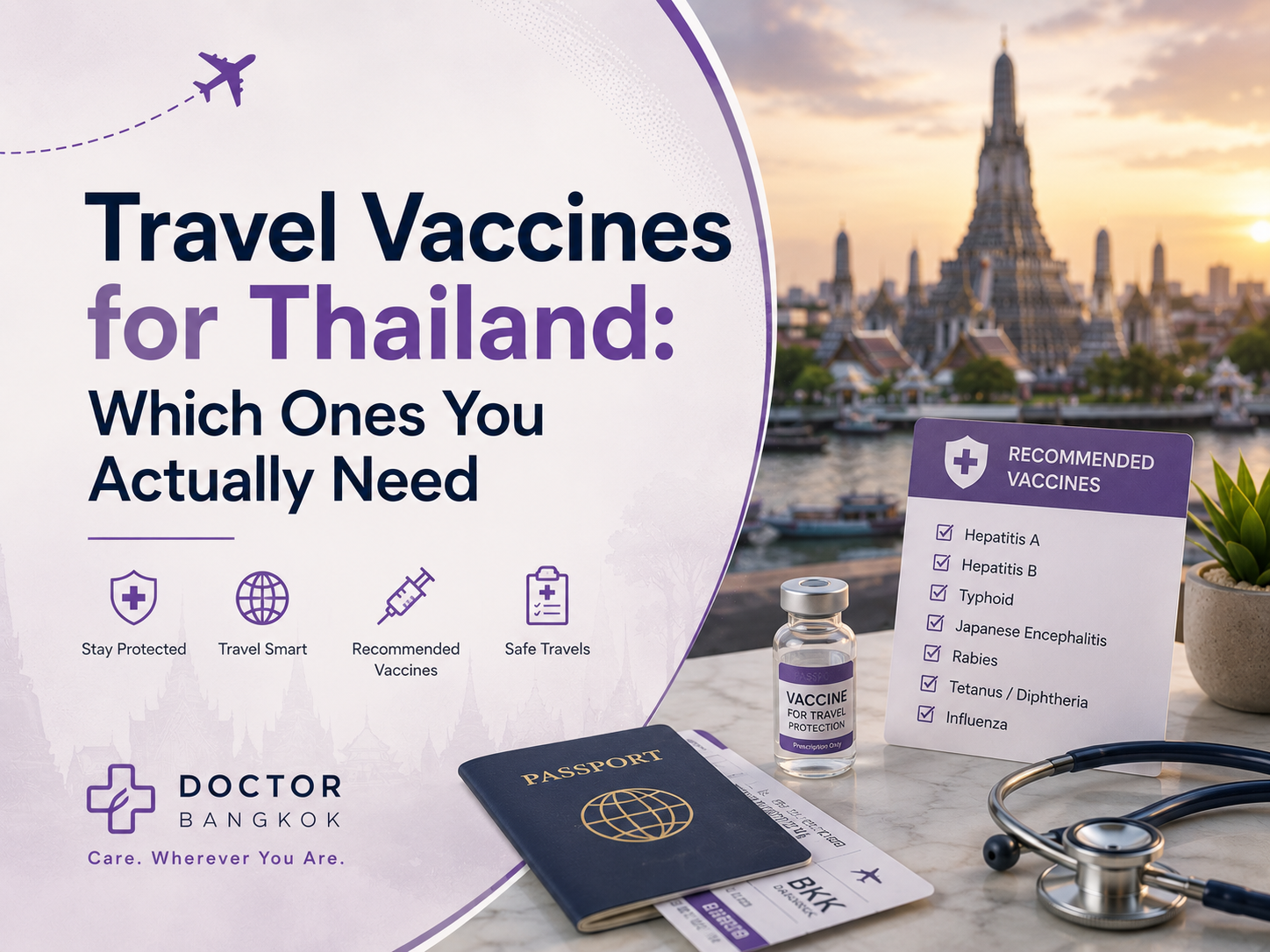
Most travellers visiting Bangkok, Phuket, or Chiang Mai need three vaccines: hepatitis A, typhoid, and a hepatitis B booster if you are not already protected. There are no mandatory vaccines to enter Thailand unless you are arriving from a country with yellow fever. Malaria tablets are not needed for Bangkok or any major resort area. Your exact needs depend on where you are going and what you plan to do there.
If you are trying to figure out which jabs to get before flying to Thailand, you have probably landed on three different websites and come away more confused than before. Every list looks the same. Nothing tells you whether the advice applies to a week in Bangkok or three months trekking near the Myanmar border. Those are very different trips, and the vaccines that matter are not the same for each.
Here is the honest version. I work in central Bangkok and see this every week: people who over-prepared with vaccines they did not need, and people who skipped ones that actually mattered. This guide is built around where you are going and what you are doing, not a generic country-level checklist.

Required vs. Recommended — Know the Difference
Most lists treat every vaccine the same. They are not.
One vaccine is required for entry under certain conditions: yellow fever. If you are arriving from a country where yellow fever is actively circulating, or you transited through one for more than twelve hours, Thailand will ask for your International Certificate of Vaccination or Prophylaxis, sometimes called a Yellow Card. If that does not apply to you, no vaccine is legally required to enter Thailand.
Everything else is recommended. Your doctor is saying the risk is real enough that protection makes sense, but you will not be turned away at the border without it. How strongly any vaccine is recommended depends on your destination and what you are doing there.
The Vaccines Most Travellers to Thailand Actually Need
For most people visiting Thailand, three vaccines cover the bulk of the risk.
Hepatitis A is the one I push hardest. It spreads through contaminated food and water, and you will be eating street food in Thailand. One dose gives you solid protection for up to a year. If you have never had it, get it before you go.
Typhoid is similar. Same transmission route, and it is genuinely present in Thailand. The oral or injected typhoid vaccine reduces your risk meaningfully. Both hepatitis A and typhoid are available at the Doctor Bangkok travel health clinic.
Hepatitis B should already be in your routine vaccination history. If you are not sure whether you completed the full course, check. Hepatitis B is common in Thailand and spreads through blood, needles, and sexual contact. If your immunity has lapsed, a quick blood test can confirm, and we can top you up if needed.
Routine vaccinations, including MMR (measles, mumps, rubella) and Tdap (tetanus, diphtheria, whooping cough), should be current before any international travel. Travel is a good prompt to check they are up to date.

Bangkok vs. The Rest of Thailand — Your Itinerary Changes Everything
This is the part most travel health pages miss entirely.
Bangkok, Chiang Mai city, Phuket, Koh Samui, and all major beach resorts carry no meaningful malaria risk. None. If your trip is hotels, restaurants, temples, and beaches, you do not need malaria tablets.
Malaria becomes relevant if you are heading into forested border provinces: Tak, Kanchanaburi, Mae Hong Son, or areas near the Cambodian border. If your itinerary includes these areas, come and see us before you go. The right antimalarial depends on the specific area and your health history.
Japanese encephalitis is another itinerary-specific vaccine. It is spread by mosquitoes in rural areas near paddy fields and pig farming regions. If you are staying in cities and resorts, the risk is very low. If you are spending time in rural Thailand, especially during or after the rainy season, it is worth discussing. The same applies to anyone planning a stay of a month or more.
| Destination | Malaria Risk | Japanese Encephalitis | Rabies Consideration |
|---|---|---|---|
| Bangkok | None | Low | Moderate (stray animals) |
| Chiang Mai city | None | Low | Moderate |
| Phuket / Koh Samui | None | Very low | Low |
| Rural / forested borders | Real risk | Higher in rainy season | Present |
| Mae Hong Son / Tak / Kanchanaburi | Real risk | Present | Present |
Rabies — Closer Than Most Travellers Realise
Rabies is the one that surprises people. Most travellers picture it as a remote jungle risk. It is not, not here.
Bangkok has a large stray dog population. In September 2025, NaTHNaC issued a specific rabies alert covering parts of Bangkok. None of my patients had heard about it. If you spend any time around markets, temples, or street-level areas, contact with stray dogs or cats is a real possibility.
Pre-exposure rabies vaccination does not make you immune, but it simplifies everything if you are bitten. Without prior vaccination, a bite means hunting down rabies immunoglobulin urgently, and supply can be limited at short notice. With pre-exposure vaccination, you still need follow-up injections after a bite, but the process is simpler and the time pressure is less extreme.
If you are scratched or bitten by any animal in Thailand, wash the wound with soap and running water for at least fifteen minutes, then go straight to a clinic. Do not wait. Rabies is fatal once symptoms appear, but entirely preventable if you act quickly.
Mosquito-Borne Diseases Without a Reliable Vaccine
Dengue fever is the mosquito-borne illness I see most often in my clinic. It is genuinely common in Bangkok, especially after rain. There is currently no vaccine that provides reliable protection for most first-time travellers. The Qdenga dengue vaccine is available in some countries, but it is currently recommended mainly for people who have already had dengue.
Chikungunya is in a similar position: present in Thailand, no widely available vaccine for travellers.
For both, the prevention is the same. Use repellent with DEET or picaridin, wear long sleeves in the evenings, and sleep with air conditioning or under a net. These are not just suggestions. They genuinely reduce your risk.
When to Book, and What to Do If You’re Already Here
The standard advice is four to six weeks before travel. That is ideal. Some vaccines need more than one dose, and spacing matters for full protection.
But if you are already in Thailand, it is not too late. A single hepatitis A dose gives useful short-term protection within two weeks. Typhoid works quickly too. Hepatitis B can be given on an accelerated schedule. Rabies pre-exposure vaccination can be started any time before exposure.
If you are in Bangkok and planning to travel upcountry, or you have been here a while and skipped the pre-travel step, come in. Doctor Bangkok is on Sukhumvit, BTS accessible, with English-speaking doctors and walk-in availability. We will look at your itinerary, check what you have had before, and vaccinate the same day where possible.
Sexual Health and STI Testing After Travel
Hepatitis B is on every travel vaccine list because it spreads through sexual contact as well as blood. That connection is real, and worth saying plainly. Travel changes behaviour for a lot of people, and that is a clinical reality, not a judgement.
Many STIs have no symptoms in the early weeks. Chlamydia, gonorrhoea, and early HIV can all be present without you knowing. If you had unprotected sex in Thailand and you are concerned, the timing of your test matters. Come and talk to us.
If you think you were exposed to HIV within the last 72 hours, PEP (post-exposure prophylaxis) needs to start as soon as possible. This is time-critical. Do not wait.
For ongoing protection, PrEP (pre-exposure prophylaxis) is available and highly effective for people at regular HIV risk. Doctor Bangkok offers confidential, same-day STI testing panels with English-speaking doctors, walk-in or by appointment, and hotel visit options. Screening before you fly home is a straightforward way to protect yourself and your partners. Our travel health service covers this alongside vaccination, so you can sort both in one visit.
Planning a trip to Thailand, already here, or just back? Doctor Bangkok offers same-day travel vaccinations, pre-travel consultations, and confidential STI testing in central Bangkok. English-speaking doctors. BTS accessible on Sukhumvit. Walk-in and booked appointments available. Visit doctorbangkok.co.th or call the clinic to book today.
FAQ
Do I need any vaccines to enter Thailand?
No mandatory vaccines are required for most travellers entering Thailand. The only exception is a yellow fever certificate if you are arriving from, or transiting through, a country with active yellow fever transmission. Outside of that scenario, there is nothing at the border that requires proof of vaccination.
Do I need malaria tablets for Bangkok or Phuket?
No. Bangkok, Phuket, Chiang Mai city, Koh Samui, and all the major beach resorts have no meaningful malaria risk. Antimalarial medication is only relevant if you are travelling into forested border provinces near Myanmar or Cambodia. If you are unsure about your itinerary, a quick consultation at Doctor Bangkok can confirm what you need.
I’m already in Bangkok and haven’t had any travel vaccines. Is it too late?
It is not too late. Many vaccines, including hepatitis A, typhoid, and the first rabies dose, can be given right away with useful protection building within days to weeks. Hepatitis B can be started on an accelerated schedule. Doctor Bangkok offers walk-in consultations on Sukhumvit and can vaccinate the same day, so come in before any upcountry or adventure travel.
A dog scratched or bit me in Thailand. What should I do?
Wash the wound with soap and running water for at least fifteen minutes, then go to a clinic immediately. Do not wait. Post-exposure treatment for rabies needs to start as quickly as possible, and Bangkok had a specific rabies alert issued in September 2025. Doctor Bangkok can assess the exposure and coordinate post-exposure management.
Should I get an STI test as part of my travel health check?
Yes, if you were sexually active during your trip, testing is a sensible part of travel health. Many STIs are asymptomatic, including chlamydia, gonorrhoea, and early HIV. Doctor Bangkok offers confidential, same-day STI testing panels with English-speaking doctors and walk-in availability, making it easy to screen discreetly before flying home.
What is the difference between pre-exposure and post-exposure rabies vaccination?
Pre-exposure vaccination is done before any potential contact and uses a short course of doses given over a few weeks. If you are then bitten, your follow-up treatment is simpler and you do not need the hard-to-find rabies immunoglobulin. Post-exposure treatment starts after a bite and must begin as soon as possible, ideally the same day.
What vaccines do I need for a trek near the Thai-Myanmar border?
For forested border areas, malaria prophylaxis and Japanese encephalitis vaccination both become relevant, on top of the standard hepatitis A, typhoid, and hepatitis B. Rabies pre-exposure vaccination is also worth considering for remote trekking where medical care is far away. Book a consultation before you go and bring your full itinerary.
Dr. Ponlawat Pitsuwan
Physician, Doctor Bangkok
a private medical clinic in central Bangkok. He sees expats, residents, and medical tourists for travel health consultations, vaccinations, STI testing, and general medical care. His focus is straightforward, evidence-based care delivered in plain language.
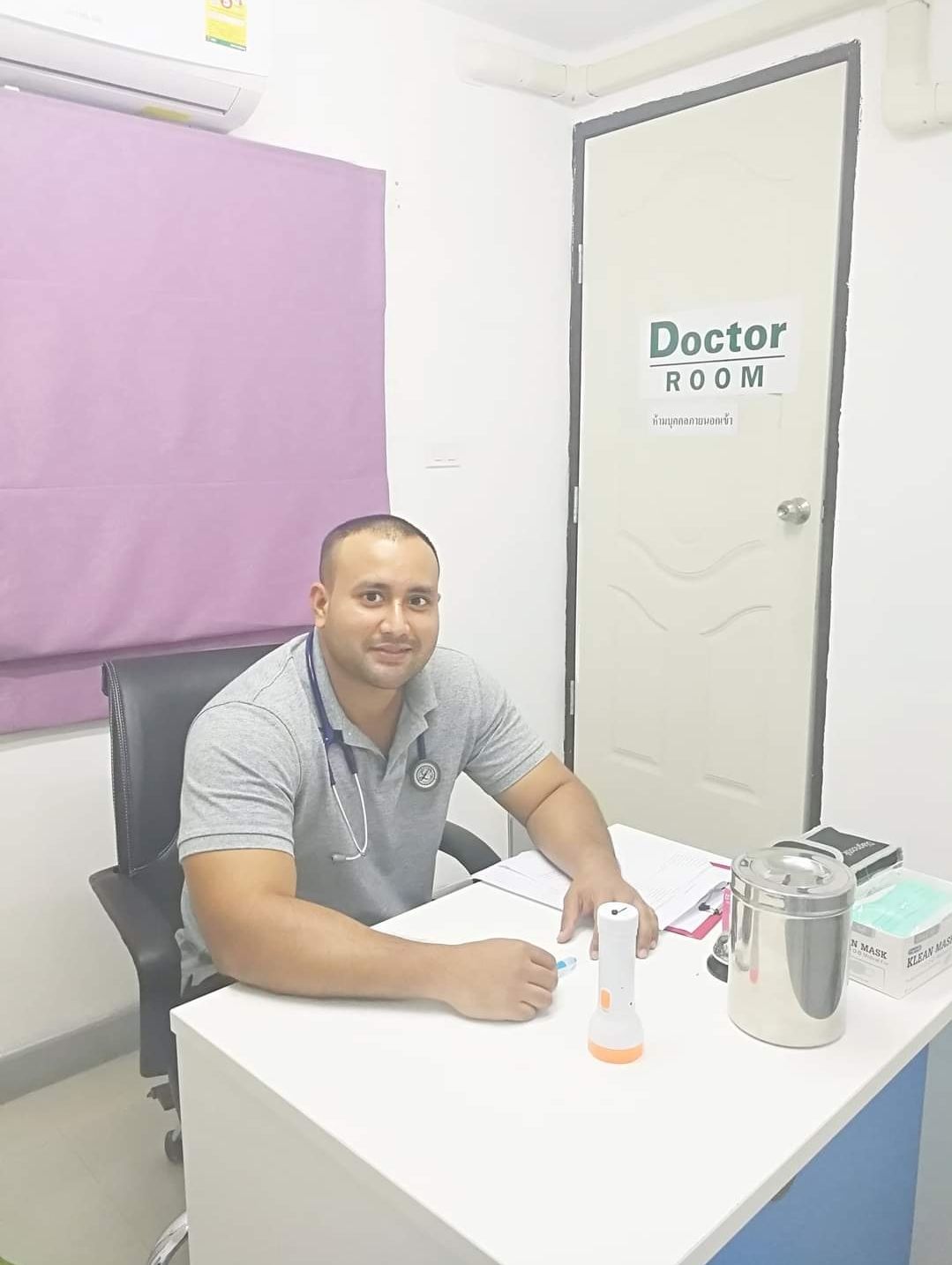
Dr. Ponlawat Pitsuwan is a physician at Doctor Bangkok, a private clinic in central Bangkok. He sees expats, residents, and medical tourists for general medicine, wellness consultations, and IV therapy. His focus is straightforward, evidence-based care delivered in plain language.