

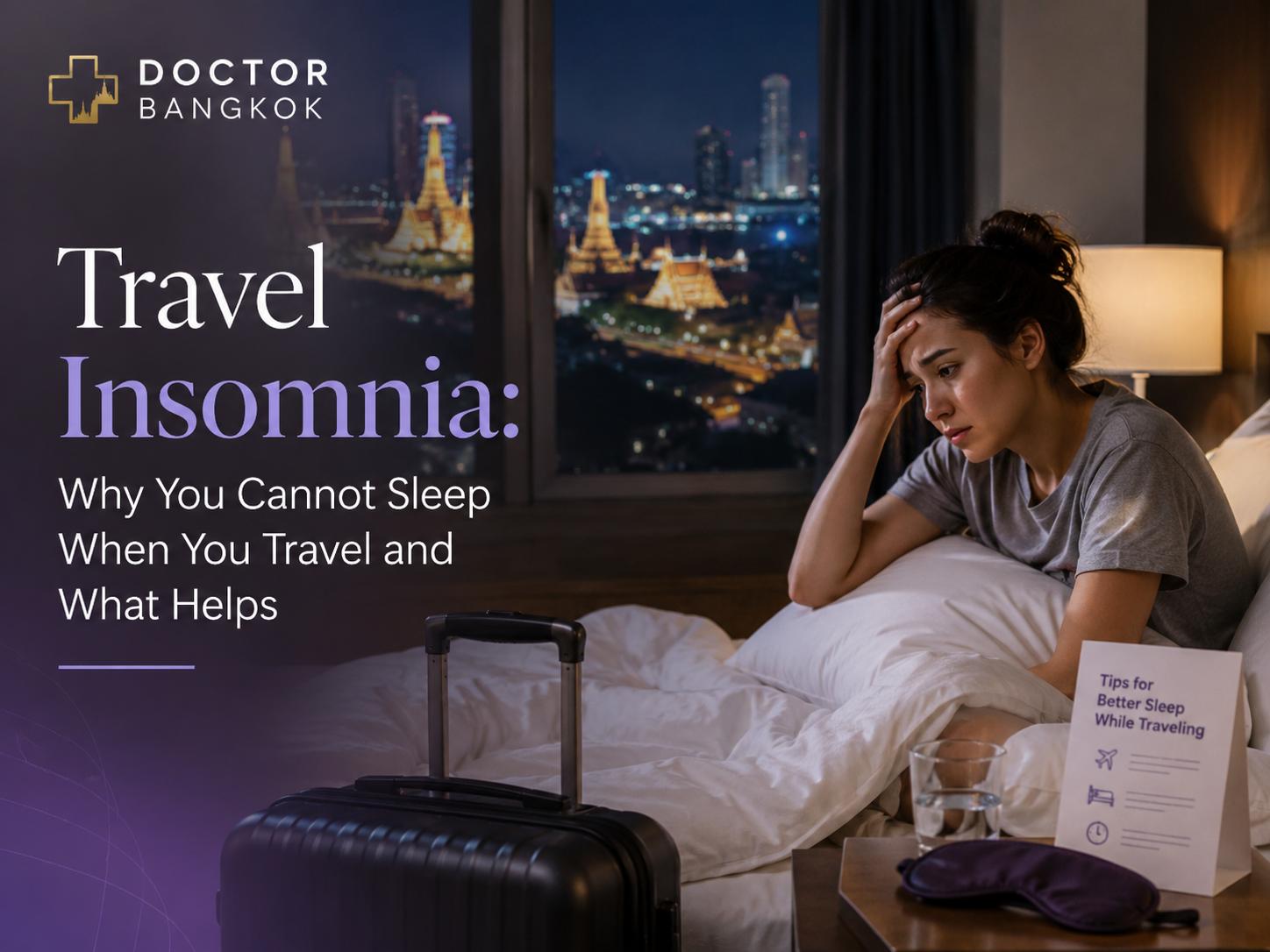
Clinically reviewed by Dr. Ponlawat Pitsuwan, Physician, Doctor Bangkok. Last reviewed: July 2026
Travel insomnia is difficulty sleeping caused by travel itself, whether from crossing time zones, sleeping in an unfamiliar place, or both. It can affect anyone, even on short regional flights with no time-zone change. Most cases resolve within a few nights. If poor sleep continues beyond ten to fourteen days, see a doctor.
You landed in Bangkok, you are exhausted, and you cannot sleep. The bed is comfortable. The room is dark. But your body refuses to switch off. If that sounds familiar, you are not alone. This is one of the most common things I hear from new arrivals, whether they flew in from London, Sydney, or Singapore.
Most travel insomnia is short-lived and responds well to a few practical steps. The part that catches people out is not knowing when it is more than just jet lag, or what you can actually buy in Thailand to help. This article covers both.

Travel Insomnia vs Jet Lag — They Are Not the Same Thing
Most people use these terms interchangeably, but they are not the same.
Jet lag is what happens when you cross multiple time zones quickly. Your internal body clock is now out of sync with local time. You feel sleepy at noon and wired at 3am. That is caused specifically by time-zone crossing.
Travel insomnia is broader. You can have it without crossing a single time zone. A traveller flying from Singapore or Hong Kong to Bangkok changes time by only one hour or not at all, but may still lie awake for hours. That is not jet lag. That is travel insomnia driven by something else entirely.
Why You Cannot Sleep in a New Place — The First-Night Effect
There is a real biological reason you sleep badly your first night somewhere new. Part of your brain stays on guard in an unfamiliar environment, even while the rest of you tries to sleep. It reduces deep restorative sleep and makes you wake more easily from small sounds or light changes.
This happens regardless of how tired you are. It is not anxiety. It is your brain doing its job in a new space.
The good news is that it usually fades by night two or three. Most short-haul visitors from within Asia who cannot sleep their first night in Bangkok are dealing with this, not jet lag.

Causes of Travel Insomnia
Several things combine to disrupt sleep during travel. Long-haul flights from Europe, the US, or Australia bring the biggest disruption. Eastward travel tends to hit harder than westward, because shortening your day is more difficult for the body than extending it.
Even without a long flight, travel disrupts sleep. Pre-trip stress, airport anxiety, unfamiliar sounds, and the physical toll of pressurised cabin air all prime you for a poor first night. Add a middle seat and a crying infant and most people land already sleep-deprived.
Your body also produces cortisol, the hormone that wakes you up in the morning, at the wrong time when your body clock is off. You feel alert when you should be winding down, and foggy when you should be sharp.
Bangkok-Specific Sleep Challenges You Probably Did Not Expect
Bangkok adds its own layer on top of all of this. I see it regularly.
The heat and humidity here affect how your body regulates temperature at night. Your core temperature needs to drop slightly for sleep to happen, and Bangkok’s ambient heat makes that harder. This is especially true in rooms where the air-conditioning is too warm or blasted so cold you wake up shivering at 4am.
If you are staying near the Sukhumvit or Nana corridor, light pollution and street noise are real. Tuk-tuks, nightlife, and early morning food vendors can interrupt sleep even when you are fully adjusted. A good eye mask and ear plugs are not optional in central Bangkok. Aim for around 20 to 22 degrees Celsius in your room if you can control it.
Symptoms of Travel Insomnia
The most common things patients describe are taking a long time to fall asleep, waking repeatedly during the night, waking too early and being unable to get back to sleep, and feeling unrefreshed in the morning despite hours in bed.
Daytime sleepiness, poor concentration, and low mood usually follow. Some people also notice irritability they do not normally have. Those are all normal short-term consequences of disrupted sleep.
Getting Melatonin and Prescription Sleep Aids in Bangkok
Here is something most international visitors do not know until they are standing in a pharmacy: melatonin is a prescription-only medication in Thailand.
In the US, UK, Australia, and most of Europe, you can buy melatonin off the shelf. Not here. Thai regulations classify it as a drug requiring a doctor’s prescription. If you rely on melatonin for jet lag, bring a personal supply from home. Carry it with a copy of your doctor’s note or the original packaging. If you have run out or forgot to pack it, a licensed clinic can assess you and prescribe it the same day.
The same applies to prescription sleeping tablets such as zolpidem. These are available in Thailand, but they require a consultation first. Do not buy them from an unlicensed source. In a sleep-deprived, jet-lagged state, sedatives carry real risks: next-day drowsiness, confusion, and a higher chance of falls or accidents. Combining them with alcohol amplifies all of those effects. A proper assessment before taking anything prescription protects you.
Evidence-Based Self-Help Strategies
For mild travel insomnia, a few approaches have good evidence behind them.
Get into local daylight as soon as possible on arrival. Morning light exposure is the most powerful signal your body clock responds to. A walk outside before 10am on your first day in Bangkok does more than most supplements.
Avoid alcohol as a sleep aid. It may help you fall asleep faster but it fragments the second half of your night. I see many patients who drink a few beers thinking it will knock them out and then wonder why they are wide awake at 3am.
Keep naps to 20 to 30 minutes and take them before 3pm. Longer naps delay your night-time sleep further. Keep your room dark and cool, and use blackout curtains if the hotel provides them.
When to Stop Self-Treating and See a Doctor in Bangkok
Most travel insomnia resolves within a few nights to a week. If you are still not sleeping well after ten to fourteen days, something else may be going on and that warrants a proper assessment.
See a doctor sooner if the insomnia is significantly affecting your ability to work or enjoy your trip, if you are using alcohol or pharmacy sedatives to cope, or if poor sleep is accompanied by anxiety, low mood, or symptoms you are not sure about.
If your insomnia began alongside other symptoms such as fever, persistent headache, or unusual fatigue, do not assume it is just travel-related. Come in and get assessed.
Our travel health service at Doctor Bangkok covers a full assessment of what is driving the insomnia. If a short-course prescription is appropriate, it can be issued the same day with clear instructions. For persistent insomnia that outlasts your trip, cognitive behavioural therapy for insomnia, known as CBT-I, is the most evidence-backed long-term approach and is worth discussing at your consultation.
How Doctor Bangkok Treats Travel Insomnia
We keep this straightforward. You come in, or we come to you.
If you are staying in central Bangkok, including Sukhumvit, Silom, or Sathorn, our team can visit your hotel. A physician will assess your symptoms, review your travel history and any medications you have taken, and discuss whether a prescription is appropriate. We can also provide documentation for travel insurance reimbursement if you need it.
For those who prefer to walk in, our clinic is BTS accessible and fully English-speaking. No appointment is needed. Whether you flew in from Europe and are still not sleeping after two weeks, or you arrived from Singapore three nights ago and have not slept since, there is no reason to spend your entire Bangkok trip running on empty.
Our travel medicine consultations cover more than sleep. We see patients for vaccinations, health checks, fever assessment, and general travel health. If something does not feel right beyond just the insomnia, we can look at the full picture.
Struggling to sleep in Bangkok? Doctor Bangkok offers same-day consultations for travel insomnia, including hotel visits across Sukhumvit, Silom, and Sathorn. Our English-speaking physicians can assess your symptoms, discuss prescription options where appropriate, and provide travel insurance documentation. Walk in or book online at doctorbangkok.co.th/travel-health-bangkok/.
FAQ
Can I buy melatonin over the counter in Bangkok?
No. Melatonin is prescription-only in Thailand, unlike in the US, UK, or Australia where you can pick it up off the shelf. If you rely on it for travel, bring a supply from home with the original packaging or a doctor’s note. If you have run out, Doctor Bangkok can assess you and prescribe it the same day.
How long does travel insomnia last after arriving in Bangkok?
If jet lag is the cause, a rough guide is one day of adjustment per time zone crossed. If it is the first-night effect from an unfamiliar environment, most people feel noticeably better by night two or three. Insomnia that persists beyond ten to fourteen days warrants a proper medical assessment.
What is the difference between travel insomnia and jet lag?
Jet lag is caused by crossing multiple time zones quickly and throwing your body clock out of sync with local time. Travel insomnia is broader and can happen without any time-zone change, triggered by unfamiliar environments, pre-trip stress, or disrupted sleep on the journey itself. You can have one without the other.
Is it safe to take sleeping pills for jet lag in Bangkok?
Short-course prescription sleep aids can be appropriate under proper medical supervision. The risk comes from unsupervised use, especially combining sedatives with alcohol when you are already sleep-deprived. That combination raises the chance of confusion, falls, and accidents. Get a proper consultation before taking anything prescription.
Can a doctor come to my hotel in Bangkok for travel insomnia?
Yes. Doctor Bangkok offers hotel visits across central Bangkok including Sukhumvit, Silom, and Sathorn. A physician can assess your sleep complaint, discuss whether a short-course prescription is appropriate, and provide documentation for travel insurance reimbursement, all without you having to leave your room.
I flew in from Singapore with no real time-zone change and still cannot sleep. Why?
This is almost certainly the first-night effect, your brain staying partially alert in an unfamiliar environment. It does not need a time-zone change to happen and usually resolves by night two or three. If it persists beyond a week, come in and we can look at what else might be contributing.
Dr. Ponlawat Pitsuwan
Physician, Doctor Bangkok
a private medical clinic in central Bangkok. He sees expats, residents, and medical tourists for travel health concerns including jet lag, travel insomnia, fever assessment, and general travel medicine. His focus is straightforward, evidence-based care delivered in plain language.
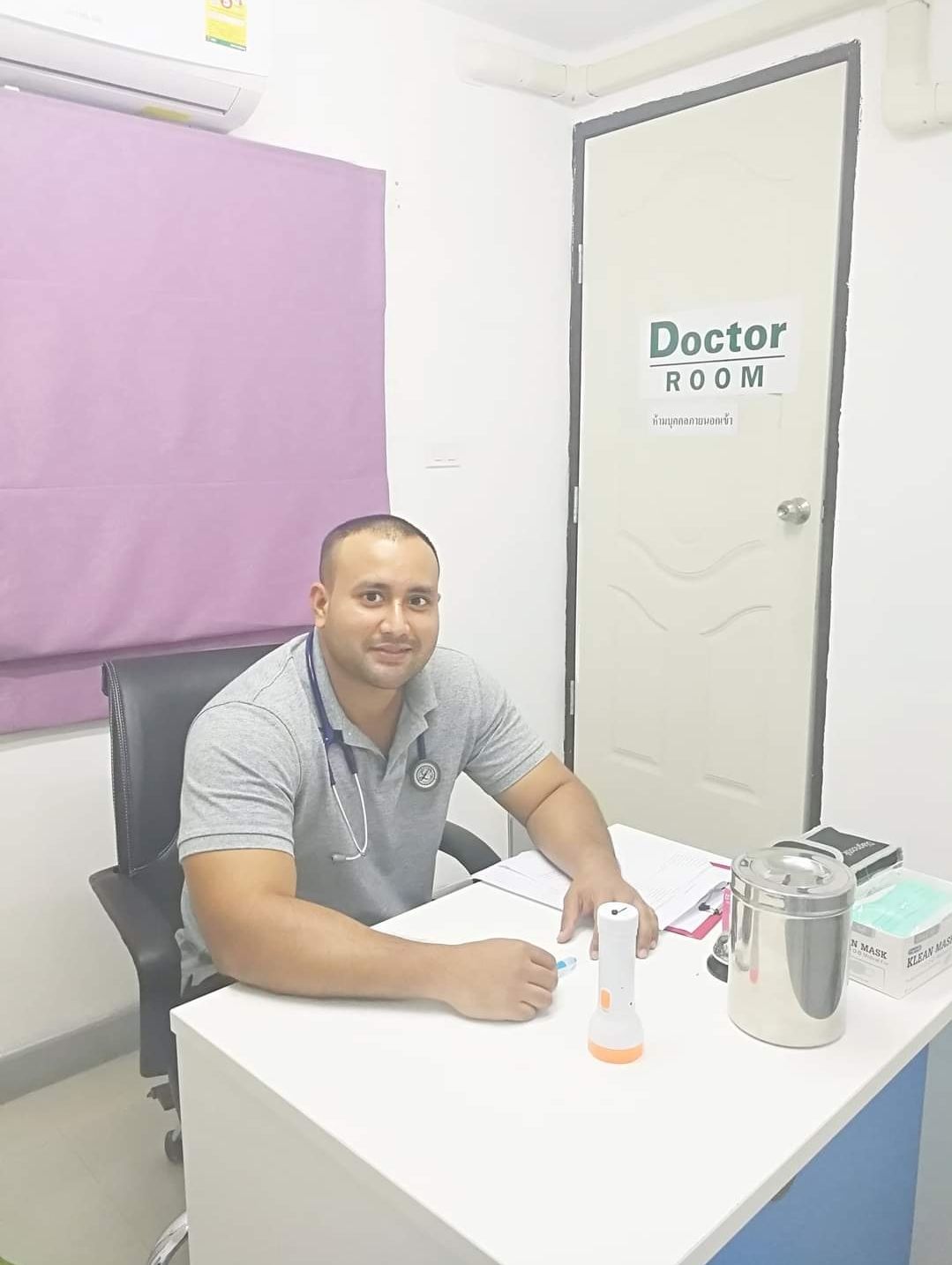
Dr. Ponlawat Pitsuwan is a physician at Doctor Bangkok, a private clinic in central Bangkok. He sees expats, residents, and medical tourists for general medicine, wellness consultations, and IV therapy. His focus is straightforward, evidence-based care delivered in plain language.