Clinically reviewed by Dr. Ponlawat Pitsuwan, Physician, Doctor Bangkok. Last reviewed: July 2026
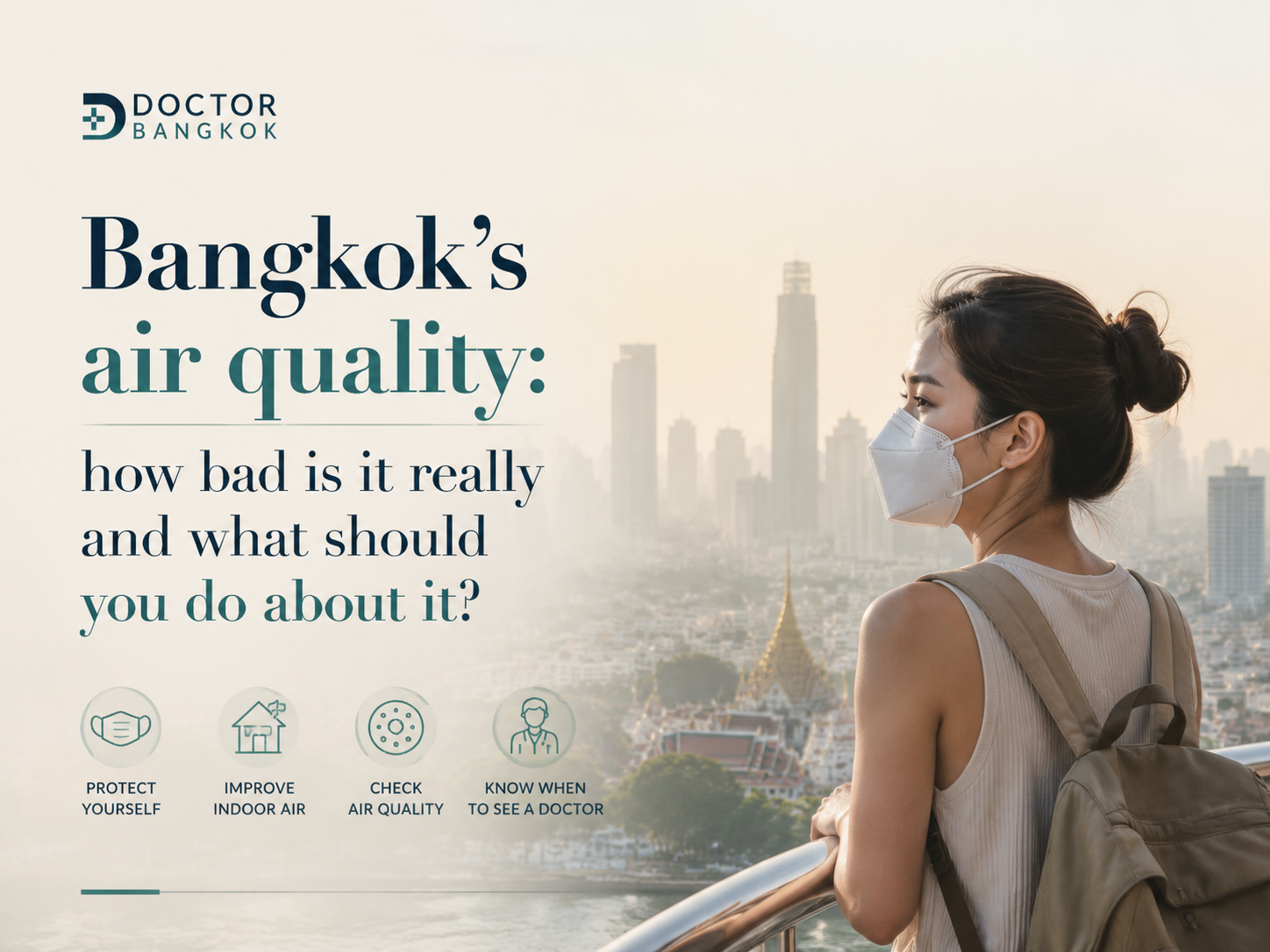
Bangkok’s air quality is worst between December and March, when agricultural burning in northern Thailand combines with cool, still air to push PM2.5 levels well above safe limits. People with asthma, older adults, and anyone exercising outdoors are most at risk. Check IQAir or the Air4Thai app before going outside, and see a doctor the same day if your breathing does not improve with your usual inhaler.
If you have just landed in Bangkok and your chest feels tighter than usual, you are not imagining it. The air here is genuinely different from most Western cities, especially between December and April. If you are reading this from a hotel room wondering whether the haze outside is something to worry about, the honest answer is: sometimes yes, and you should know when.
Bangkok’s pollution comes from several sources at once. Traffic, industry, and urban dust are year-round problems. But the worst spikes come from agricultural burning, when farmers in northern and central Thailand burn their fields after harvest. In the cool, dry months, a weather pattern called thermal inversion traps that smoke at street level. The result is a grey ceiling over the city that can last for days. Elevated PM2.5 levels can appear from November onward, with the worst typically in February and March.

What AQI actually means and which number expats should trust
Most expats quickly notice that the AQI number on the Thai government’s Air4Thai app often looks lower than the number on IQAir. This is not a discrepancy to distrust. It reflects two different measurement scales.
Thailand’s Pollution Control Department uses its own national index, calibrated differently from the US EPA scale that IQAir displays. A reading that shows "moderate" on Air4Thai may appear as "unhealthy for sensitive groups" on IQAir for the same air, at the same time, in the same location. Neither is wrong. They are measuring against different thresholds.
For expats, use IQAir as your daily reference. It reports on the US EPA scale, which is the most widely used international standard. Use Air4Thai as a cross-check. If both are elevated, trust your symptoms.
Here is how to read the US EPA AQI scale in plain terms:
| AQI Range | Category | What it means for you |
|---|---|---|
| 0–50 | Good | No action needed |
| 51–100 | Moderate | Sensitive groups should reduce prolonged outdoor exertion |
| 101–150 | Unhealthy for sensitive groups | Asthma, heart disease, children: limit outdoor time |
| 151–200 | Unhealthy | Everyone should limit outdoor exertion |
| 201–300 | Very unhealthy | Avoid outdoor activity |
| 300+ | Hazardous | Stay indoors. Seek medical advice if symptomatic |
Bangkok’s pollution calendar: when to expect the worst
The rainy season, roughly June through October, is when Bangkok’s air is cleanest. Rain washes particles out of the atmosphere. You can generally exercise outside without extra worry during these months.
November marks the shift. As the rains stop and temperatures drop slightly, air circulation decreases and agricultural burning picks up in the north. January and February are typically the worst months. March and April see continued burning, though warming temperatures eventually break the thermal inversion and start to clear the air.
This matters for trip planning. Many visitors choose November to February because the weather feels cooler. That is precisely the period with the worst air. If you have asthma, COPD, or any chronic lung condition, factor this into your travel dates and your preparation.

Travelling to Bangkok with asthma: what to prepare before you land
Most asthma advice for Bangkok is written for people who are already here and already struggling. I want to address people who have not landed yet, because that is when preparation does the most good.
The single biggest mistake I see is patients arriving with an asthma action plan that worked fine at home but has not been reviewed for travel. Bangkok’s air is a real trigger. If your asthma has been poorly controlled in the months before your trip, a respiratory review before you fly is genuinely worth doing.
What to check before you travel
If you are using your rescue inhaler more than twice a week at home, your asthma is not well controlled. Travelling to Bangkok in that state is a real risk. A written asthma action plan tells you and anyone helping you exactly what to do at each level of symptoms. If you do not have one, ask your doctor before you fly.
Pack more inhalers than you think you need. Airlines have confiscated inhalers in carry-on bags before, and luggage does get lost. Carry your rescue inhaler on your person, not in your checked bag.
If your current treatment includes an ICS-formoterol combination inhaler, make sure you have enough for your full trip plus extra. This type of inhaler requires a prescription in Thailand. You cannot replace it at a pharmacy without seeing a doctor first.
On arrival and during your stay
Check the AQI every morning before planning outdoor activities. If it is above 100, keep outdoor exposure short and wear a well-fitted N95 if you do go out. A surgical mask does not filter PM2.5 meaningfully. A cloth mask does not either. N95 only.
If you arrive without your inhaler, salbutamol relievers are available over the counter at most Bangkok pharmacies. For controller or combination inhalers, you need a prescription. Doctor Bangkok on Sukhumvit Soi 13 offers same-day consultations without a prior appointment, and the consultation report is in English for travel insurance purposes.
When breathlessness is not asthma
Not all chest tightness in Bangkok is pollution or asthma. After a long-haul flight, there is a small but real risk of a blood clot in the lungs, called a pulmonary embolism. It can feel like an asthma attack and it does not respond to an inhaler.
Red flags that mean you need a hospital emergency department, not a clinic, include: sudden breathlessness with no prior warning, sharp chest pain that worsens when you breathe in, coughing up blood, or one leg that is swollen and painful. Do not wait and see with these symptoms.
Vocal cord dysfunction is another condition that mimics asthma, particularly in people under stress. It does not respond well to bronchodilators and can cause a frightening tightening sensation in the throat. If your symptoms are not responding to your usual inhaler, a clinical assessment is the right next step.
Running in Bangkok: how to exercise safely in the heat and pollution
Bangkok has active running communities at Lumpini Park and Benjakitti Park. But the combination of heat, humidity, and PM2.5 makes this city genuinely harder on the body than most.
When you run, your breathing rate increases dramatically. A runner at a moderate pace inhales roughly ten times the air volume of someone sitting still. If the AQI is 120 and you run for 45 minutes, you are pulling far more PM2.5 deep into your lungs than a pedestrian on the same route. For runners with asthma, the risk goes further. Fast breathing through the mouth bypasses the nose, which normally filters and humidifies incoming air. Dry, polluted air hitting the airways directly can trigger sudden tightening, known as exercise-induced bronchoconstriction. Even people who have never had asthma can develop this in the right conditions.
Then add Bangkok’s heat. At 35 degrees Celsius and 80 percent humidity, sweat cannot evaporate efficiently and your cardiovascular system works harder to compensate. Combined with the lung load from pollution, the same run places considerably more stress on your body than it would in a cooler, cleaner city.
Practical rules for running in Bangkok
Go early. The window before 06:30 catches lower traffic pollution and slightly lower temperatures. After 09:00, both climb quickly. Check IQAir before every session. If the AQI is above 100, move your run indoors. If you have asthma or a respiratory condition, use 80 as your personal cut-off.
Run in the parks, not along main roads. Lumpini and Benjakitti both have tree cover that reduces ground-level pollution compared to roadside running. Avoid Sukhumvit and Silom during morning rush hour entirely.
Hydrate more than you think you need to. Start the night before a long run, not just the morning of. For runs over 45 minutes, consider an electrolyte drink rather than water alone.
If you are new to Bangkok, give yourself two weeks before pushing hard sessions. Heat acclimatisation is a real process. Your body gradually becomes more efficient at cooling itself. Jumping into intervals in week one is how people end up in our clinic with heat exhaustion.
Respiratory concerns in Bangkok are something we see every week at Doctor Bangkok. Whether it is an asthma flare, a chest that has been tight since you landed, or a runner who pushed too hard on a bad air day, we can help. We offer same-day consultations on Sukhumvit Soi 13, nebulised treatment for acute attacks, inhaler prescriptions, and peak flow assessment. No appointment needed. All consultations are in English and include a written report for travel insurance. Visit doctorbangkok.co.th or walk in.
FAQ
Which months have the worst air quality in Bangkok?
December through March is the peak risk window, with February and March often the worst. Agricultural burning in northern Thailand combines with cool, still air to trap smoke at street level. The rainy season from June through October brings significantly cleaner air.
Can I travel to Bangkok if I have asthma?
Most people with well-controlled asthma travel to Bangkok without major problems if they prepare properly. Bring both your controller and rescue inhalers plus spares, carry a written asthma action plan, and check the AQI daily. If your asthma has been poorly controlled in the months before travel, get a review before you fly.
Is it safe to run outside in Bangkok when air quality is poor?
Running increases how much air you breathe in dramatically, so even a moderate AQI hits your lungs harder than it would at rest. If IQAir shows above 100, move your run indoors. For runners with asthma, use 80 as your personal threshold. Early morning before 06:30 at Lumpini or Benjakitti is your best option on lower-AQI days.
What should I do if my asthma gets worse in Bangkok?
For mild worsening, use your rescue inhaler and move indoors away from pollution. If symptoms are not improving within 30 minutes, come in to see us at Doctor Bangkok for same-day nebulised treatment and assessment. If you cannot complete a sentence, your lips look bluish, or four puffs of salbutamol are not helping, go directly to a hospital emergency department.
I arrived in Bangkok without my inhaler. Can I get a replacement?
Salbutamol reliever inhalers are available over the counter at most Bangkok pharmacies without a prescription. Combination controller inhalers require a prescription, which you can get at Doctor Bangkok on Sukhumvit Soi 13 with a same-day consultation and no appointment needed.
Why does the Thai AQI app show a lower number than IQAir?
They use different measurement scales. Thailand’s national index is calibrated differently from the US EPA scale that IQAir uses, so the same air can produce different numbers on each app. For expats, IQAir is the more familiar reference point and the one most international health guidance is written against.
Should I buy an air purifier for my Bangkok apartment?
If you are staying longer than a few weeks, particularly through the November to March season, a HEPA air purifier in the bedroom is worth considering. Keep windows closed on high-AQI days and run the purifier continuously in the rooms where you sleep and spend most time. This matters most if you have asthma, young children, or a heart condition.
Dr. Ponlawat Pitsuwan
Physician, Doctor Bangkok
a private medical clinic in central Bangkok. He sees expats, residents, and medical tourists for respiratory concerns, travel medicine, and general medical consultations, including same-day asthma assessment and inhaler prescriptions. His focus is straightforward, evidence-based care delivered in plain language.
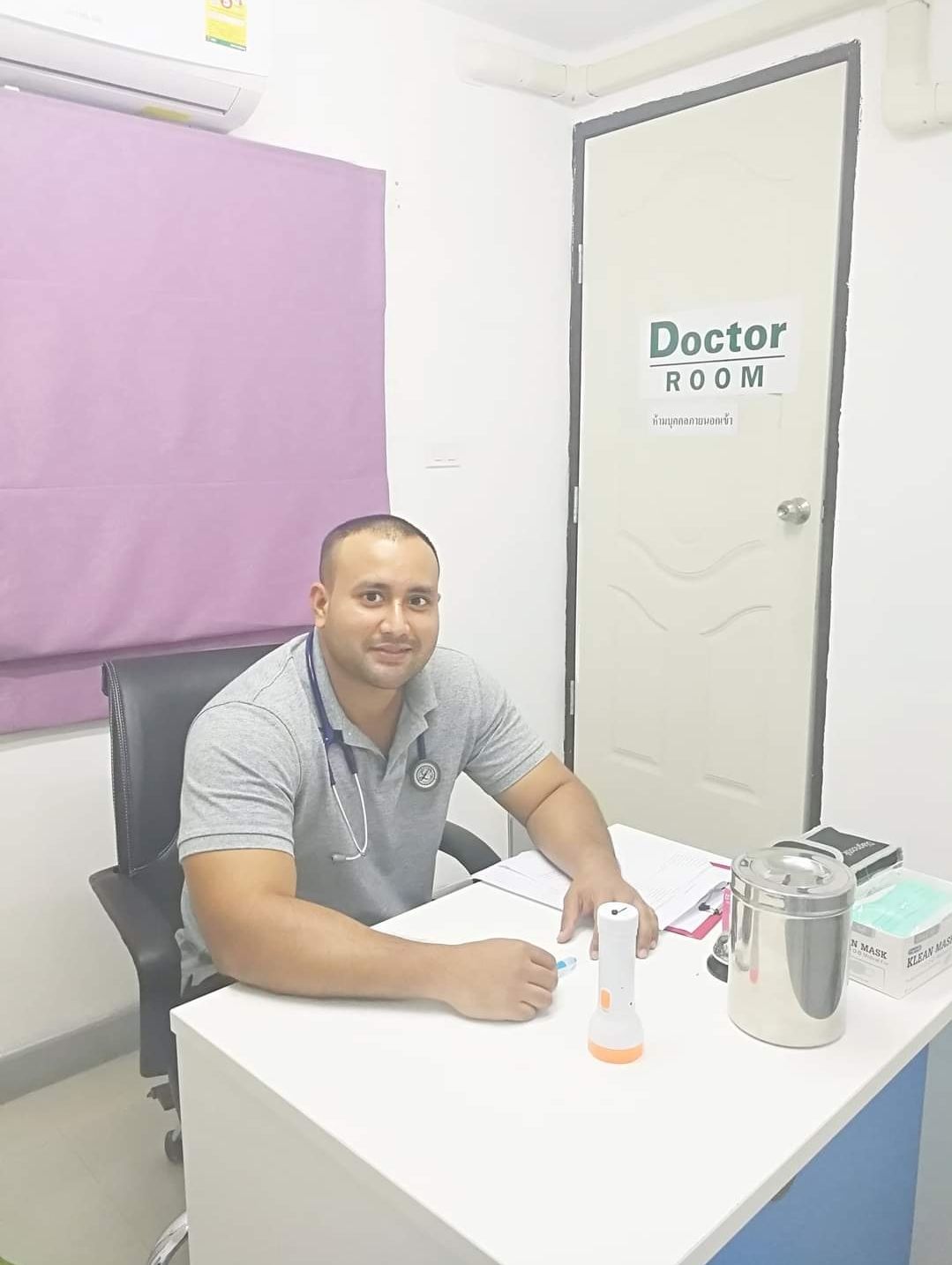
Dr. Ponlawat Pitsuwan is a physician at Doctor Bangkok, a private clinic in central Bangkok. He sees expats, residents, and medical tourists for general medicine, wellness consultations, and IV therapy. His focus is straightforward, evidence-based care delivered in plain language.