

Clinically reviewed by Dr. Ponlawat Pitsuwan, Physician, Doctor Bangkok.
Last reviewed: November 2026
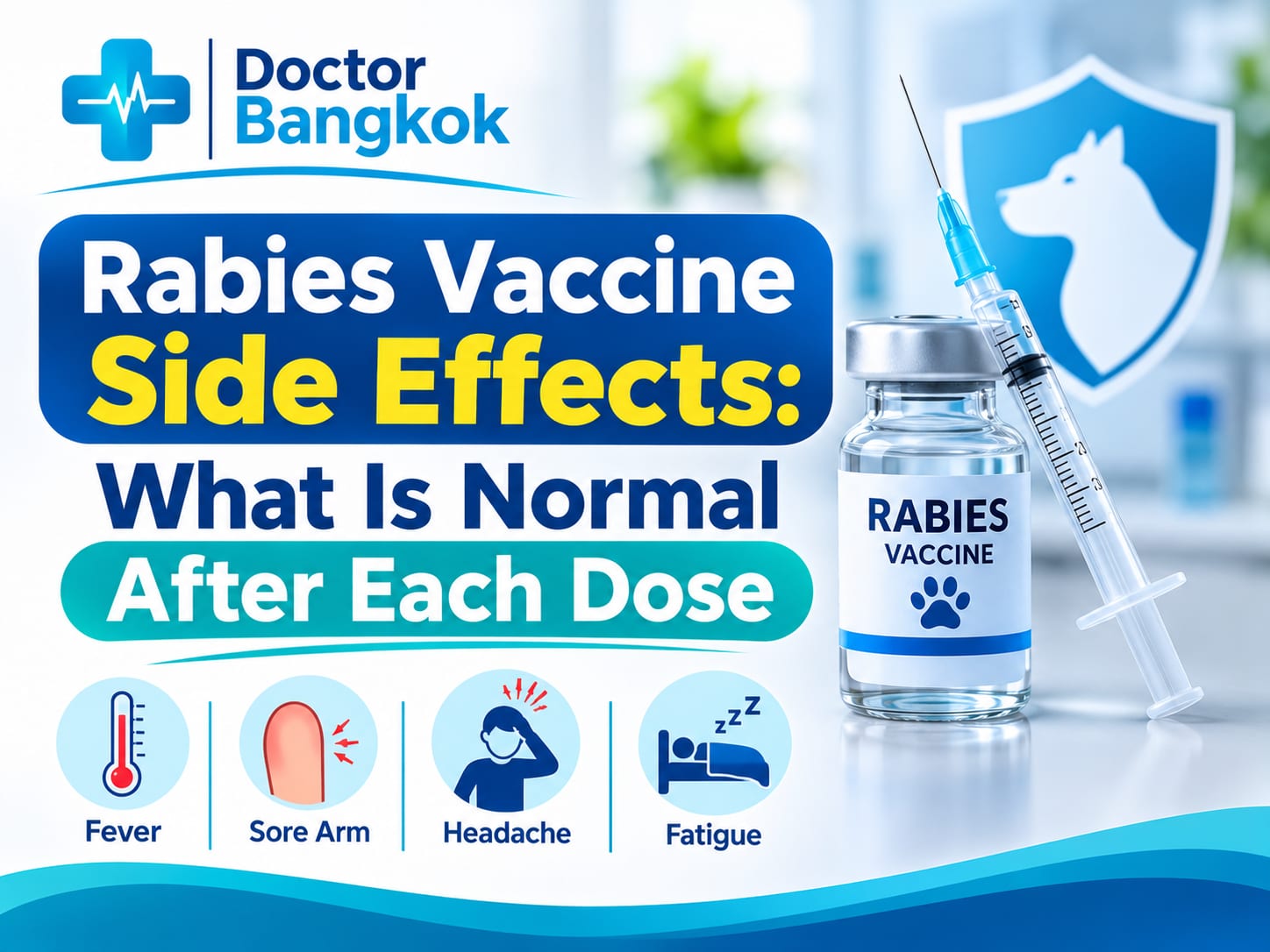
Most rabies vaccine side effects are mild and short-lived. A sore arm, some redness, and tiredness for a day or two are normal after any dose. Systemic reactions like headache or low-grade fever are also common, especially after the first injection. Serious reactions are rare. If you develop hives, difficulty breathing, or face swelling after a shot, seek medical attention the same day.
You are midway through your post-exposure shots in Bangkok and your arm feels worse than last time. Is that normal? For most people, yes. Mild soreness, redness, and a day of feeling flat are well within the expected range after each dose in the series.
What catches people off guard is not knowing what to expect at each injection. The rabies course runs across several visits, and reactions can vary between doses. This article covers what is normal, what is not, and what to do if something feels off, including how to reach a doctor when getting back to a clinic is not practical.

Common Rabies Vaccine Side Effects
The most frequently reported side effects are at the injection site. Your arm may feel sore, look red, or swell slightly. These reactions usually settle within a day or two.
Beyond the arm, some people feel tired, develop a mild headache, or run a low-grade fever. These are systemic reactions, meaning the whole body responding to the vaccine, not just the injection site. They tend to be most noticeable after the first dose.
Paracetamol handles these well. Rest and good hydration also help. There is no strong clinical reason to avoid light activity, though working the injected arm hard on the day of the shot may increase soreness.
What Changes Between Doses
On the standard post-exposure prophylaxis schedule, most adults receive injections on days 0, 3, 7, and 14. The first dose is often the one that triggers the most noticeable systemic response. By days 3 and 7, arm soreness may still recur at the new injection site, but flu-like symptoms tend to be less pronounced.
If reactions seem to escalate between doses rather than stay stable or improve, flag that before the next injection. It does not mean you stop the course. Completing every dose on schedule is critical for protection. It just means a quick check is sensible.
A booster dose, given to people who had pre-exposure prophylaxis previously, generally produces milder reactions than a fresh post-exposure course.
Rare Reactions Worth Knowing
Anaphylaxis is rare after rabies vaccines. It typically appears within minutes to an hour of the injection. Signs include throat tightness, difficulty breathing, hives spreading across the body, or a sudden drop in blood pressure. This is a medical emergency. Call for help immediately or go to the nearest emergency care facility.
Serum sickness-like reactions have been reported after booster doses of some rabies vaccines, particularly HDCV (human diploid cell vaccine). Symptoms include joint pain, hives, and general unwellness appearing several days after the shot. This is uncommon and needs medical assessment.
Guillain-Barré syndrome, a nerve condition causing weakness that starts in the legs, was associated with older rabies vaccines made from animal nerve tissue. Modern cell-culture vaccines such as HDCV, PCECV, and PVRV have not been shown to cause GBS. Any new limb weakness or tingling after a rabies shot still warrants a same-day call to your doctor.
If you have IgA deficiency, tell the clinician before any injection. It can increase the risk of allergic reactions to some plasma-derived products.
Side Effects of Rabies Immune Globulin (RIG)
Rabies immune globulin is given alongside the first vaccine dose in post-exposure cases where you have not previously been vaccinated. It is not part of pre-exposure or booster schedules. Its job is to provide immediate short-term protection while your body builds its own response to the vaccine.
There are two types. Human rabies immunoglobulin (HRIG) is derived from human plasma. Equine rabies immunoglobulin (ERIG) is horse-derived and costs less, but it is associated with more frequent reactions. Private clinics in Bangkok, including Doctor Bangkok, typically stock HRIG because its side effect profile is better tolerated.
RIG is infiltrated directly into and around the wound site, with any remaining volume given as a separate injection. Local soreness at the wound site is common. Mild swelling, itching, or bruising can occur and usually settles within a few days.
Allergic reactions to HRIG are uncommon. Reactions to ERIG are more frequent and can include serum sickness, with joint pain, rash, and fever appearing days after the injection. If you received ERIG and develop these symptoms, contact your doctor promptly.
When to Call a Doctor After a Rabies Shot
Most side effects do not need a clinic visit. Arm soreness, mild fever, headache, and tiredness all resolve on their own.
Call a doctor the same day if you notice any of the following: a rash spreading beyond the injection site, joint swelling or pain appearing two or more days after the dose, new limb weakness or tingling, or any sign of a serious allergic reaction such as throat tightening or difficulty breathing.
If you are midway through a post-exposure course and feel unwell enough to wonder whether to continue, do not skip the next dose without speaking to a doctor first. Stopping early removes the protection you have been building. If you are not sure whether your reaction is within the normal range, a quick check is the right call, not a wait-and-see approach.
Doctor Bangkok’s doctor-on-call service operates 24 hours a day and can come to your hotel or condo anywhere in Bangkok, so completing the course does not have to mean sitting in a waiting room when you feel rough. You can also read more about what to expect from your shots on the rabies vaccine page, or walk in to the clinic on Sukhumvit Soi 13 at any hour.
If you started your post-exposure course near Khao San Road or elsewhere in the city and need to continue at a different location, that is straightforward. Bring your vaccination record showing which product was used and on which dates. Doctor Bangkok can pick up mid-course cases and keep your schedule on track. For anyone staying near the Sukhumvit corridor, the walk-in clinic on Soi 13 is open around the clock.
Need to complete a dose or concerned about a reaction? Doctor Bangkok offers 24/7 rabies vaccine support, including post-exposure courses and RIG administration. A doctor can come to your hotel or condo anywhere in Bangkok within one hour, day or night. Walk-ins are welcome at our clinic on Sukhumvit Soi 13 at any time. Contact Doctor Bangkok through the button below.
FAQ
Dr. Ponlawat Pitsuwan
Physician, Doctor Bangkok
a private medical clinic in central Bangkok open 24 hours a day, seven days a week. He sees expats, residents, and medical tourists for travel medicine, rabies post-exposure management, wound care, and general medical consultations. His focus is straightforward, evidence-based care delivered in plain language.
References
- Centers for Disease Control and Prevention. Post-Exposure Prophylaxis (PEP). CDC Rabies Clinical Care, 2023.
- Rupprecht CE, et al. Use of a Reduced (4-Dose) Vaccine Schedule for Postexposure Prophylaxis to Prevent Human Rabies. MMWR Recommendations and Reports, 2010.
- Vetter JM, et al. Vaccines and Guillain-Barré Syndrome. Drug Safety, 2009. (Archived PMID 19388722)
- WHO Essential Medicines List. Rabies immunoglobulins — HRIG and ERIG comparison. WHO, 2023.
- World Health Organization. Rabies vaccines: WHO position paper. Weekly Epidemiological Record, 2018.
The information in this article is for educational purposes only and does not constitute medical advice. It should not be used to self-diagnose or replace a consultation with a qualified physician. If you have concerns about your health, contact a licensed medical professional. For appointments at Doctor Bangkok, visit doctorbangkok.co.th.

Dr. Ponlawat Pitsuwan is a physician at Doctor Bangkok, a private clinic in central Bangkok. He sees expats, residents, and medical tourists for general medicine, wellness consultations, and IV therapy. His focus is straightforward, evidence-based care delivered in plain language.