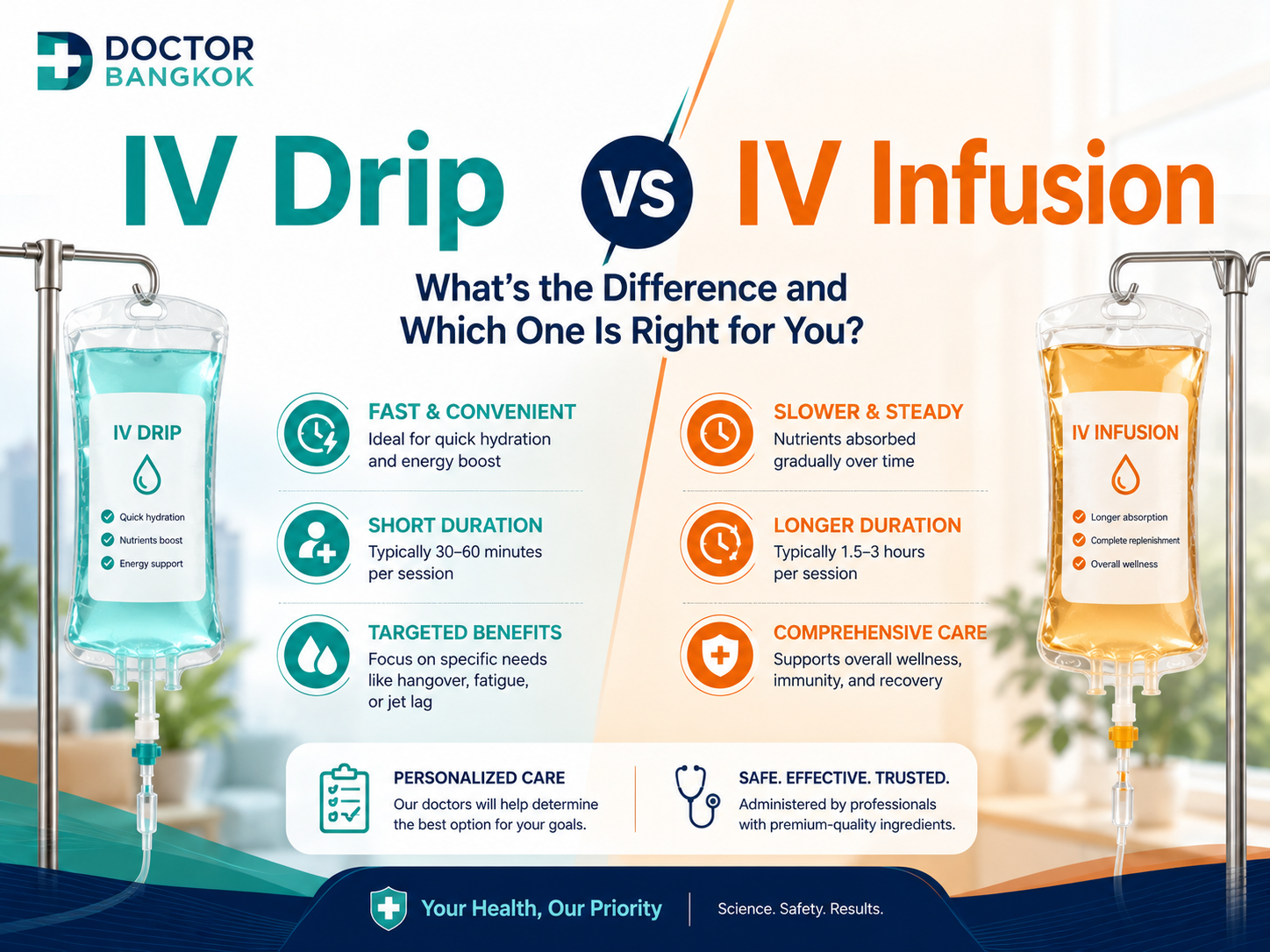
An IV drip and an IV infusion both deliver fluid directly into a vein, but they differ in delivery method, precision, duration, and clinical purpose. An IV drip typically refers to a gravity-fed or pump-assisted session lasting 30 to 60 minutes, used for hydration, vitamins, and electrolytes in outpatient and wellness settings. An IV infusion is a broader term covering more complex, longer, and more precisely controlled delivery of medications including antibiotics, chemotherapy, and biological drugs, usually requiring specialist oversight and extended monitoring.
The two terms are often used interchangeably in everyday conversation, and clinicians sometimes use them loosely as well. In practice the distinction matters because it determines what equipment is used, how long you will be treated, what level of monitoring is needed, and whether a general outpatient clinic or a specialist hospital setting is the right place for your treatment.
If you are considering an IV drip for hydration, vitamin support, or wellness at a private clinic in Bangkok, this article clarifies what that involves and how it differs from the more complex infusion therapies you might encounter in a hospital. Doctor Bangkok’s IV drip service in Bangkok offers physician-supervised outpatient sessions for exactly these purposes.

Definitions: What Each Term Actually Means
IV Drip
An IV drip describes a method of delivering fluid into a peripheral vein using a bag suspended above the patient, connected by tubing to a catheter. Gravity pulls the fluid through a drip chamber, where visible drops fall at a rate controlled by a roller clamp. The drops-per-minute count corresponds to a volume per hour, which the nurse calculates based on the tubing’s calibration factor.
The term is also used more loosely to describe any short intravenous session in an outpatient or wellness setting, including those using electronic pumps. When a Bangkok clinic advertises an IV drip for hydration or vitamins, they mean a session of 30 to 60 minutes, usually using a peripheral cannula in the forearm or hand, delivering a formulation of saline, electrolytes, and nutrients at a controlled rate.
IV Infusion
An IV infusion is the broader clinical term for any delivery of fluid or medication into a vein over a defined period. All IV drips are infusions in the technical sense, but not all infusions are drips. The word infusion is more commonly used for longer, more complex, and more precisely controlled treatments that typically require an electronic infusion pump programmed in millilitres per hour.
IV infusions in the hospital or specialist clinic sense include antibiotic courses running over one to two hours multiple times daily, chemotherapy agents delivered over several hours, biological drugs such as monoclonal antibodies requiring specific infusion rate escalation protocols, and total parenteral nutrition providing complete nutrition over twelve to twenty-four hours continuously. These require different equipment, more intensive monitoring, and in most cases specialist medical oversight.
IV Push or Bolus
A third term worth knowing is IV push or bolus. This refers to a single concentrated dose injected directly into the vein over seconds to a few minutes, rather than dripped or infused from a bag. Emergency medications, certain antiemetics, and some analgesics are given this way. It achieves an immediate pharmacological effect but requires careful attention to the recommended injection rate because delivering a drug too quickly can cause vascular irritation, cardiac effects, or systemic reactions. In wellness IV settings, antiemetics like ondansetron are sometimes given as a slow IV push before or alongside a drip.
Side-by-Side Comparison
| Feature | IV Drip | IV Infusion |
| Delivery method | Gravity-fed drip chamber or pump | Electronic pump or controlled gravity |
| Rate control | Manual roller clamp (drops per minute) or pump | Pump-programmed in ml per hour, precise |
| Typical duration | 30 to 60 minutes | Minutes to many hours depending on drug |
| Setting | Outpatient clinic, wellness centre, emergency | Hospital, infusion centre, outpatient clinic |
| Common uses | Hydration, vitamins, electrolytes, hangover, jet lag | Antibiotics, chemotherapy, biologics, complex nutrition |
| Physician oversight | Required under Thai law | Required, often specialist-led |
| Monitoring level | Regular checks during session | Continuous or frequent, often with labs |

How Each Method Is Delivered
Gravity Drip Setup
In a gravity drip, the IV bag hangs on a pole above the patient. Fluid moves through the tubing by gravity, passing through a drip chamber where the nurse counts drops per minute to estimate the flow rate. A roller clamp on the tubing adjusts the rate up or down. This setup is simple, requires no power source, and works well for standard hydration and vitamin sessions where precise millilitre-per-hour accuracy is not critical.
The practical limitation is that flow rate varies slightly with changes in arm position, bag height, and vein pressure. For most wellness drips delivering saline, vitamins, and electrolytes, this variability is clinically unimportant. For medications with narrow therapeutic windows, it is not acceptable.
Electronic Infusion Pump
An electronic infusion pump delivers fluid at a rate programmed in millilitres per hour, regardless of arm position or bag height. Modern pumps include alarms for air in the line, occlusion, and empty bags, reducing the risk of complications from undetected flow problems. Drug library functions in hospital-grade pumps cross-reference the programmed dose against safe ranges and alert the operator to potential errors.
Infusion pumps are used when the drug requires precise dosing, when the infusion runs for many hours, when the rate needs to be titrated based on clinical response, or when the medication has a narrow margin between therapeutic and toxic concentrations. Vasoactive drugs like norepinephrine, chemotherapy agents, and continuous insulin infusions all require pump delivery. In an outpatient wellness setting, pumps are less commonly needed but may be used to control the rate of high-dose vitamin C or NAD+ infusions, which benefit from slower, more controlled delivery to reduce vein irritation.
Peripheral vs Central Venous Access
Most outpatient IV drips use peripheral venous access, meaning a small cannula inserted into a vein in the forearm, the back of the hand, or the antecubital fossa at the inner elbow. This is straightforward, takes seconds in experienced hands, and is appropriate for sessions lasting up to a few hours using isotonic or near-isotonic solutions.
Central venous access, through larger veins in the neck, chest, or via a peripherally inserted central catheter (PICC), is required for long-term therapy, highly concentrated solutions, or drugs that cause vein damage if delivered peripherally. Chemotherapy agents, concentrated dextrose solutions, and some antibiotics fall into this category. Central line placement requires a specialist procedure, sterile technique, and imaging guidance in most cases. You will not encounter central access at an outpatient wellness clinic; it belongs firmly in the hospital setting.
When Is an IV Drip Used and When Is an Infusion Needed?
The clearest way to understand the distinction is through use cases. The table below maps common clinical situations to the right type of treatment and explains the reasoning.
| Situation | Right Choice | Why |
| Dehydration, hangover, jet lag | IV drip (outpatient) | Short session, no pump required, same-day |
| Vitamin and mineral correction | IV drip (outpatient) | 30 to 60 min, physician-supervised |
| Severe infection needing antibiotics | IV infusion (hospital or clinic) | Precise dosing, longer duration, monitoring |
| Migraine with nausea | IV drip with antiemetic (clinic) | Magnesium, ondansetron, fast relief |
| Chemotherapy | IV infusion (specialist centre) | Complex drugs, long duration, pump required |
| Post-flight fatigue | IV drip (outpatient) | Same-day, 45 min, no pump needed |
| Nutritional support long-term | IV infusion (TPN, hospital) | Complex formulation, continuous delivery |
The pattern is consistent. IV drips in the outpatient wellness sense are appropriate for situations requiring rapid correction of fluid and electrolyte deficits, vitamin replenishment, or symptom relief that can be achieved in a single 30 to 60 minute session using peripheral access and no specialist equipment. IV infusions in the hospital or specialist centre sense are appropriate when the drug is complex, the duration is long, precise dosing is critical, or the clinical situation requires continuous monitoring and the capacity to respond to acute deterioration.
Safety Requirements: What Both Have in Common
Despite the differences in complexity and setting, IV drips and IV infusions share the same fundamental safety requirements. Both involve breaking the skin barrier and introducing a foreign object and external fluid into the bloodstream. The principles that prevent complications are identical regardless of whether the session lasts 45 minutes or 8 hours.
Pre-Treatment Assessment
A clinical assessment before any IV treatment identifies contraindications, allergy risks, and conditions that affect how fluid and electrolytes should be managed. Kidney disease and heart failure affect how the body handles additional fluid volume. Anticoagulant medications increase bleeding and haematoma risk at the insertion site. Known allergies to any ingredient in the formulation are an absolute contraindication. Under Thai medical law, intravenous therapy must be supervised by a licensed physician. At Doctor Bangkok, every session begins with a physician-led consultation and informed consent process before the cannula is inserted.
Aseptic Technique
Infection risk is present any time a needle enters a vein. The catheter and tubing provide a direct route to the bloodstream if contamination occurs at insertion or during the session. All equipment should be opened from sealed single-use packaging in front of the patient. The nurse or physician performs hand hygiene and prepares the insertion site with an alcohol-based antiseptic before venepuncture. Gloves are worn throughout. Multi-dose vials require strict access controls and a documented beyond-use date. At Doctor Bangkok, all ingredients are pharmaceutical-grade and registered with the Thai FDA, อย., for intravenous use.
Monitoring During the Session
Vital signs should be checked before the session begins and monitored during it. The insertion site needs regular inspection for swelling, redness, or pain indicating infiltration or phlebitis. Any systemic reaction, including flushing, breathlessness, or dizziness, requires the infusion to be stopped and the clinical team alerted immediately. Emergency equipment including epinephrine, oxygen, and a bag-valve mask should be on-site throughout every session, regardless of whether the treatment is a simple hydration drip or a complex infusion.
What Outpatient IV Drips Look Like at a Bangkok Clinic
For the majority of people reading this article, the relevant experience is an outpatient IV drip at a Bangkok private clinic rather than a hospital infusion for a medical condition. Here is what that looks like in practice.
You arrive, complete a short intake form covering your medical history, current medications, and allergies. A physician reviews this, checks your vital signs, and conducts a brief consultation to determine the appropriate formulation and volume. This is not a formality. It is the step that ensures the drip is safe and appropriate for you specifically.
The nurse prepares your treatment area, opens all equipment from sealed single-use packaging in front of you, inserts a peripheral cannula into your forearm or hand using aseptic technique, and connects the IV bag. The solution drips at a controlled rate over 30 to 60 minutes while you sit in a reclining chair. A physician or nurse monitors you throughout and is immediately available if you notice any unusual sensation.
Doctor Bangkok’s outpatient IV drip service in central Bangkok follows this process for every session. Formulations are confirmed by a licensed physician. Emergency equipment is maintained on-site. All ingredients are pharmaceutical-grade and Thai FDA-registered. Same-day appointments are available.
If you are looking for a physician-supervised IV drip in Bangkok for hydration, wellness, recovery, or vitamin support, that is an outpatient IV drip, not a hospital infusion. The two are different in complexity, duration, and setting. Doctor Bangkok’s IV drip service handles outpatient drips with the same clinical rigour as a hospital, in a private clinic setting close to the BTS network.
Frequently Asked Questions
What is the difference between an IV drip and an IV infusion?
An IV drip typically refers to a short outpatient session lasting 30 to 60 minutes delivering hydration, vitamins, or electrolytes through a peripheral cannula, using gravity or a simple pump. An IV infusion is the broader clinical term covering any intravenous delivery, including complex, longer, and more precisely controlled treatments for medications like antibiotics or chemotherapy that require specialist oversight and electronic pump delivery.
Are IV drip and IV infusion the same thing?
Technically all IV drips are infusions, but not all infusions are drips. In everyday usage, IV drip refers to the simpler, shorter outpatient treatment you would receive at a wellness or private clinic. IV infusion more often refers to the complex, longer treatments used in hospitals for serious medical conditions. The terms are sometimes used interchangeably but describe different levels of clinical complexity.
Which is better, an IV drip or an IV infusion?
Neither is universally better. The right choice depends entirely on the clinical situation. For hydration, vitamins, electrolytes, and general wellness in a healthy adult, an outpatient IV drip is appropriate, safe, and effective. For complex medical conditions requiring antibiotics, chemotherapy, or biological drugs, an IV infusion in a properly equipped setting is required. Choosing the wrong setting for the wrong situation is where problems arise.
How long does an IV drip take compared to an infusion?
An outpatient wellness IV drip typically runs 30 to 60 minutes. An IV push or bolus takes seconds to a few minutes. Hospital infusions for antibiotics typically run one to two hours per dose. Chemotherapy and biological drug infusions can run from two hours to a full day depending on the protocol. Total parenteral nutrition runs continuously over twelve to twenty-four hours.
Do I need a doctor for an IV drip in Bangkok?
Yes. Under Thai medical law, intravenous therapy must be supervised by a licensed physician. A doctor should be on-site throughout your session, not just reachable by phone. They should review your medical history and approve the formulation before the drip begins, and be present or immediately available if a reaction occurs.
Is an IV drip safe at a wellness clinic?
It is safe at a clinic that meets the clinical requirements: physician on-site, pharmaceutical-grade Thai FDA-registered ingredients, single-use sterile equipment, pre-treatment assessment, vital signs monitoring, and emergency equipment available. Clinics that skip any of these steps present an avoidable risk. Ask directly before booking: is a doctor on-site during my session, and can I see the full ingredient list with concentrations?
What does an IV drip feel like?
You will feel a brief sharp sensation during venepuncture when the cannula is inserted. Once the infusion begins, most patients feel nothing other than a slight coolness as the fluid enters. Some formulations containing magnesium or high-dose B vitamins produce a mild warmth or flushing sensation that passes within a few minutes. Most patients feel noticeably better before the session ends.
Can I get an IV drip the same day in Bangkok?
Same-day appointments are available at Doctor Bangkok subject to clinic capacity. A physician consultation is conducted before every session. Calling ahead is the most reliable way to confirm a slot. See the Doctor Bangkok IV drip page for availability and formulation details.

Dr. Ponlawat Pitsuwan is a physician at Doctor Bangkok, a private clinic in central Bangkok. He sees expats, residents, and medical tourists for general medicine, wellness consultations, and IV therapy. His focus is straightforward, evidence-based care delivered in plain language.