
Clinically reviewed by Dr. Ponlawat Pitsuwan, Physician, Doctor Bangkok.
Last reviewed: November 2026
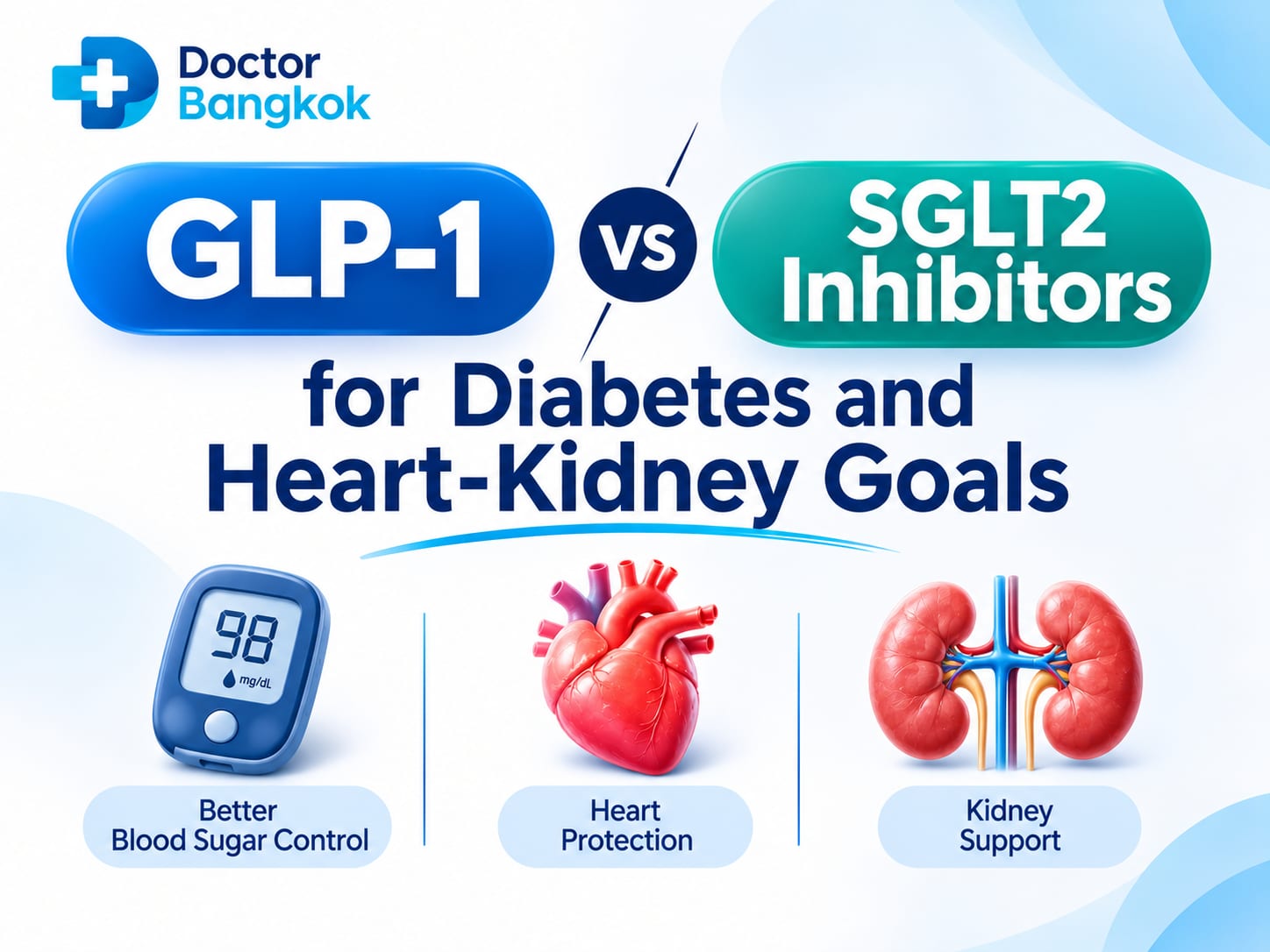
GLP-1 receptor agonists (semaglutide, tirzepatide) and SGLT2 inhibitors (empagliflozin, dapagliflozin) work through different pathways. GLP-1s drive more weight loss and reduce heart attack risk in people with established cardiovascular disease. SGLT2 inhibitors lead for heart failure hospitalisation and high-risk chronic kidney disease. The 2026 ADA-EASD consensus recommends using both classes together earlier in type 2 diabetes management, rather than waiting until one drug stops working.
You are managing type 2 diabetes, your cardiologist mentioned Jardiance, your GP back home started you on Ozempic, and now you are in Bangkok wondering whether you are on the right drug, the right dose, or whether you should be on both. That question deserves a proper answer.
These two drug classes are not competing options where one wins. They target different organs through different pathways, and current guidelines reflect that by recommending earlier combination use. What drives the choice is your specific risk profile: your heart, your kidneys, your weight, and where your HbA1c, your average blood sugar level over three months, currently sits.
Two Different Mechanisms for Metabolic Care
GLP-1 receptor agonists work through the incretin system. Incretins are gut hormones that signal the pancreas to release insulin when you eat. Drugs like semaglutide (Ozempic, Wegovy, Rybelsus) and tirzepatide (Mounjaro) mimic that signal, slow stomach emptying, and reduce appetite through brain receptors. The result is lower blood sugar after meals, less hunger, and meaningful weight loss.
SGLT2 inhibitors work entirely outside the pancreas. Drugs like empagliflozin (Jardiance) and dapagliflozin (Forxiga) block a protein in the kidney that normally reabsorbs glucose from urine back into the bloodstream. That glucose is excreted instead. This also lowers blood pressure and reduces fluid load on the heart.
One practical limit for SGLT2 inhibitors is kidney function. Below a certain eGFR threshold, your kidney filtration rate, the glucose-lowering effect diminishes. Your doctor will check your eGFR before prescribing, and again during follow-up. GLP-1 agonists do not depend on kidney filtration to lower blood sugar, which makes them useful across a wider range of kidney function.
Where Guidelines Emphasise Each Class
The 2026 ADA-EASD consensus made a clear shift. Metformin is no longer a mandatory first step. Both GLP-1 agonists and SGLT2 inhibitors now carry strong recommendations for type 2 diabetes with confirmed cardiovascular disease, heart failure, or chronic kidney disease, regardless of whether blood sugar is already controlled.
For atherosclerotic cardiovascular disease, meaning narrowed arteries raising your risk of heart attack or stroke, GLP-1 agonists have the stronger evidence base. The LEADER and SUSTAIN-6 trials showed significant reductions in major cardiovascular events with liraglutide and semaglutide respectively.
For heart failure and diabetic nephropathy, kidney damage caused by diabetes, SGLT2 inhibitors currently lead. The EMPA-REG OUTCOME and DECLARE-TIMI 58 trials established clear reductions in heart failure hospitalisation. The CREDENCE trial showed kidney protection in patients with diabetic nephropathy specifically. Where heart and kidney damage overlap, SGLT2 inhibitors are often the priority choice per current guidance.
Kidney risk tier matters more than many patients realise. At high CKD risk, SGLT2 inhibitors have the most robust trial evidence. At moderate CKD risk, current data suggests GLP-1 agonists may perform comparably or better. Your eGFR, urine albumin-to-creatinine ratio, and cardiovascular history all feed into the decision. A single-answer approach does not work here.

Weight Effects Compared in Everyday Terms
If weight is part of your goal, GLP-1 agonists produce substantially more loss. In type 2 diabetes trials, semaglutide 1 mg has shown average losses of roughly 4.5 to 6.5 kg. Tirzepatide trials in type 2 diabetes have reported average losses in the range of 9 to 12 kg. These figures come from the SUSTAIN and SURPASS trial programmes respectively.
SGLT2 inhibitors typically produce around 2 to 3 kg of weight reduction. That reflects some fluid loss from the glucose-in-urine effect and a modest reduction in body fat. If you have metabolic syndrome, the cluster of high blood sugar, central obesity, high blood pressure, and abnormal lipids, visceral fat reduction matters more than fluid loss. GLP-1 agonists produce confirmed visceral fat reduction on imaging studies. SGLT2 weight loss is real but smaller and partly fluid-driven.
Neither class replaces dietary change. Both work better alongside it. If weight management is a primary goal alongside diabetes, the weight-loss injection service at Doctor Bangkok covers both semaglutide and tirzepatide options.
When Clinicians Combine Both Classes
Combining a GLP-1 agonist with an SGLT2 inhibitor is not new, but the evidence base for it has strengthened. A 2024 BMJ cohort study reported a hazard ratio of 0.70 for major cardiovascular events with combination therapy versus either class alone. Cohort data has limitations compared to a randomised trial, but it is a meaningful signal.
The 2026 ADA-EASD consensus formalises what many specialists were already doing: starting combination pharmacotherapy earlier, rather than waiting for monotherapy to fail. If you have type 2 diabetes with both cardiovascular disease and chronic kidney disease, using both classes simultaneously addresses different organ risks that neither drug covers alone.
The mechanisms are complementary. A GLP-1 agonist reduces appetite, lowers post-meal blood sugar, and cuts cardiovascular event risk through pathways unrelated to the kidney glucose mechanism that SGLT2 inhibitors use. Running both does not simply double the side effects. You can read more at the Doctor Bangkok GLP-1 page, which covers combination therapy considerations in more detail.
One clinical note: starting both at once makes it harder to identify which drug caused a side effect if one appears. Many physicians prefer to stabilise one before adding the second.
What This Means for a Bangkok Consultation
Both drug classes are available in Thailand through private clinics. Semaglutide (Ozempic, Rybelsus, Wegovy), tirzepatide (Mounjaro), empagliflozin (Jardiance), and dapagliflozin (Forxiga) are Thai FDA-approved branded products, not grey-market imports. Stock varies by clinic and by time, so confirming availability before your appointment is worthwhile.
If you are an expat managing diabetes in Bangkok without a regular physician, the practical issue is continuity. These medications require baseline blood tests, renal function monitoring, and periodic HbA1c checks. Starting either class without that baseline is not safe prescribing. At Doctor Bangkok, a same-day consultation includes the relevant bloodwork, so you leave with a clinical picture, not just a prescription.
The sick-day rules for SGLT2 inhibitors are worth knowing before you need them. If you become acutely unwell, undergo surgery, or go without food for an extended period, SGLT2 inhibitors should generally be paused. The risk is euglycaemic diabetic ketoacidosis, a serious condition where ketones build up even when blood sugar looks normal. If you feel unwell on an SGLT2 inhibitor, stop the medication, check ketones if you have a meter, and seek medical review. The Doctor Bangkok doctor-on-call service can reach your hotel or condo within an hour, day or night.
Use the cardiovascular risk calculator for a clearer picture of your personal heart and stroke risk before or after your consultation. It does not replace a clinical review, but it gives you useful context going into the conversation.
Managing type 2 diabetes in Bangkok? Doctor Bangkok offers same-day consultations at our Sukhumvit 13 clinic, open 24 hours a day, seven days a week. We run the relevant blood tests, review your cardiovascular and kidney risk, and discuss current prescribing options including semaglutide and tirzepatide. If you cannot get to the clinic, our doctor-on-call service comes to your hotel or condo anywhere in Bangkok within one hour. Walk in anytime or contact us to arrange a call-out.
Frequently Asked Questions
Dr. Ponlawat Pitsuwan
Physician, Doctor Bangkok
a private medical clinic in central Bangkok open 24 hours, with a doctor-on-call service that reaches your hotel or condo within one hour. He sees expats, residents, and medical tourists for diabetes management, metabolic health, cardiovascular risk assessment, and prescription review including GLP-1 and SGLT2 therapies. His focus is straightforward, evidence-based care delivered in plain language.
References
- Simms-Williams N et al. Effect of combination treatment with glucagon-like peptide-1 receptor agonists and sodium-glucose cotransporter-2 inhibitors on incidence of cardiovascular and serious renal events: population based cohort study. BMJ 2024;385:e078242.
- Zinman B et al. Empagliflozin, Cardiovascular Outcomes, and Mortality in Type 2 Diabetes. N Engl J Med. 2015;373:2117-2128.
- Marso SP et al. Semaglutide and Cardiovascular Outcomes in Patients with Type 2 Diabetes. N Engl J Med. 2016;375:1834-1844.
- Perkovic V et al. Canagliflozin and Renal Outcomes in Type 2 Diabetes and Nephropathy. N Engl J Med. 2019;380:2295-2306.
- NPS MedicineWise. Semaglutide (Ozempic) for type 2 diabetes. Australian Government, 2020.
- Drugs in Context. GLP-1 receptor agonists in heart failure with preserved ejection fraction (HFpEF): beyond weight loss – a condensed scientific review. 2025.
The information in this article is for educational purposes only and does not constitute medical advice. It should not be used to self-diagnose or replace a consultation with a qualified physician. If you have concerns about your health, contact a licensed medical professional. For appointments at Doctor Bangkok, visit doctorbangkok.co.th.

Dr. Ponlawat Pitsuwan is a physician at Doctor Bangkok, a private clinic in central Bangkok. He sees expats, residents, and medical tourists for general medicine, wellness consultations, and IV therapy. His focus is straightforward, evidence-based care delivered in plain language.