
Clinically reviewed by Dr. Ponlawat Pitsuwan, Physician, Doctor Bangkok. Last reviewed: June 2026
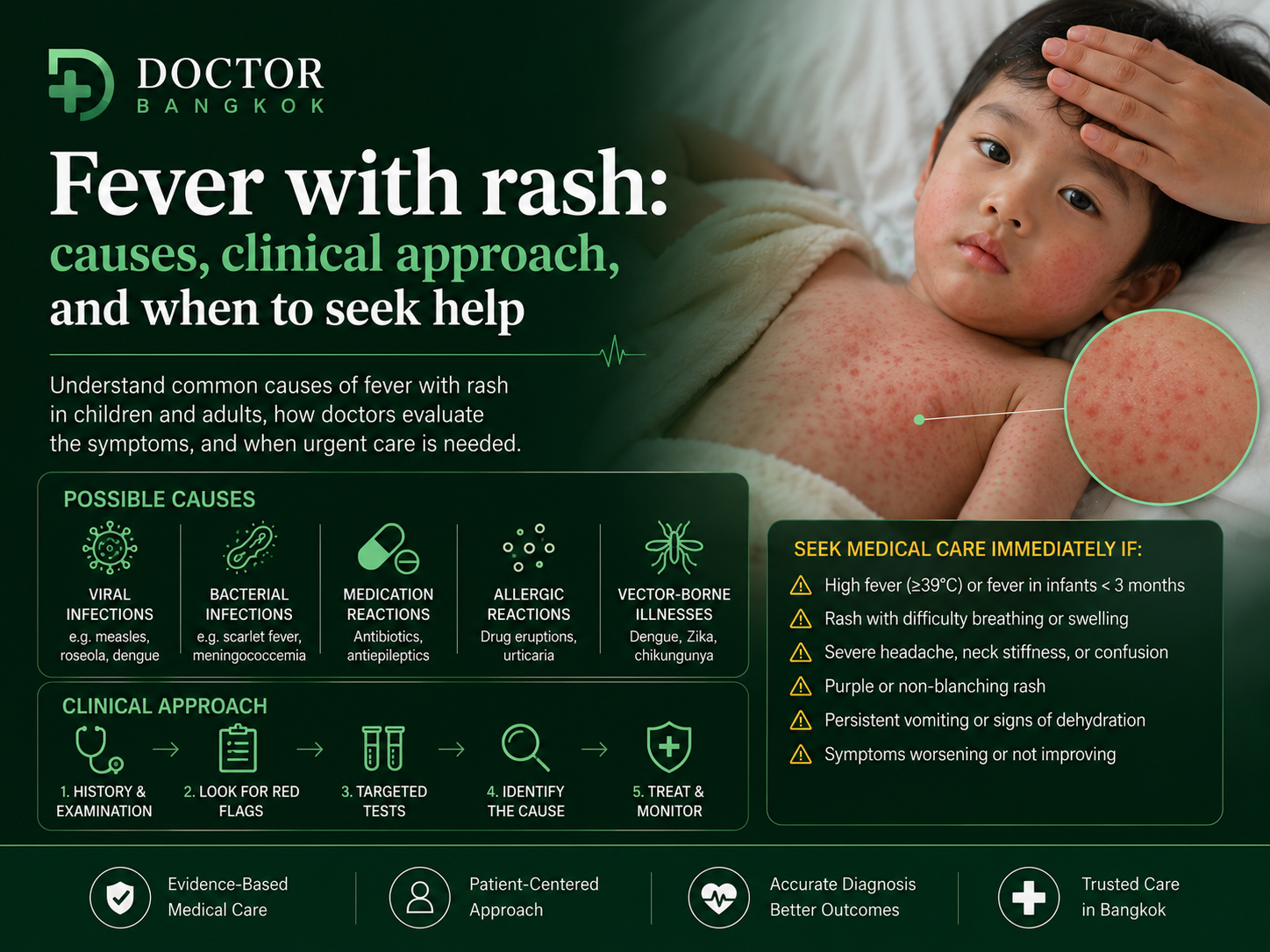
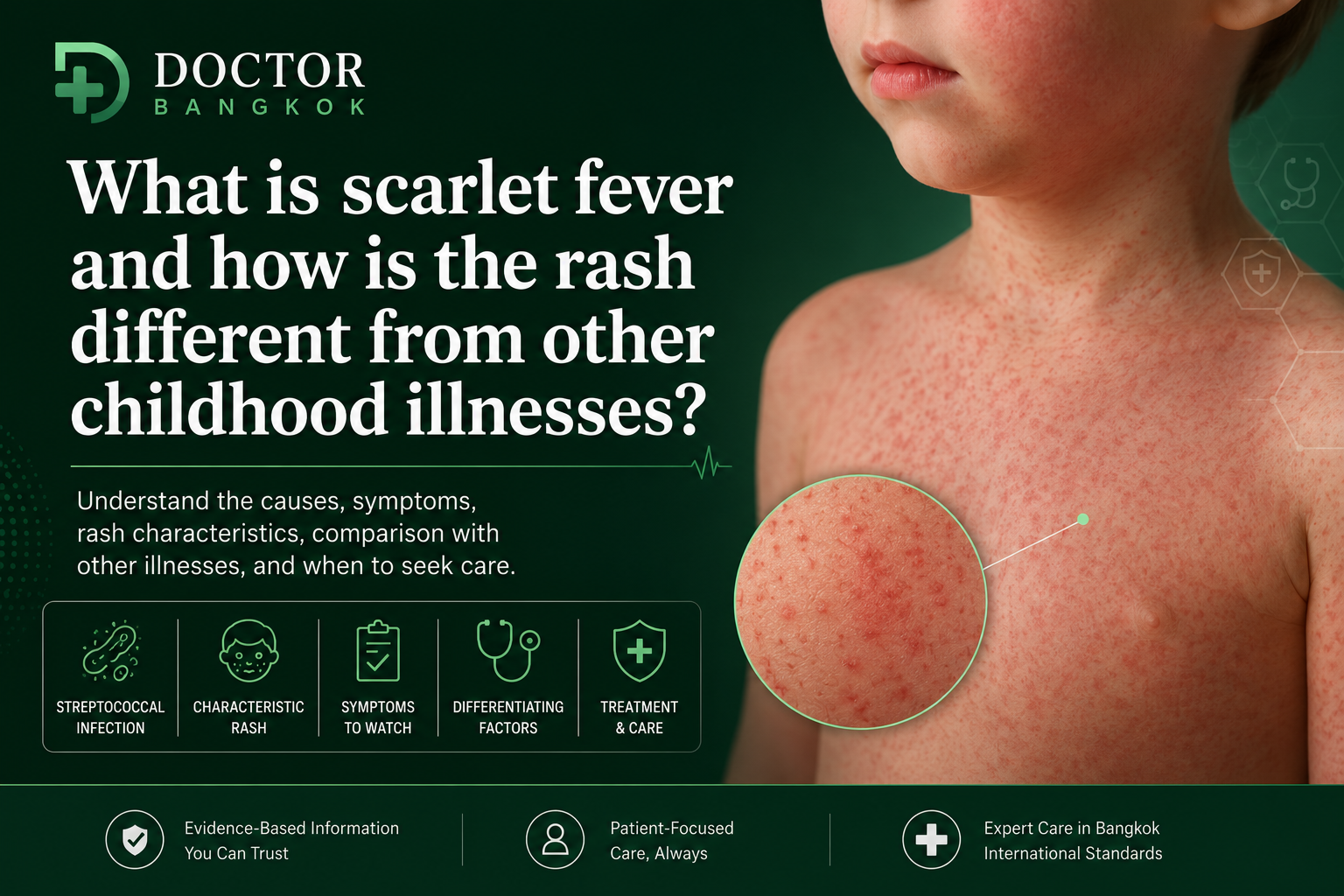
Scarlet fever is a bacterial throat infection that causes a rough, sandpaper-like rash, high fever, and sore throat. It is fully treatable with a ten-day course of antibiotics. Most patients feel noticeably better within 48 hours of starting treatment. Without a complete antibiotic course, serious complications including permanent heart damage are possible.
Most adults think of scarlet fever as something from a history book. In practice, we see it regularly in Bangkok clinics, in school-age children, in parents who caught it from their kids, and in adults who assumed a sore throat with an unusual rash was viral and waited too long to come in. Bangkok’s school calendar, shared transport, and dense housing mean group A Streptococcus moves through communities quickly. It is not rare here, and it is entirely treatable when caught early.
What separates scarlet fever from an ordinary strep throat is a toxin released by certain strains of the bacteria. That toxin causes the widespread skin rash. Not every strep infection produces it, which is why not every strep throat turns into scarlet fever. The diagnosis matters because starting antibiotics promptly shortens the illness and prevents complications that can cause lasting harm.

Scarlet Fever Symptoms: What to Look For
The illness usually starts one to four days after exposure. The first signs are a sudden high fever and a painful sore throat. Headache and nausea are common. The rash appears shortly after, usually within 12 to 48 hours of the fever starting.
The rash is what makes scarlet fever recognisable. It starts on the chest and abdomen before spreading to the neck, arms, and legs. The texture matters more than the colour. It feels rough, like fine sandpaper drawn across the skin. In lighter skin tones it appears as a red flush with a slightly darker, stippled texture. In darker skin tones the redness may be less visible, but the sandpaper feel is still there. The face is usually flushed, with a pale ring around the mouth called circumoral pallor.
Inside the mouth, the tongue changes too. In the first day or two it may look coated in white with red bumps poking through, called a white strawberry tongue. As the illness progresses, the coating sheds and the tongue turns bright red with raised bumps, the red strawberry tongue most clinicians associate with scarlet fever. The throat is typically very red, and the tonsils may have white or yellow patches.
Pastia lines are another sign worth knowing. These are dark streaks that form in skin creases, especially inside the elbow. When present, they help confirm the diagnosis. Towards the end of the first week, as the fever fades, the skin often starts to peel. This usually begins on the fingers and toes and can continue for one to three weeks. It looks alarming to parents but is a normal part of recovery and needs no treatment beyond moisturiser if the skin feels dry.
How Scarlet Fever Spreads and Who Is at Risk
Group A Streptococcus spreads through respiratory droplets. A cough, a sneeze, or close face-to-face conversation with an infected person is the usual route. Sharing food or drink carries real risk, which matters in school lunch settings and shared office kitchens.
Children aged five to fifteen account for most cases, and that pattern holds in Bangkok’s international school community. Adults are not immune. A parent with young children at school, a teacher, or someone in a shared flat can all contract it. Prior infection offers some protection against the same toxin strain, but different strains exist, so having had scarlet fever before does not mean it cannot happen again.
A person with scarlet fever is contagious until they have been on antibiotics for at least 24 hours and are fever-free. This matters for families with school-age children and for anyone working in healthcare, childcare, or food preparation.

Scarlet Fever in Adults Versus Children: Key Differences
Adults and children share the same core picture: fever, sore throat, and rash. Children tend to run a higher fever and show more obvious tonsillar involvement. Adults sometimes present with a milder fever, a less obvious rash, and a sore throat they have been tolerating for days under the assumption it is viral.
The sandpaper texture can be subtler in adults, particularly where the rash is still developing. The strawberry tongue and the rash pattern starting on the trunk before spreading outward are consistent across age groups, but they need to be looked for deliberately.
The risk of complications exists in both groups. An adult who stops antibiotics after three or four days because they feel better is exactly the patient who may return weeks later with a complication. Completing the full course is not optional.
Scarlet Fever Complications: When to Seek Urgent Care
Treated promptly and completely, scarlet fever resolves without lasting consequences in the vast majority of patients. Complications arise when treatment is delayed or the antibiotic course is not finished.
Rheumatic fever is the complication that makes this diagnosis worth taking seriously. It develops two to four weeks after the initial infection in patients who were not treated or did not complete treatment. It causes inflammation of the joints and heart, and cardiac damage, specifically to the heart valves, can be permanent. Completing the full ten-day course substantially reduces this risk.
Post-streptococcal glomerulonephritis is another potential complication affecting the kidneys. It presents one to three weeks after the initial infection with swelling around the eyes and ankles, reduced urine output, and darker-coloured urine. These symptoms need same-day assessment.
Seek urgent care, not a routine appointment, if you notice: severe throat swelling that makes swallowing very difficult, a stiff neck, a rash that turns purple or develops bruise-like areas, chest pain, joint swelling, reduced urine output, or confusion. These are not typical of uncomplicated scarlet fever and require prompt assessment.
Scarlet Fever Treatment: Antibiotics, Timeline, and Recovery
Scarlet fever is curable with antibiotics. Penicillin is the first-line treatment, and oral amoxicillin is the most commonly prescribed form because of its palatability and dosing schedule. The standard course is ten days. For patients with a confirmed penicillin allergy, alternatives such as azithromycin or a cephalosporin are appropriate depending on the allergy history.
Most patients feel meaningfully better within 24 to 48 hours of starting antibiotics. The fever drops, the sore throat eases, and energy starts to return. This improvement tempts many patients to stop the antibiotic early. What I tell patients is this: stopping early does not fully clear the bacteria. Residual bacteria can re-establish themselves, and the inflammatory process that leads to rheumatic fever can still be triggered even after symptoms have gone. The ten-day course is about clearing the infection, not just feeling better.
For fever and throat pain, paracetamol at appropriate doses works well. Ibuprofen is also effective for most patients, though it should be avoided in children with concurrent chickenpox and used carefully where kidney involvement is a concern. Keeping fluid intake up matters, especially when fever is high and the throat is making drinking uncomfortable.
The rash fades gradually over the first week. The skin peeling that follows is normal and needs no specific treatment other than moisturiser if the skin becomes dry. Peeling can last two to three weeks and tends to be most noticeable on the palms and fingertips.
Scarlet Fever Diagnostic Criteria
Scarlet fever is usually a clinical diagnosis. A doctor who sees the sandpaper rash, strawberry tongue, fever, and acute sore throat together has a strong basis to diagnose and treat without waiting for lab results. In practice, a rapid strep test is done at the same visit to add confirmation.
The rapid strep test uses a throat swab and gives a result within minutes. A positive test alongside the clinical picture is enough to start treatment the same day. If the rapid test comes back negative but the picture still strongly suggests scarlet fever, a throat swab culture, which takes 24 to 48 hours, is the next step.
| Feature | Typical Finding in Scarlet Fever |
|---|---|
| Onset | Sudden; fever and sore throat before rash |
| Fever | High, often above 38.5°C |
| Rash texture | Rough, sandpaper-like |
| Rash distribution | Trunk first, then limbs |
| Tongue | White strawberry early; red strawberry after day 2 to 3 |
| Throat | Red, often with tonsillar exudate |
| Pastia lines | Dark streaks in skin creases, especially elbow folds |
| Circumoral pallor | Pale ring around mouth against flushed face |
| Late finding | Skin peeling on fingertips and toes, weeks 1 to 3 |
Getting Diagnosed and Treated at a Private Clinic in Bangkok
For expats and visitors in Bangkok, the practical question is where to go and how quickly. Scarlet fever does not require an emergency department unless the red-flag symptoms above are present. A private clinic with same-day appointments, English-speaking physicians, and on-site rapid strep testing is the right first step for most presentations.
At Doctor Bangkok, the general medical consultation covers clinical assessment for fever, sore throat, and rash. Where the presentation points to scarlet fever, a rapid strep test is done during the same visit. A confirmed diagnosis means a prescription the same day, with guidance on fever management, when to isolate from school or work, and which symptoms should prompt a return. The clinic is BTS accessible and accepts same-day bookings.
If you are unsure whether what you are seeing is scarlet fever or something else, that uncertainty is itself a reason to be assessed. The earlier antibiotics are started, the shorter the illness and the lower the risk of complications.
Fever, sore throat, and a sandpaper rash need same-day assessment. Doctor Bangkok offers walk-in and same-day appointments for fever assessment, rapid strep testing, and antibiotic prescriptions for scarlet fever in adults and children. English-speaking physicians, BTS accessible, central Bangkok. Book at doctorbangkok.co.th.
Frequently Asked Questions
Can adults get scarlet fever, or is it only a childhood illness?
Adults can and do get scarlet fever. It is more common in children aged five to fifteen, but adults living with school-age children, working in schools, or sharing close living spaces with an infected person face real exposure risk. The presentation in adults is sometimes milder, which can delay diagnosis. The risk of complications, including rheumatic fever, remains if the infection goes untreated or the antibiotic course is not completed.
How quickly do antibiotics work for scarlet fever?
Most patients notice a meaningful drop in fever and less throat pain within 24 to 48 hours of starting antibiotics. The rash fades gradually over the first week. Despite feeling better within the first few days, the full ten-day course must be completed. Stopping early leaves residual bacteria that can still trigger the inflammatory process responsible for rheumatic fever, even after symptoms have fully gone.
Is scarlet fever dangerous, and what complications should I watch for?
Treated promptly and completely, scarlet fever is not dangerous for the vast majority of patients. Rheumatic fever is the most serious potential complication, developing two to four weeks after the initial infection and capable of causing permanent heart valve damage. Post-streptococcal glomerulonephritis can develop one to three weeks after infection and presents with swelling around the face or ankles, reduced urine output, and darker-coloured urine, all of which need same-day assessment. During the acute illness, a stiff neck, severe difficulty swallowing, a rash that turns purple or bruise-like, chest pain, or confusion require urgent care.
Do I need a throat swab to diagnose scarlet fever, or can a doctor diagnose it by examination?
Scarlet fever is often diagnosed by clinical examination alone. A doctor who sees the sandpaper rash, strawberry tongue, fever, and sore throat together has a strong basis for diagnosis. A rapid strep test adds useful confirmation and takes only minutes. At Doctor Bangkok, the rapid strep test is done during the same consultation, so patients do not need to return for results before starting antibiotics. A throat swab culture taking 24 to 48 hours is typically reserved for cases where the rapid test is negative but clinical suspicion remains high.
How long is someone with scarlet fever contagious?
A person with scarlet fever is contagious from the onset of symptoms until they have been on antibiotics for at least 24 hours and are fever-free. Both conditions are required before returning to school or work. Household members who develop a sore throat, fever, or rash during this period should seek clinical assessment promptly rather than waiting to see whether symptoms resolve on their own.
Can scarlet fever come back after it has been treated?
Reinfection is possible. Immunity after one episode is specific to the toxin strain responsible for that infection. Multiple strains exist, so prior infection does not protect against all future infections. Reinfection is less common than a first episode but does occur, particularly where re-exposure is ongoing. If a patient who recently completed antibiotics develops a new fever, sore throat, and rash, they should seek reassessment rather than assuming it is a relapse or a coincidental viral illness.
About the Author
Dr. Ponlawat Pitsuwan
Physician, Doctor Bangkok
A private medical clinic in central Bangkok. He sees expats, residents, and medical tourists for fever assessment, bacterial infections, and general medical consultations, including the diagnosis and treatment of scarlet fever in adults and children. His focus is evidence-based care delivered in plain language.

Dr. Ponlawat Pitsuwan is a physician at Doctor Bangkok, a private clinic in central Bangkok. He sees expats, residents, and medical tourists for general medicine, wellness consultations, and IV therapy. His focus is straightforward, evidence-based care delivered in plain language.