
Clinically reviewed by Dr. Ponlawat Pitsuwan, Physician, Doctor Bangkok.
Last reviewed: August 2026
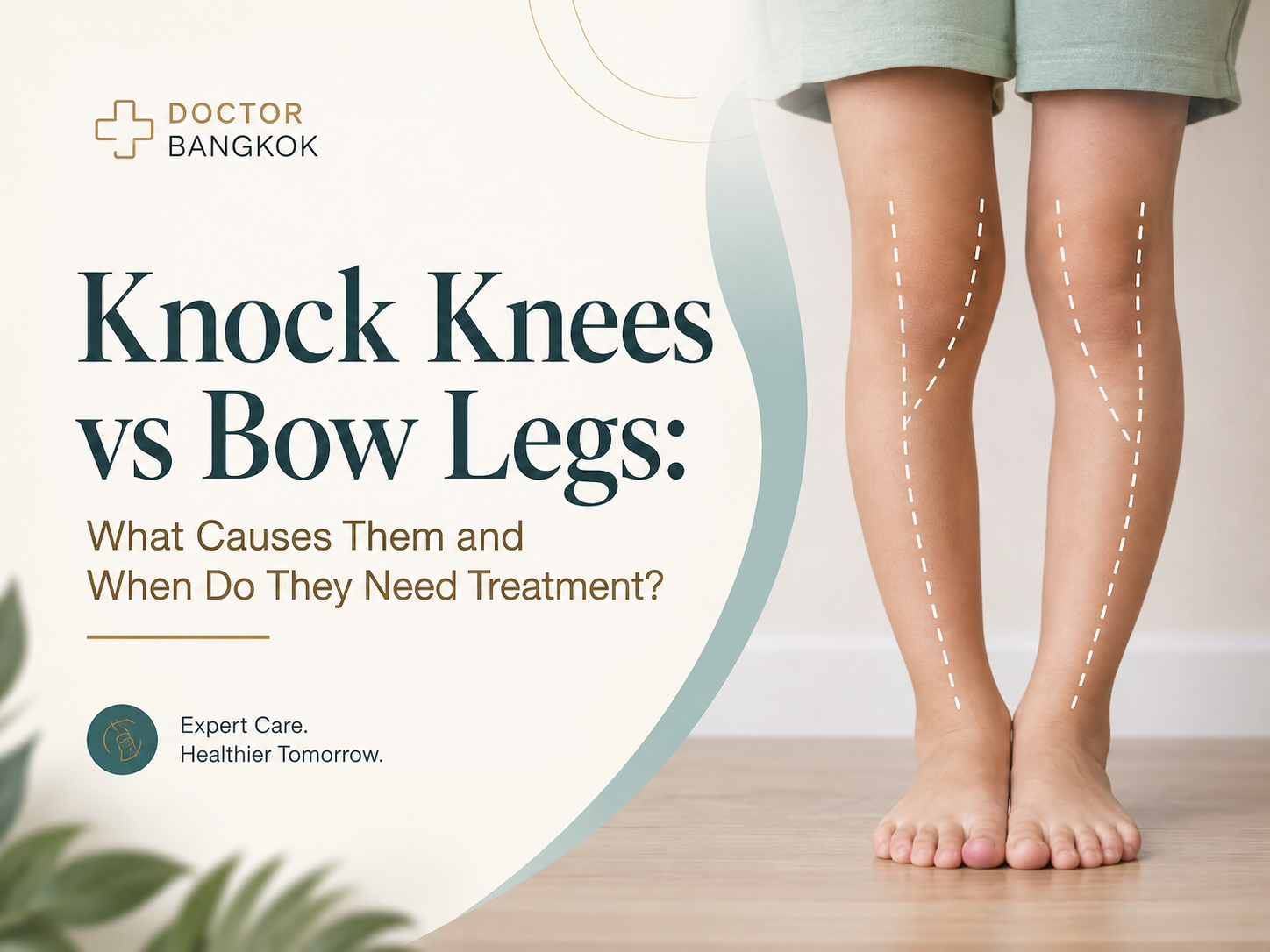
Knock knees, called genu valgum, mean your knees touch when you stand but your ankles do not. Mild cases in children usually self-correct by age seven. In adults, the condition does not fix itself, and if you have knee pain, a worsening gait, or an ankle gap larger than about ten centimetres, a clinical assessment is the right next step.
A lot of adults walk around Bangkok every day with knock knees and have never had them looked at. They noticed it as a teenager, figured it was just how they were built, and got on with life. Then the knee pain started, or the gait shifted, or someone pointed it out, and suddenly they are searching at midnight wondering if they have left it too long.
For most people, this is not an emergency. But adult knock knees do not self-correct, and ignoring them for years does add up. Whether you are based here long-term or passing through, getting a proper assessment does not take long and tells you exactly where you stand.

What Are Knock Knees, and How Are They Different from Bow Legs?
Stand with your feet together and look in a mirror. If your knees touch but your ankles do not, that is knock knees, or genu valgum. If the opposite is true, a gap at the knee with ankles touching, that is bow legs, or genu varum.
The two conditions pull the knee in opposite directions. Knock knees push the lower leg outward and put extra stress on the outer knee and kneecap. Bow legs press harder on the inner side. Both can cause pain and joint wear, but they are treated differently, which is why the right diagnosis matters before anything else.
Normal vs. Abnormal: When Does the Angle Become a Problem?
Some degree of knock knees is completely normal in young children. Most kids between three and five have noticeable inward knee alignment that straightens on its own by age six or seven.
In adults, the practical sign to watch for at home is this: if the gap between your inner ankles is more than about ten centimetres when your knees are touching, that is worth having assessed. No pain, no change in gait, gap well under that? You are likely fine. Any symptoms, or a gap above that threshold, come in.

What Causes Knock Knees in Adults?
Most people assume knock knees are something you either grow out of or do not. But adults can develop or worsen the condition for several reasons.
Osteoarthritis is a common driver. When cartilage on the outer side of the knee wears down, it gradually shifts the leg inward. Excess body weight speeds this up, since every extra kilogram increases the load through the joint with every step. Previous knee injury, including ligament tears or fractures that healed slightly off-axis, can also cause the leg to drift over time.
Vitamin D deficiency is worth mentioning here, especially in Bangkok. Expats who work indoors and avoid the midday heat often have lower levels than they expect. In children, severe deficiency causes rickets, a known cause of genu valgum. In adults it will not reshape bone, but chronic deficiency affects cartilage health in ways that compound existing alignment problems. A simple blood test covers this.
Some cases are genetic, structural differences that were always present and simply become more symptomatic with age and activity.
How Knock Knees Are Diagnosed
When you come in for an assessment, we start by watching you walk. Gait tells us a lot before any measuring begins. Then we look at how you stand, check the alignment of your hips, knees, and feet, and measure the ankle gap.
We also check the Q angle, the relationship between your quadriceps and your kneecap tendon. A high Q angle, common with knock knees, increases strain through the front of the knee and often explains the kneecap pain patients describe after stairs or long periods of sitting.
If the physical exam suggests the angle is significant, we refer for a weight-bearing X-ray. This is done standing, which matters because a lying-down X-ray does not show how your joints load under your actual body weight. That image maps the mechanical axis of the leg and gives us a precise degree of deformity to work from.
Non-Surgical Treatment Options for Knock Knees
For mild to moderate knock knees in adults, non-surgical management is the starting point. It cannot reshape bone, but it can reduce pain, slow joint wear, and improve how the knee functions day to day.
Custom orthotics, insoles prescribed and fitted to your foot, help redistribute load across the knee during walking. Off-the-shelf pharmacy insoles are not the same thing and rarely sufficient for true genu valgum. After your assessment at Doctor Bangkok, we can point you toward the right physiotherapy or specialist fitting in the city.
Weight management has strong evidence behind it. Reducing body weight is one of the most effective non-surgical steps you can take for a knee that is already under abnormal load.
Exercises for Knock Knees: What Actually Helps
Exercise will not correct bone alignment in an adult. I want to be clear about that. But it can significantly reduce the inward collapse of the knee during movement, which is where a lot of the pain and damage actually come from.
The muscles that matter most are the hip abductors, on the outside of the hip, which stop the knee from caving inward during movement. Clamshells and lateral resistance band walks target these directly. The VMO, the teardrop-shaped muscle on the inner quadriceps, is equally important. Terminal knee extensions and single-leg step-downs train it well.
If you run, do Muay Thai, or spend long hours at a desk before hitting the gym, these exercises are especially relevant. A desk-bound lifestyle shortens the hip flexors and weakens the glutes, which pushes knees further inward under load. A physiotherapist can build a programme specific to your activity level and alignment.
Complications If Knock Knees Go Without Assessment
This is the part most people do not think about until it is already happening. Knock knees that are never assessed tend to progress slowly. The outer knee takes more load than it should, and over years that leads to lateral compartment arthritis. Once cartilage is gone, it does not regenerate.
Patellar maltracking is another common result. The kneecap, pulled outward by the altered alignment, starts to track unevenly in its groove. This causes a specific type of front-knee pain that gets worse going down stairs or sitting for long periods. Quite a few expats I see have been managing this with ibuprofen for months without knowing the underlying cause.
Getting assessed early does not mean you need surgery. It means you know your options while all of them are still available.
When Surgery Is Considered for Knock Knees
Surgery is not the first step. For adults with a significant valgus angle, ongoing pain, and a joint that is worsening despite conservative management, it may be the right one.
The most common procedure is a distal femoral osteotomy, where the thigh bone is cut and realigned to shift load away from the damaged compartment. In younger patients with growth plates still open, guided growth surgery uses a small implant to gradually correct alignment as the child grows. These are specialist procedures performed by orthopaedic surgeons.
Doctor Bangkok does not perform surgical correction, but we assess you, arrange imaging, and coordinate a referral to the right orthopaedic specialist in Bangkok when that step is needed.
When to See a Doctor in Bangkok About Knock Knees
If your knees are painful, your gait has changed, or you have simply never had this looked at and the ankle gap is noticeable, a GP consultation is the right starting point.
At Doctor Bangkok, our English-speaking physicians do a full lower limb assessment, take your history, and tell you honestly whether imaging or a specialist referral is warranted. Most international health insurance policies cover GP consultations and diagnostic imaging as standard. We provide itemised receipts for all consultations, which makes reimbursement straightforward.
You do not need a referral letter or a diagnosis to come in. Describe what you are experiencing, and we work out the right next step from there.
Knee pain or a change in how you walk? Doctor Bangkok offers English-language GP consultations with full lower limb assessment, weight-bearing X-ray referral, and orthopaedic specialist coordination when needed. Our clinic is centrally located in Bangkok and BTS accessible. Book at doctorbangkok.co.th or contact us directly for same-day appointments.
Frequently Asked Questions
Dr. Ponlawat Pitsuwan
Physician, Doctor Bangkok
a private medical clinic in central Bangkok. He sees expats, residents, and medical tourists for musculoskeletal assessments, general medicine, and diagnostic referrals. His focus is straightforward, evidence-based care delivered in plain language.
Dr. Ponlawat Pitsuwan is a physician at Doctor Bangkok, a private clinic in central Bangkok. He sees expats, residents, and medical tourists for general medicine, wellness consultations, and IV therapy. His focus is straightforward, evidence-based care delivered in plain language.