Clinically reviewed by Dr. Ponlawat Pitsuwan, Physician, Doctor Bangkok. Last reviewed: July 2026
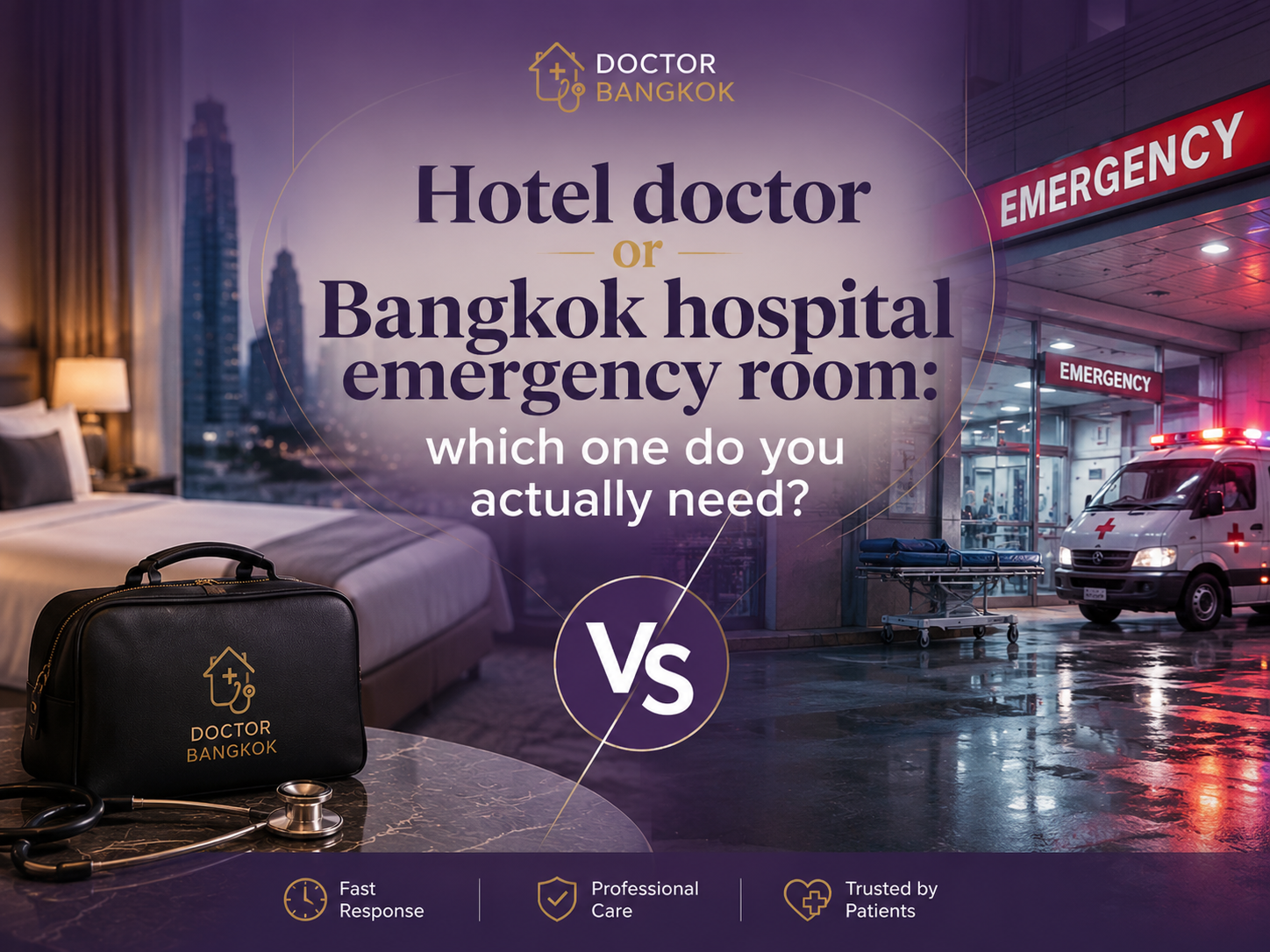
For most illnesses that hit you in a Bangkok hotel room — high fever, food poisoning, severe dehydration, a wound that needs cleaning — a hotel doctor visit is the faster, cheaper, and clinically appropriate choice. The emergency room is for true emergencies: chest pain, stroke signs, major trauma, loss of consciousness. If you are not sure, call a doctor first. They will tell you honestly if you need to go to hospital.
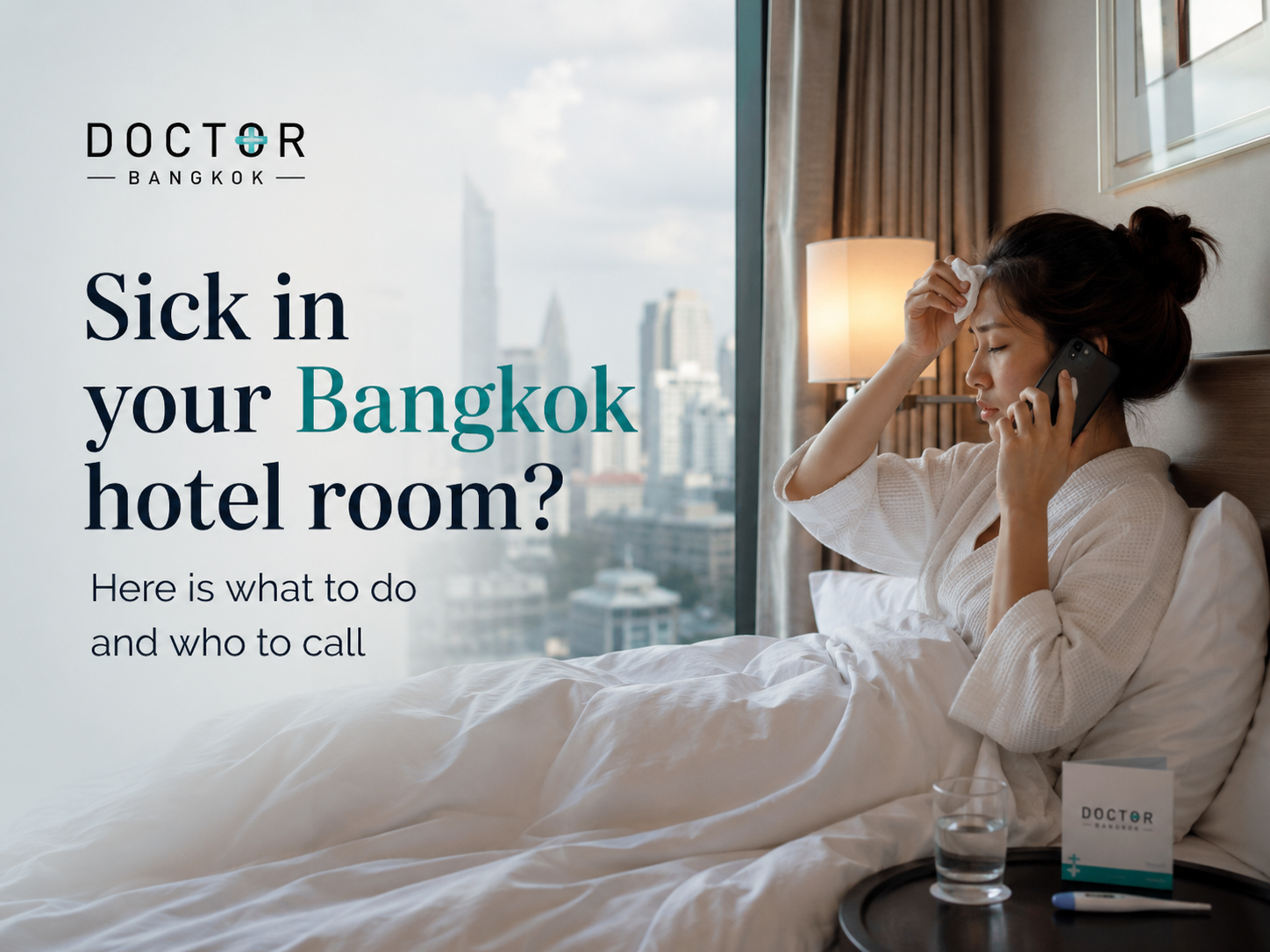
It is 2am. You are in a Bangkok hotel room and you feel awful. Your fever is climbing, your stomach is a mess, or you have a wound that does not look right. Your first instinct is probably to search for the nearest hospital. But here is what I tell every patient who calls me after a miserable night at a Bangkok ER: for a lot of what goes wrong on a trip, the emergency room was never the right first step.
Bangkok has a real alternative. A licensed physician can be at your hotel room within the hour, equipped to examine you, run tests, give you medication, and set up an IV drip right there on the bed. The question is not whether that is convenient. The question is whether it is clinically right for what you have. That is what this article answers.

The three-tier decision: pharmacy, hotel doctor, or emergency room
Not everything needs a doctor. Not everything needs an ER. Before you decide, ask yourself which tier fits.
The first tier is the pharmacy. A mild cold, minor stomach upset, a small scratch, or a headache you have had before — these usually do not need a physician. Bangkok pharmacies are well-stocked and pharmacists here are genuinely helpful.
The second tier is a hotel doctor visit. This is where most sick travellers actually belong. High fever, severe dehydration from food poisoning, a wound that needs proper cleaning, suspected dengue, a urinary tract infection, an animal bite — all of these need a real doctor, but none require an emergency room.
The third tier is the emergency room, and ideally an ambulance. Chest pain, signs of a stroke, a severe allergic reaction, major bleeding, loss of consciousness, or serious injury. These are true emergencies. Do not wait for a hotel doctor. Call 1669, Thailand’s emergency number, or get to the nearest hospital immediately.
True emergencies: when to call an ambulance first
Call 1669 or go straight to the ER for any of the following. Do not call a hotel doctor first.
Chest pain or pressure, especially with sweating or arm pain. Any sign of a stroke: sudden face drooping, arm weakness, or speech that does not make sense. A severe allergic reaction with throat tightening or breathing difficulty. Loss of consciousness or a seizure, especially a first one. Major bleeding that is not stopping. A serious road accident or fall from height. Breathing that is fast, laboured, or getting worse quickly.
For everything else, a doctor coming to you is almost always the smarter move. And if a hotel doctor examines you and decides you need hospital admission, they will coordinate that directly. You will not arrive at the ER alone with no one expecting you.

Why not just go to the ER?
I hear this a lot: "I did not want to bother anyone, so I just took a Grab to Bumrungrad." I understand the instinct. But here is what actually happens when a non-emergency patient shows up at a Bangkok private hospital ER at midnight.
First, there is the cost. Assessment and triage at a major international private hospital in Bangkok typically starts at 8,000 to 15,000 THB before any treatment begins. If you need an IV, bloodwork, or imaging, that climbs fast. A hotel doctor visit covers the consultation, examination, point-of-care testing, medication, and IV fluids if needed — usually for significantly less.
Then there is Bangkok traffic. At 2am it is manageable, but at 10pm on a Friday, a ride to Sukhumvit’s major hospitals can take 45 minutes or longer. You are unwell, finding your way around a large hospital in a foreign language, and waiting behind patients who are more critical than you. An ER triage nurse will correctly deprioritise a stable fever. You could wait two hours.
There is also the language issue. Bangkok’s top private hospitals have English-speaking staff, but coverage is inconsistent in a busy overnight ER. A hotel doctor from Doctor Bangkok will speak to you directly, in plain English, in your room.
Conditions best handled by a hotel doctor in Bangkok
These are the cases I see most often, and the ones where a hotel visit genuinely makes clinical sense.
Food poisoning and traveller’s diarrhoea are the most common. Bangkok’s street food is wonderful, but it does catch people out. Severe vomiting and diarrhoea can dehydrate you quickly in the heat. IV fluids, anti-nausea medication, and proper advice on what to eat over the next 48 hours — all of that can happen in your room.
A high fever that will not break needs assessment. Dengue fever is real in Bangkok and can look exactly like severe flu for the first couple of days. A doctor can examine you, check your history, and decide if you need a dengue blood test. Dengue does not always need hospital admission, but it does need proper monitoring. A hotel visit starts that process the right way.
Animal bites, especially from dogs or monkeys, need attention the same day. Rabies post-exposure treatment needs to start quickly, and the first vaccine dose can be organised through a hotel visit. Do not wait until morning. Wounds from a motorbike scrape or a bad fall, urinary tract infections, and respiratory infections with fever are all hotel doctor territory.
What happens during a Doctor Bangkok hotel visit
Here is exactly what to expect when you contact us for a hotel visit.
You reach us by phone or WhatsApp. We confirm your location, your symptoms, and your hotel. A licensed physician, not a nurse or a call centre, is dispatched to you. For most of central Bangkok — Sukhumvit, Silom, Sathorn, Siam, Riverside, and nearby areas — the doctor typically arrives within 45 to 75 minutes.
The doctor brings a full clinical kit: stethoscope, blood pressure equipment, a pulse oximeter to check your oxygen levels, thermometer, blood glucose testing, and point-of-care blood tests where relevant. Medication is dispensed at the bedside. If you need an IV drip for dehydration or severe vomiting, it goes up in your room.
If the doctor examines you and decides you need hospital care, they do not just hand you a taxi number. They contact the receiving hospital, brief the team, and coordinate your admission. That pre-briefed handover makes a real difference to the care you receive.
Insurance, payment, and documentation
Most international travel insurance and expat health insurance policies cover urgent medical consultations, including hotel visits. The key is documentation, and this is where a lot of patients run into trouble with informal services.
Doctor Bangkok provides itemised English-language receipts and a signed doctor’s letter as standard. These are what your insurer will ask for. Without them, reimbursement claims get rejected or delayed. Keep every piece of paperwork.
For cases that require hospital admission, we can liaise with international insurer assistance lines about direct billing arrangements. You should still contact your insurer yourself as soon as you are able, but we make that process easier.
If you are paying out of pocket, a hotel visit is a fraction of what an ER visit costs at a Bangkok international private hospital, including medication and IV fluids. Ask for the full fee upfront so there are no surprises.
Sick in your Bangkok hotel room? Doctor Bangkok sends a licensed, English-speaking physician to you — any hour, any day. We cover central Bangkok including Sukhumvit, Silom, Sathorn, Siam, and Riverside. We bring full clinical equipment, medication, and IV fluids if needed. If you need hospital care, we coordinate it directly. Contact us by phone or WhatsApp, or visit our hotel doctor visit page to book. Do not spend the night guessing. Get a real doctor to your room.
FAQ
How do I know if I need a hotel doctor or the emergency room in Bangkok?
If you have chest pain, signs of a stroke, a severe allergic reaction, or you are unconscious, seizing, or seriously injured, call 1669 and go to the ER immediately. For everything else — high fever, food poisoning, dehydration, wounds, animal bites, suspected dengue — a hotel doctor is the right first step. If the doctor examines you and decides you need hospital care, they will arrange it.
How much does a hotel doctor visit in Bangkok cost compared to the emergency room?
A Bangkok international private hospital ER typically charges 8,000 to 15,000 THB for initial assessment before any treatment begins. A Doctor Bangkok hotel visit covers the full consultation, examination, medication, and IV fluids if needed, usually for significantly less. Most international travel insurance and expat health policies cover hotel doctor visits, and we provide the documentation your insurer requires.
What can the doctor actually do in my hotel room?
This is a full physician visit, not a telemedicine call. The doctor brings clinical equipment, performs a physical examination, runs point-of-care blood tests where appropriate, dispenses medication at the bedside, and sets up an IV drip if needed. If your case needs hospital admission, the doctor coordinates that directly with the receiving team.
Does a hotel doctor visit work with travel insurance?
Yes. International travel insurance and expat health policies routinely cover urgent medical consultations including hotel visits. Doctor Bangkok provides itemised English-language receipts and a signed doctor’s letter as standard — the exact documents your insurer will ask for. Keep all paperwork and contact your insurer as soon as you are able.
How quickly can a doctor reach my Bangkok hotel?
For central Bangkok — Sukhumvit, Silom, Sathorn, Siam, Riverside, and nearby areas — most visits are fulfilled within 45 to 75 minutes of your call or WhatsApp message, at any hour, including public holidays. Contact us to confirm availability and your exact location.
Can a hotel doctor help if I think I have dengue fever?
Yes. Dengue is something I see regularly in Bangkok, and a hotel visit is an appropriate first step. The doctor will assess your symptoms, arrange a blood test if indicated, and advise on whether you need hospital monitoring or can recover with close observation. Early assessment matters with dengue, so do not wait to see if it improves on its own.
What if I got bitten by a dog or monkey in Bangkok?
Contact a doctor the same day. Rabies post-exposure treatment needs to begin quickly, and the first vaccine dose can be organised through a hotel visit or at our clinic. The wound also needs proper cleaning to reduce infection risk. Do not wait until the next morning or assume it will be fine.
Dr. Ponlawat Pitsuwan
Physician, Doctor Bangkok
a private medical clinic in central Bangkok. He sees expats, residents, and medical tourists for urgent medical care, hotel doctor visits, travel medicine, and general consultations. His focus is straightforward, evidence-based care delivered in plain language.
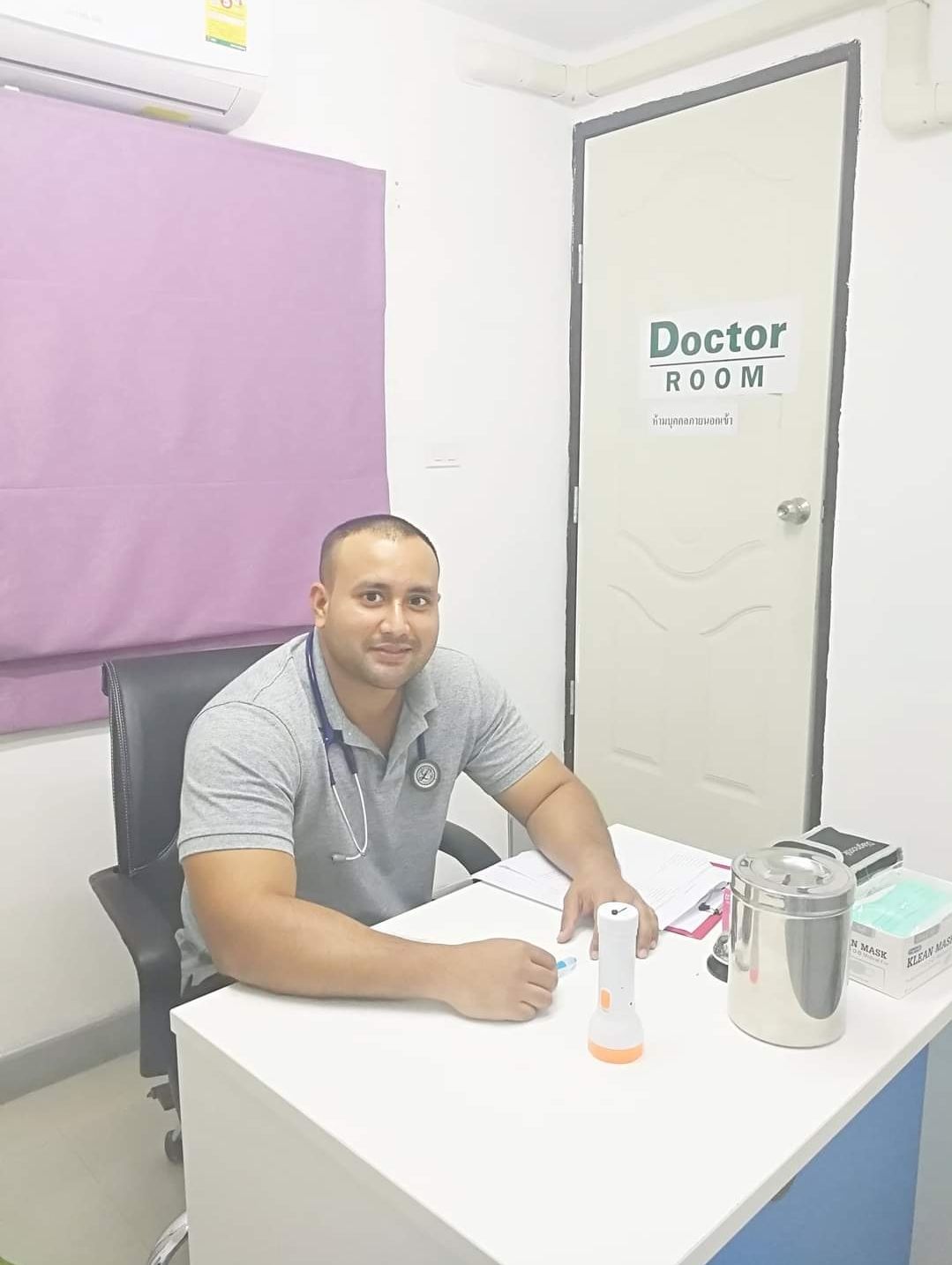
Dr. Ponlawat Pitsuwan is a physician at Doctor Bangkok, a private clinic in central Bangkok. He sees expats, residents, and medical tourists for general medicine, wellness consultations, and IV therapy. His focus is straightforward, evidence-based care delivered in plain language.