
Clinically reviewed by Dr. Ponlawat Pitsuwan, Physician, Doctor Bangkok.
Last reviewed: July 2026
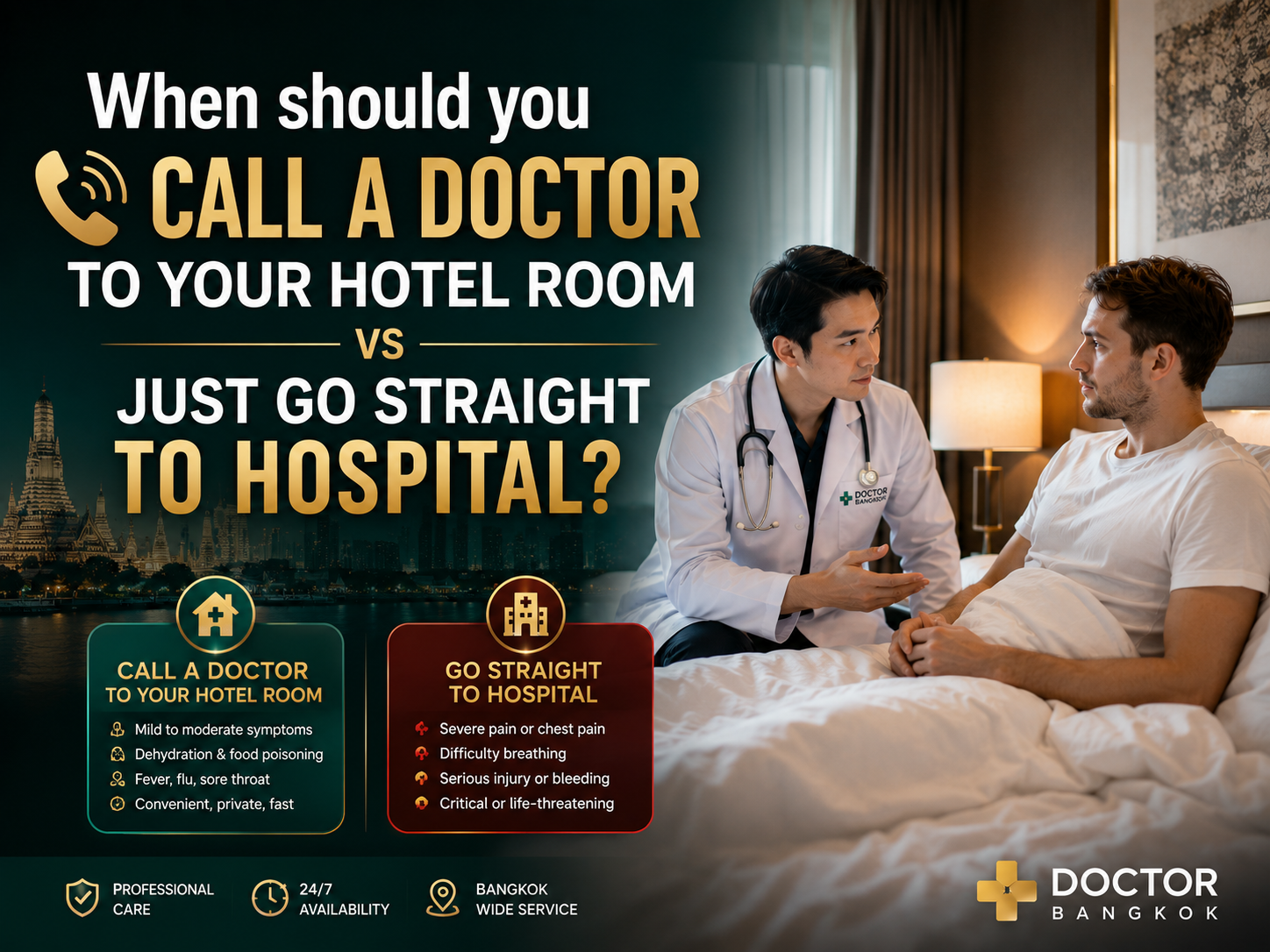
Most illnesses that hit travellers in Bangkok, including fever, food poisoning, and traveller’s diarrhoea, can be assessed and treated in your hotel room by a visiting doctor. Go straight to hospital for chest pain, stroke symptoms, uncontrolled bleeding, severe difficulty breathing, or loss of consciousness. If you are not sure which applies to you, calling a doctor to come to you is usually the safer and faster first step.
You are lying in your hotel room at midnight. Your stomach has been cramping for hours, your fever is climbing, and you are trying to decide whether to call someone or drag yourself into a Bangkok taxi. This is the situation I hear about every week. The decision is not always obvious, especially when you are sick, alone, and far from home.
Most things can be handled in your room. Some things cannot. Knowing the difference could genuinely matter. This article tells you exactly where the line is, what a visiting doctor can do in Bangkok, and when you need to skip the call and go straight to an emergency room.

What a doctor can actually do in your hotel room
More than most people expect. When I do a hotel visit, I bring proper clinical equipment. That means checking your temperature, blood pressure, pulse, and oxygen levels. I can do a urine dipstick test, check blood glucose, and carry medications to give you on the spot, including antiemetics, pain relief, and antibiotics when they are clinically appropriate.
If you are too dehydrated to keep fluids down, I can set up an IV drip in your room. I can also arrange same-day blood tests through a visiting phlebotomist if we need to check for dengue or infection markers. Prescriptions can be written and medications delivered. The limits of in-room care are real but narrower than most people assume.
What I cannot do in your room is anything that requires imaging, surgery, a cardiac monitor, or intensive care. If your situation calls for those, I will tell you directly and help arrange transfer.
Conditions that are well-suited to a hotel doctor call
These are the situations I get called for most often in Bangkok, and they are the right call.
Food poisoning and traveller’s diarrhoea are the top two. You have been sick for hours, you cannot keep anything down, and you are worried about dehydration. A visiting doctor can assess you, give IV fluids if needed, prescribe the right medication, and check whether something more serious is going on. Going to a Bangkok hospital ER for this usually means hours of waiting and significant cost for a condition that can be managed in your room.
Fever without alarming symptoms is another common one. You have a temperature and feel rough, but you are not struggling to breathe and you are not confused. A hotel visit lets us assess the likely cause, run a rapid dengue test if the picture fits, and start treatment without you sitting in a waiting room feeling terrible.
Urinary tract infections, skin infections, mild allergic reactions, respiratory infections, and wound checks all fall into the same category. You are unwell enough to need a doctor, but not so unwell that you need emergency hospital care. That is exactly the gap a hotel visit fills.

Bangkok-specific illnesses that change the decision
Bangkok is not London or New York. There are illnesses here that require different thinking. Here are three that come up regularly.
Dengue fever starts with high fever, severe body aches, headache, and pain behind the eyes. A hotel doctor can do a rapid NS1 antigen test to check for dengue early in the illness. If it comes back positive and you have no warning signs, close monitoring in your hotel is sometimes appropriate. Warning signs, including bleeding gums, severe abdominal pain, persistent vomiting, or confusion, mean you need a hospital. I will tell you clearly if we reach that point.
Heat exhaustion is something I see particularly in visitors who have spent a long day outdoors in the Bangkok heat. You feel dizzy, weak, and nauseous, with pale and clammy skin. This responds well to rest, cooling, and IV hydration in your room. Heat stroke is different. If you stop sweating, become confused, or lose consciousness, that is an emergency. Call 1669 for an ambulance.
Animal bites, particularly dog bites, are a specific Bangkok concern. Thailand has a real risk of rabies, and any bite from an unknown animal requires post-exposure vaccination. That cannot be handled in your hotel room. Do not wait and do not call a hotel doctor for this one. Go straight to a hospital.
When to skip the hotel call and go straight to hospital
There are situations where calling a doctor to your room wastes time you do not have.
Go straight to a hospital emergency room if you have chest pain or pressure. Go if you have any sign of stroke: face drooping on one side, arm weakness, slurred speech, or a sudden severe headache unlike anything before. Go if you are bleeding and cannot control it, or if you are having serious difficulty breathing at rest. Go if you are confused or cannot be woken properly.
Go if you have a serious allergic reaction with throat tightening, facial swelling, or any difficulty breathing. Go if you have been bitten by an animal. Go if you have taken something you should not have.
Bangkok has excellent private hospitals with 24-hour emergency rooms. Bumrungrad International and Samitivej Sukhumvit are both accessible from central Bangkok and have English-speaking staff. Thailand’s emergency number is 1669 for an ambulance.
The three-way decision: hotel doctor, clinic walk-in, or hospital ER
Most people think of this as a binary choice. It is not. There is a middle option: walking into a private clinic during the day, which may be faster and cheaper if you are well enough to travel. Here is how to think about it.
| Situation | Best option |
|---|---|
| Sick at night, cannot travel comfortably | Hotel doctor visit |
| Fever, vomiting, diarrhoea, moderate dehydration | Hotel doctor visit |
| Mild illness, can walk and travel | Walk-in clinic |
| Need blood tests, vaccinations, STD check | Walk-in clinic |
| Follow-up from a hotel visit | Walk-in clinic |
| Chest pain, stroke signs, uncontrolled bleeding | Hospital ER immediately |
| Severe breathing difficulty | Hospital ER immediately |
| Animal bite | Hospital ER immediately |
| Loss of consciousness | Hospital ER, call 1669 |
The hotel visit costs more than a clinic walk-in. That is the honest reality. But when you are too unwell to travel safely, when it is 2am, or when Bangkok traffic means a long taxi ride followed by hours in a waiting room, the hotel visit is often the more practical choice. Our page on doctor hotel visits versus walking into the clinic explains the cost and process in full.
Travel insurance and hotel doctor visits in Bangkok
Most international travel insurance policies cover medically necessary consultations wherever they take place, including your hotel room. The key phrase is "medically necessary." A significant fever, food poisoning, or a genuine illness almost always qualifies.
Doctor Bangkok provides a full itemised receipt with the consultation details, diagnosis, and treatment given. That is what your insurer needs to process a reimbursement claim. Keep every document you receive, including prescriptions and any referral letters.
Check your policy before you travel to see whether it requires pre-authorisation for non-emergency care outside a hospital. Some do, some do not. If yours does and the situation is not urgent, call your insurer before calling the doctor. If it is urgent, get the care first and sort the paperwork after.
Not just hotels: who else can call a doctor to them in Bangkok
If you are in a serviced apartment, a condominium, or an Airbnb anywhere in central Bangkok, the Doctor Bangkok visiting doctor service works exactly the same way. You do not need to be in a hotel. Contact us by phone or WhatsApp, share your address, and a physician is dispatched to you.
Long-stay expats, business travellers in corporate apartments, and visitors in residential accommodation all use this service. The distinction that matters is not the type of building. It is whether your condition is suited to in-room care or needs something more.
What to expect when you call Doctor Bangkok for a hotel visit
You contact us by phone or WhatsApp. We ask about your symptoms, your location, and whether there are any immediate red flags. If the situation sounds like it needs a hospital, we will tell you that on the call. If it suits a hotel visit, we give you an estimated arrival time.
In central Bangkok, including Sukhumvit, Silom, and Sathorn, arrival is typically 45 to 75 minutes. Bangkok traffic is a real variable, especially at peak hours, and we are upfront about that. The doctor assesses you properly, treats what can be treated in the room, and arranges follow-up or referral if needed. You receive full documentation for your records and for any insurance claim.
Sick in your Bangkok hotel room? Doctor Bangkok dispatches an English-speaking physician to hotels, serviced apartments, and private residences across central Bangkok. We assess your symptoms, start treatment in your room, and tell you honestly if you need hospital care instead. Contact us by phone or WhatsApp to book a visit, or if you are well enough to travel, come directly to our clinic on Sukhumvit Soi 13, a short walk from BTS Nana. Find out more about how our hotel visit service works and how it compares to a clinic appointment.
How quickly can a doctor reach my Bangkok hotel?
In central Bangkok, including Sukhumvit, Silom, and Sathorn, Doctor Bangkok typically arrives within 45 to 75 minutes of booking. Bangkok traffic is a genuine variable, particularly during morning and evening peak hours, and we give you an honest estimated time when you call. That is usually still faster than getting a taxi, travelling to a private hospital, and waiting through emergency triage.
Could this be dengue? Should I call a hotel doctor or go straight to hospital?
Early dengue looks like a bad fever with severe body aches and headache. A hotel doctor can do a rapid NS1 antigen test in your room to check. If you have warning signs, specifically bleeding gums, severe abdominal pain, persistent vomiting, or confusion, go straight to hospital. Without those symptoms, a hotel assessment is a reasonable and often faster first step.
Will my travel insurance cover a hotel doctor visit in Bangkok?
Most international travel insurance policies cover medically necessary consultations regardless of where they take place. Doctor Bangkok provides a full itemised receipt with your diagnosis and treatment details, which is what insurers need for a claim. Check whether your policy requires pre-authorisation for non-hospital care before you call, unless the situation is urgent, in which case get the care first.
What symptoms mean I should go straight to a hospital and not call a hotel doctor?
Chest pain, any sign of stroke, uncontrolled bleeding, severe difficulty breathing, loss of consciousness, serious allergic reaction, and any animal bite all require a hospital emergency room, not a hotel visit. Thailand’s emergency number is 1669. Bumrungrad International and Samitivej Sukhumvit both have 24-hour ERs with English-speaking staff.
I am in a serviced apartment or Airbnb, not a hotel. Can a doctor still come to me?
Yes. The Doctor Bangkok visiting service covers any private accommodation in central Bangkok, including serviced apartments, condominiums, and Airbnb properties. Contact us by phone or WhatsApp, share your address, and we dispatch a physician to you. The process is identical to a hotel booking.
Is there anything a hotel doctor cannot treat in my room that I might expect them to?
Anything requiring imaging, surgery, cardiac monitoring, or intensive care cannot be handled in a hotel room. Animal bites also require hospital attendance for rabies post-exposure vaccination, which a visiting doctor cannot provide. If your situation turns out to need hospital care, a good hotel doctor will tell you directly and help you get there.
Dr. Ponlawat Pitsuwan
Physician, Doctor Bangkok
a private medical clinic in central Bangkok. He sees expats, residents, and medical tourists for general medical consultations, fever assessment, travel medicine, and hotel and home visits across Bangkok. His focus is straightforward, evidence-based care delivered in plain language.
Dr. Ponlawat Pitsuwan is a physician at Doctor Bangkok, a private clinic in central Bangkok. He sees expats, residents, and medical tourists for general medicine, wellness consultations, and IV therapy. His focus is straightforward, evidence-based care delivered in plain language.