
Clinically reviewed by Dr. Ponlawat Pitsuwan, Physician, Doctor Bangkok. Last reviewed: July 2026
Yellow fever is a serious viral illness spread by mosquitoes in parts of Africa and South America. There is no specific treatment, so the vaccine is your only real protection. A single dose gives lifelong immunity, and many countries require official proof of vaccination before they let you in. If you are travelling from Bangkok to any yellow fever risk area, get vaccinated at least 10 days before you go.
Bangkok is one of the busiest travel hubs in Asia. A lot of patients I see here are heading out on big trips: safaris in East Africa, backpacking across South America, conservation work in West Africa. Many of them have no idea yellow fever applies to them until someone at check-in asks for their Yellow Card. By then, it is often too late.
If you are planning a trip from Bangkok to anywhere in sub-Saharan Africa or South America, you need to know about yellow fever. Not because it is common in Thailand, it is not, but because the countries you are visiting may turn you away at the border without proof of vaccination. This article covers what yellow fever is, who should and should not get the vaccine, what the certificate requires, and how to get everything sorted in Bangkok before you fly.

What is yellow fever and how do you catch it?
Yellow fever spreads through mosquito bites. It exists in tropical Africa and South America. Thailand is not a yellow fever country, which is why most expats living here have never needed to think about it. The issue starts the moment you travel to or through an affected region. There is no person-to-person spread, so the only real risk is being in a place where infected mosquitoes are present.
Yellow fever symptoms — what to watch for
Most people who are infected get a few days of fever, headache, muscle aches, and nausea. It feels a lot like dengue, and I have seen patients confuse the two. For most people, that is where it ends and they recover without lasting problems.
A smaller number of patients go through what doctors call the toxic phase. After seeming to improve for a day or so, they suddenly get much sicker. The liver is affected, which turns the skin and eyes yellow. This is where the disease gets its name. Bleeding from the mouth, nose, or gut can follow, and kidney failure is possible.
If you have travelled to an affected region and come back with high fever, yellowing of the skin, or any bleeding symptoms, do not wait. Come in to be assessed straight away. You can find out more about our approach to returning travellers on our fever treatment page.

Bangkok as a gateway — why this matters for expats and travellers here
I see yellow fever questions at Doctor Bangkok more than most people would expect. Bangkok sits between two of the world’s highest-risk regions. Direct flights from Suvarnabhumi connect to destinations across sub-Saharan Africa and South America, and many expats here travel to those regions for work, volunteering, or extended trips.
The issue is not just where you are going. It is the route you take. A layover through Nairobi or Addis Ababa can trigger a yellow fever certificate requirement at your next stop, even if you never leave the transit zone. More on that below.
If you are unsure whether your itinerary puts you at risk, a pre-travel consultation is the right first step. We review your full route, not just the destination printed on your ticket.
Which countries require a yellow fever certificate — and does your layover count?
This is the part that catches the most people off guard.
Some countries require proof of yellow fever vaccination because the disease exists there. Others require it because you are arriving from a country where yellow fever circulates, even if you personally never left the airport. The WHO and CDC both maintain updated lists, and I always recommend checking directly with those sources before travel, because the rules do change.
As a general guide, most of sub-Saharan Africa and large parts of South America either require or strongly recommend proof of vaccination.
The layover rule is the most important thing to understand. If any leg of your journey passes through a yellow fever risk country, your next destination may demand your certificate. A connecting flight through Lagos, Accra, or Bogotá could mean the country you are actually visiting requires your Yellow Card. The safest approach is to check requirements for every country your flight touches, not just your final destination.
The yellow fever vaccine — what you need to know
The vaccine used in Thailand is called Stamaril. It is a live vaccine, meaning it contains a weakened form of the virus that trains your immune system. It is highly effective, and strong evidence supports lasting protection after a single dose.
Since 2016, the WHO confirmed that one dose is valid for life. Countries can no longer legally require a booster as a condition of entry, even if your original certificate is more than 10 years old. If you have an older Yellow Card showing a 10-year expiry date, it is still valid under current WHO rules. That said, some border officials are not aware of this change. Carrying a printed copy of the relevant WHO guidance alongside an older certificate is a sensible precaution.
The certificate becomes valid 10 days after vaccination. Plan ahead. You cannot get vaccinated two days before departure and use the certificate at the border the same week.
Who should not get the yellow fever vaccine
This is a section most travel clinic pages skip, and it matters.
The vaccine cannot be given to infants under 6 months old. It is also not safe for anyone with significant immune suppression, including people on chemotherapy, organ transplant recipients, those on high-dose corticosteroids, or anyone with symptomatic HIV. People with thymus disorders, or a history of severe allergic reactions to egg, chicken protein, or gelatin, should not receive it either.
Two rare but serious reactions are worth knowing about. One is a severe reaction where the vaccine virus behaves like the real infection. The other affects the nervous system. Both are rare, but the risk is higher in older adults and those with immune conditions. For patients aged 60 and over, I have a longer conversation before recommending the vaccine because the risk-benefit calculation changes with age.
If you cannot receive the vaccine for medical reasons, a physician can write a medical waiver letter. Many countries accept this in place of the certificate. It does not work everywhere, but it is worth exploring if vaccination is not safe for you. Come in for a consultation and we can advise based on your situation and your itinerary.
Is there a treatment for yellow fever?
There is no specific antiviral treatment. If someone develops the disease, care focuses on managing symptoms and treating complications as they arise. The vaccine is your only real protection before travel.
Once you are infected, medicine can help your body cope, but nothing targets the virus directly. For more detail on how we assess fever in returning travellers, visit our fever and illness assessment service.
What is the Yellow Card (ICVP) and how does it work?
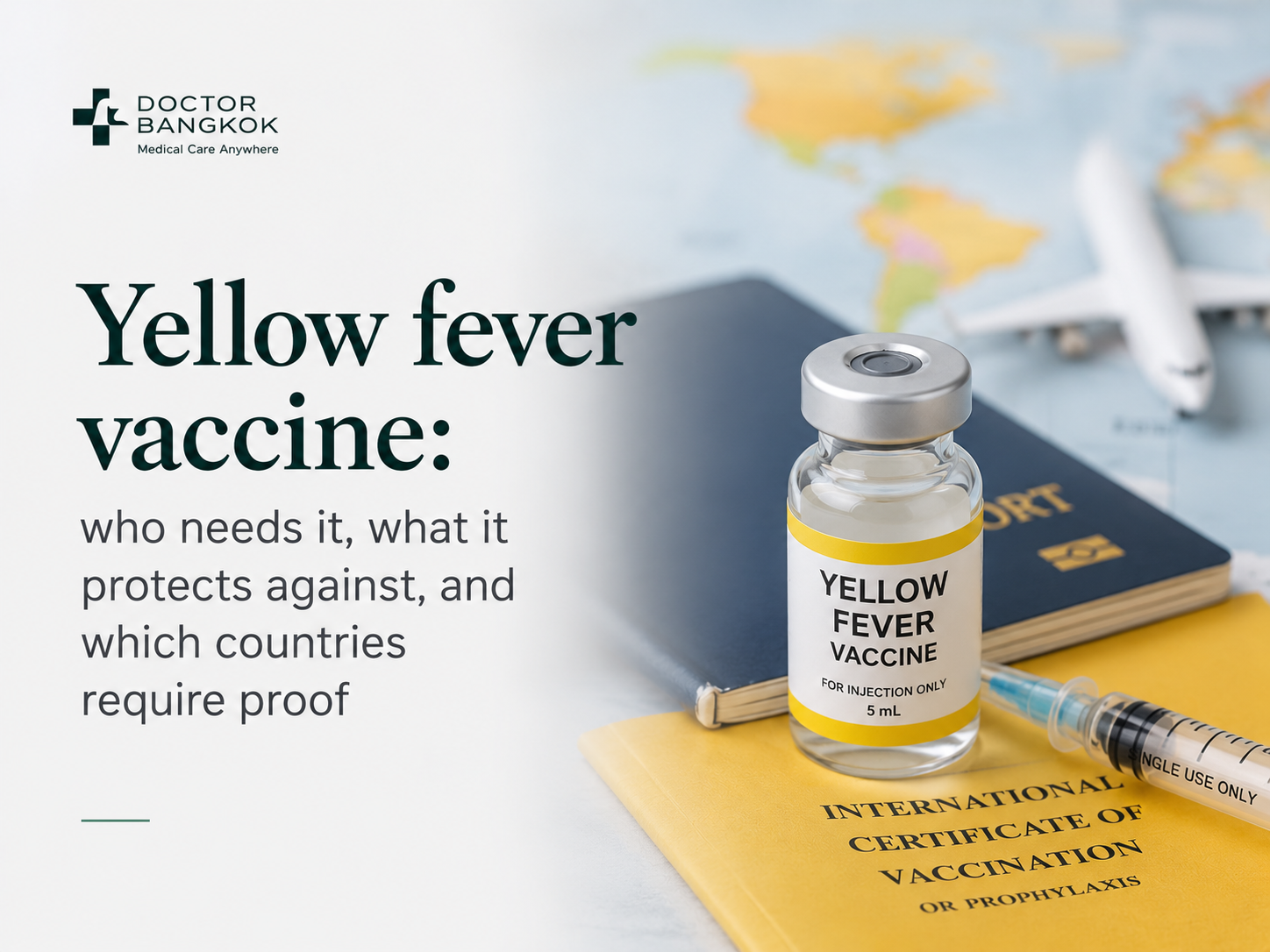
The Yellow Card is the official name for the International Certificate of Vaccination or Prophylaxis, known as the ICVP. It is issued under WHO International Health Regulations and is the only document that countries legally accept as proof of yellow fever vaccination.
The certificate must be stamped by a licensed vaccination centre. A GP letter, a hospital record, or a photo of your vaccine vial will not be accepted. The stamp, the issuing clinic’s signature, and the batch number of the vaccine must all be present.
Since 2016, the validity period changed from 10 years to lifetime. If you have an old card showing a 10-year expiry, you do not need re-vaccination. The card is still valid. If you have lost your certificate, contact the clinic where you were vaccinated. If the original batch record can be confirmed, some centres can reissue. If that is not possible, re-vaccination is usually the simplest solution.
Getting your yellow fever vaccine in Bangkok
At Doctor Bangkok, we see a lot of expats and travellers heading to Africa or South America. The yellow fever appointment includes a brief consultation to confirm you are eligible, the vaccination itself, and issuance of your ICVP on the same day.
We recommend booking in advance rather than walking in, because Stamaril requires careful cold storage and is not always available without notice. Bring your passport to your appointment, as it is recorded on the certificate. If you are travelling with children, bring their documentation too.
We also offer full pre-travel consultations covering your entire trip, including malaria prevention, other required or recommended vaccines, and health risks specific to your destination. You can book at doctorbangkok.co.th.
Travelling to Africa or South America from Bangkok? Doctor Bangkok provides yellow fever vaccination, same-day ICVP issuance, and full pre-travel health consultations with English-speaking physicians. We are centrally located and BTS accessible. Book your appointment at doctorbangkok.co.th before your departure date. Remember: the certificate is only valid from 10 days after vaccination.
Frequently asked questions
Do I need a yellow fever vaccine if I am just transiting through an African country on the way to my destination?
Yes, and this catches a lot of travellers off guard. If any leg of your journey passes through a yellow fever risk country, your onward destination may require proof of vaccination even if you never left the transit zone. Always check the requirements for every country your flight touches, not just your final destination. Doctor Bangkok can review your full itinerary and advise.
Is the yellow fever vaccine valid for life, or do I need a booster after 10 years?
Since 2016, the WHO confirmed that a single dose provides lifelong immunity. Countries can no longer legally require a booster as a condition of entry. If you have an old certificate showing a 10-year expiry, it is still valid. Some border officials may not know this, so carrying printed WHO guidance alongside an older certificate is a sensible precaution.
Who should not get the yellow fever vaccine?
The vaccine is not safe for infants under 6 months, people with significant immune suppression, those with thymus disorders, or anyone with a history of severe allergic reactions to egg, chicken protein, or gelatin. Adults over 60 face a higher risk of rare side effects and need an individual assessment before vaccination. If you cannot safely receive the vaccine, a medical waiver letter from a physician may be accepted in place of the certificate at many borders.
What happens if I arrive at a border without my yellow fever certificate?
Consequences vary by country but can include being denied entry, placed in quarantine for up to six days, or vaccinated on the spot and then required to wait 10 days before the certificate is valid. A digital photo or GP letter is not accepted. The physical stamped ICVP booklet is the only document recognised under international health regulations.
I had yellow fever once — do I still need the vaccine?
Natural infection likely does confer immunity, but proof of past infection is not an accepted substitute for the ICVP at international borders. Countries require the official certificate, not a medical history. If you are travelling somewhere that requires documentation, you will still need to be vaccinated and obtain a Yellow Card, unless a contraindication applies.
Can I get the yellow fever vaccine while pregnant?
The vaccine is generally not recommended during pregnancy because it is a live vaccine and carries a theoretical risk. However, if the risk of actual yellow fever exposure is high, the benefit may outweigh the risk, and this is decided case by case with a physician. Come in for a consultation and we can help you weigh your options based on your destination and travel dates.
Dr. Ponlawat Pitsuwan
Physician, Doctor Bangkok
a private medical clinic in central Bangkok. He sees expats, residents, and medical tourists for travel medicine, pre-departure health consultations, vaccinations, and general medical care. His focus is straightforward, evidence-based care delivered in plain language.

Dr. Ponlawat Pitsuwan is a physician at Doctor Bangkok, a private clinic in central Bangkok. He sees expats, residents, and medical tourists for general medicine, wellness consultations, and IV therapy. His focus is straightforward, evidence-based care delivered in plain language.