Clinically reviewed by Dr. Ponlawat Pitsuwan, Physician, Doctor Bangkok. Last reviewed: June 2026
Fever is a temperature of 38.0°C or above. Most fevers resolve within a week. If fever lasts more than three weeks without a clear cause, it meets the criteria for fever of unknown origin and needs a structured medical workup. In Bangkok, dengue, typhoid, malaria, and leptospirosis all belong in the differential from day one.
A raised temperature is one of the most common reasons people come to a clinic. But fever is a symptom, not a diagnosis. The real question is always: what is driving it?
Duration, pattern, recent travel, and what you have been exposed to all matter. In Bangkok, tropical infections circulate alongside the usual respiratory and urinary causes. That changes how doctors think through every febrile patient they see.
Expats and visitors often arrive at Doctor Bangkok after several days of unexplained fever, sometimes already taking paracetamol that has partially brought the temperature down. That masking effect is itself a clinical clue. What follows is how doctors actually think through a fever: what the patterns mean, when tests are needed, and when the situation is more serious.

Fever Patterns: What They Tell a Doctor
The shape of a fever over time carries information that a single temperature reading misses.
An intermittent fever returns to normal at some point each day, then spikes again. This pattern is classically linked to malaria. The fever rises when parasites are released into the bloodstream, then settles, then returns. In practice, the cycle is often less regular than textbooks suggest, especially with falciparum malaria.
A remittent fever stays elevated throughout the day but fluctuates. It never quite returns to normal. This is the most common pattern overall and appears in many bacterial and viral infections. It is less specific than an intermittent pattern, but the trend and amplitude still matter.
A sustained fever stays continuously high with very little daily variation. This pattern is classically associated with typhoid. If a patient in Bangkok has a sustained fever and a heart rate that is lower than expected for their temperature, typhoid sits near the top of the differential.
Dengue, which is common enough in Bangkok to be on every febrile patient’s list, often produces a biphasic pattern. The temperature is high for several days, briefly dips, and then rises again. That second phase can coincide with the most dangerous period of the illness. A patient who feels briefly better is not necessarily improving.
Subacute Fever: More Than a Week, Less Than Three
Subacute fever has lasted more than one week but less than three. This duration is clinically significant. It is too long to assume a simple viral illness, and too short to meet the formal criteria for fever of unknown origin.
At this stage, the doctor wants to know what has been tried, what has been tested, and what the patient was doing in the two to four weeks before the fever started.
In Bangkok, subacute fever in an expat or traveller raises specific possibilities. Typhoid typically presents in the first two weeks after exposure with a progressively rising temperature. Leptospirosis, caught through contact with water or soil contaminated by animal urine, is underdiagnosed in Southeast Asia. It can present with fever, muscle pain, and red eyes. Rickettsial infections, spread by ticks and mites, often produce a small dark scab at the bite site called an eschar. Patients frequently miss it entirely.
The investigation at this stage usually includes a full blood count, liver and kidney tests, blood cultures, and targeted serology based on the exposure history. A chest X-ray is reasonable in most adults who have had fever for more than a week, even without obvious chest symptoms.

Prolonged Fever: Beyond Three Weeks
Once a fever has lasted more than three weeks, most straightforward viral illnesses have already resolved. The differential shifts toward less common but more significant causes. Doctors typically organise these into three groups: infection, malignancy, and non-infectious inflammatory disease.
Infection is still the most frequent explanation. Tuberculosis deserves specific emphasis in Bangkok. Thailand carries a higher TB burden than most high-income countries, and TB can cause a prolonged low-grade fever with weight loss, night sweats, and fatigue that develops so gradually that patients attribute it to stress. TB does not always affect the lungs. It can involve lymph nodes, the abdomen, the spine, or the nervous system, and those forms are harder to diagnose.
Malignancy, particularly lymphoma, accounts for a meaningful proportion of prolonged fever cases. Some lymphomas cause fever without obvious enlarged lymph nodes. Leukaemia and certain solid tumours can also cause prolonged fever.
Non-infectious inflammatory diseases include conditions like adult-onset Still’s disease, which produces high spiking fevers, joint pain, and a salmon-coloured rash. Lupus and vasculitis belong here too. These require specific blood tests and often specialist input.
Fever of Unknown Origin: A Specific Diagnosis
Fever of unknown origin has a precise definition. It requires a temperature above 38.3°C on multiple occasions, lasting more than three weeks, with no diagnosis established after thorough investigation. The criteria exist to separate true FUO from fever that simply has not yet been adequately worked up.
Infection remains the most common cause. Occult malignancy, particularly lymphoma, and inflammatory conditions account for much of the rest. In a proportion of genuine FUO cases, no cause is ever found. Patients who remain undiagnosed despite thorough workup often do well long-term, which suggests the underlying cause was self-limiting.
The workup proceeds in tiers. The first covers what should already have been done: full blood count, inflammatory markers, liver and kidney function, urine culture, blood cultures on at least three separate occasions, and chest imaging. The second tier adds targeted serology, autoimmune markers, and cross-sectional imaging. In Bangkok, TB testing and malaria blood films are part of any responsible FUO workup given the regional disease burden.
If those investigations are unrevealing, a PET-CT scan can identify areas of high activity anywhere in the body, including occult infection, malignancy, or inflammation that conventional scans miss. Bone marrow biopsy or lymph node biopsy is considered when blood cancer remains a possibility. Starting treatment without a diagnosis is generally avoided in FUO because it can obscure the underlying cause.
When to Seek Urgent Medical Attention
Most fevers in otherwise healthy adults are uncomfortable rather than dangerous. But certain features alongside a raised temperature mean you should be seen the same day rather than waiting.
Fever with severe headache and neck stiffness, especially with sensitivity to light, raises concern for meningitis. Fever with a rash that does not fade when you press a glass against it suggests meningococcal disease and needs immediate emergency care.
Fever with confusion, inability to keep fluids down, or very little urine output requires urgent review. Any fever above 40°C that is not responding to paracetamol, or any temperature above 41°C, needs prompt assessment.
For dengue specifically, the warning signs include severe abdominal pain, persistent vomiting, any bleeding, rapid deterioration as the fever breaks, and altered consciousness. These indicate severe dengue and require hospital-level monitoring.
Fever with violent shaking chills and any history of travel to a malaria-endemic area needs a malaria test the same day. Falciparum malaria can deteriorate quickly, and delay in diagnosis makes outcomes significantly worse.
Fever in Bangkok: Tropical Causes to Know
Living in or travelling through Bangkok puts you in a disease environment that is different from Northern Europe or North America. Doctors here keep a broader tropical differential as a matter of routine.
Dengue is the most common mosquito-borne infection in Bangkok and occurs year-round, with peaks during and after the rainy season. The mosquito that carries it bites during daylight hours. A falling platelet count, a white cell count that drops below normal, and a rising haematocrit together form the characteristic dengue blood picture.
Malaria is not common in central Bangkok, but it is a real risk for anyone who has spent time in forested areas near Thailand’s borders with Laos, Myanmar, or Cambodia. Any febrile patient with recent travel to those areas needs a malaria test, regardless of whether they took prophylaxis.
Typhoid is relevant for patients with sustained fever and gut symptoms after exposure through food or water. The picture of a sustained fever, a slower-than-expected heart rate, and abdominal discomfort should prompt blood cultures.
Leptospirosis risk rises sharply during and after flooding. Contact with floodwater, rivers, or wet soil is the typical exposure. The illness can range from mild fever to severe disease with jaundice and kidney failure.
Rickettsial infections, including scrub typhus and murine typhus, are significantly underdiagnosed across Southeast Asia. The eschar of scrub typhus is found in only some confirmed cases and is often hidden in a skin fold.
How Fever Is Evaluated at a Private Clinic in Bangkok
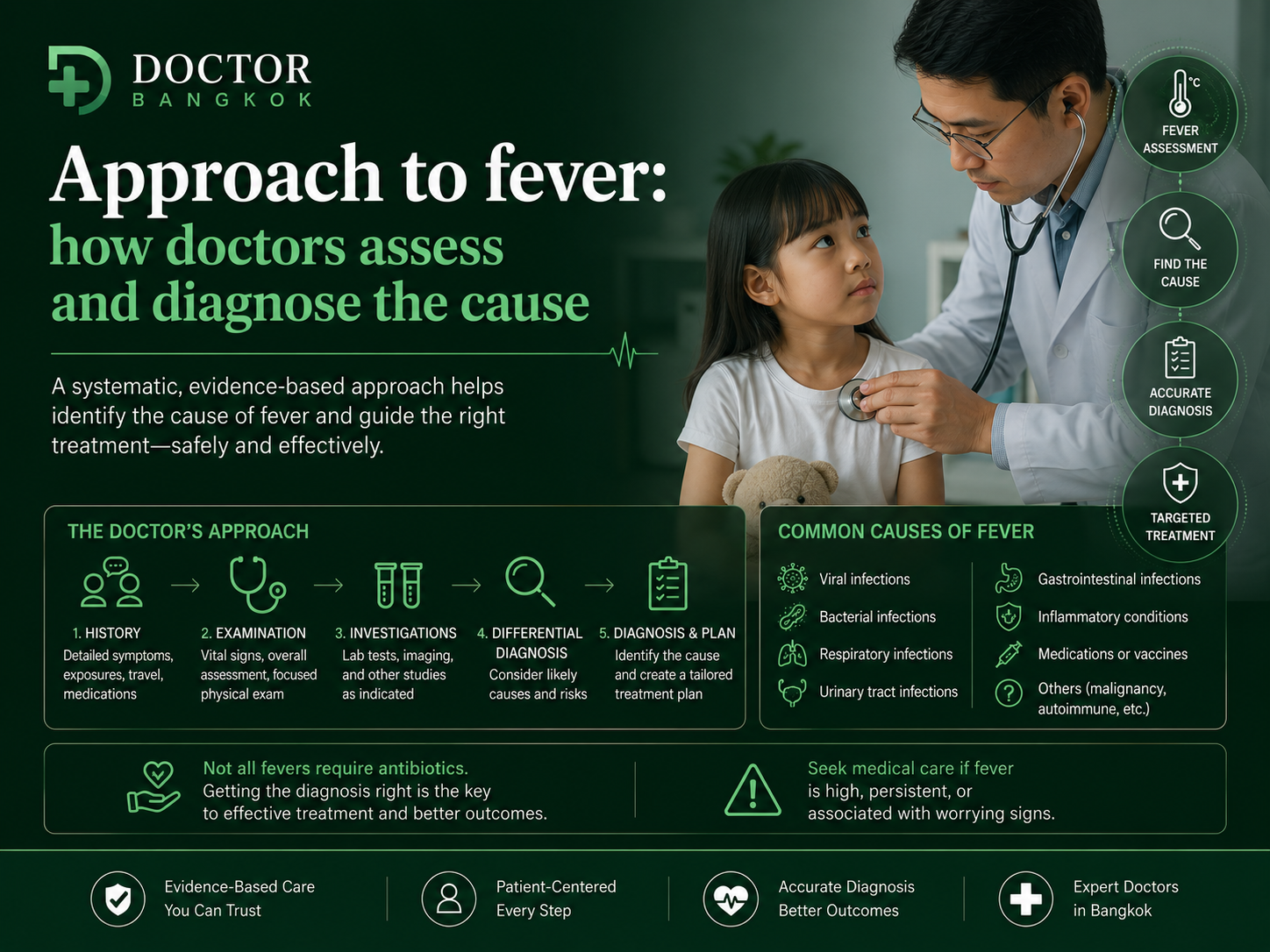
The consultation at Doctor Bangkok follows a structured approach rather than a standard menu of tests. The doctor takes a detailed history covering when the fever started, what pattern it has followed, associated symptoms, recent travel, food and water exposures, animal contact, and any medications taken before the visit. Physical examination covers temperature, pulse, blood pressure, and respiratory rate, and includes the skin, lymph nodes, throat, chest, abdomen, and joints.
For most adults in the first week of fever, a full blood count, C-reactive protein, and urine test cover the initial workup. For patients with tropical exposure, dengue testing, malaria films, and liver function tests are added. Blood cultures are drawn when bacterial infection is suspected or the patient looks unwell.
Point-of-care results are available during or shortly after the consultation. Specialist serology for leptospirosis, rickettsia, and typhoid comes back within 24 to 48 hours through an accredited external laboratory. Imaging, when indicated, is arranged through partner facilities the same day.
The doctor explains at the end of the visit what is most likely driving the fever, what has been tested, and what to watch for before results return. Written instructions are provided, including clear guidance on when to return or seek further care. This matters most in dengue, where the critical phase often begins exactly when the fever appears to be settling.
Fever that has lasted more than a few days, or any fever with severe headache, a rash, rigors, or recent travel to rural Southeast Asia, warrants a clinical assessment rather than continued self-management. Doctor Bangkok offers same-day fever consultations with in-house blood tests and access to tropical disease serology. English-speaking physicians see expats, visitors, and residents in central Bangkok, BTS accessible. Book at doctorbangkok.co.th or walk in during clinic hours.
Frequently Asked Questions
What temperature counts as a fever in adults?
The standard threshold is 38.0°C. Some guidelines use 37.5°C in older adults or people with weakened immune systems, where even a modest rise can be significant. Where the temperature is measured also matters: rectal is most accurate, oral runs slightly lower, and axillary readings are the least reliable. In a clinical consultation, the doctor will note the method and interpret the reading accordingly.
How long before a fever is considered prolonged or fever of unknown origin?
The formal criteria for fever of unknown origin require a temperature above 38.3°C on multiple occasions over more than three weeks, with no diagnosis after thorough investigation. Prolonged fever is used more loosely for fever lasting beyond two to three weeks. The distinction matters because many unexplained fevers at the one-week mark simply resolve with a few more days of observation, while a fever reaching the FUO threshold needs a systematic, tiered workup rather than repeating the same basic tests.
Can I get a fever workup at a private clinic in Bangkok without a referral?
Yes. Doctor Bangkok is a direct-access clinic. You can book or walk in without a GP referral, and the physician will arrange whatever tests the situation warrants, including same-day processing for initial investigations. If the workup points toward a need for hospital care or specialist input, the clinic assists with referral and documentation.
What tropical diseases should I think about if I develop a fever in Bangkok?
Dengue comes first, for any febrile illness in Bangkok, regardless of whether you noticed mosquito bites. Malaria is relevant if you have spent time in forested or border regions of Thailand or neighbouring countries. Typhoid is worth considering with sustained fever and gut symptoms after food or water exposure. Leptospirosis enters the picture with any contact with floodwater, rivers, or soil during or after the rainy season. Rickettsial infections, especially scrub typhus, are underrecognised and can occur even without a visible bite mark. Travel and exposure history are the most important tools for sorting through these possibilities.
Is a fever after surgery or a medical procedure dangerous?
Fever in the first 24 to 48 hours after surgery is common and is usually driven by the body’s inflammatory response to the procedure itself rather than by infection. It is uncomfortable but not inherently dangerous in most cases. Fever from day three onward is more likely to indicate wound infection, urinary tract infection, or pneumonia and deserves clinical review. Fever appearing more than a week after a procedure suggests a deeper problem and warrants prompt assessment. Drug fever, a reaction to medications started around the time of the procedure, is also possible and can mimic infection.
Should I take paracetamol or ibuprofen before seeing a doctor?
Taking an antipyretic before your consultation is fine and will not prevent a diagnosis being made. Tell the doctor when you last took it and what your highest recorded temperature was. In dengue, ibuprofen and other anti-inflammatory drugs are best avoided because they can increase bleeding risk. Paracetamol is preferred. If the fever returns quickly after each dose, or is not responding to standard doses at all, that pattern is clinically useful and worth mentioning. Bringing any temperature records from a home thermometer helps, as patterns often tell the doctor more than a single reading taken in clinic.
About the Author
Dr. Ponlawat Pitsuwan
Physician, Doctor Bangkok
A private medical clinic in central Bangkok. He sees expats, residents, and medical tourists presenting with fever, tropical infections, and general medical concerns. His focus is straightforward, evidence-based care delivered in plain language.

Dr. Ponlawat Pitsuwan is a physician at Doctor Bangkok, a private clinic in central Bangkok. He sees expats, residents, and medical tourists for general medicine, wellness consultations, and IV therapy. His focus is straightforward, evidence-based care delivered in plain language.